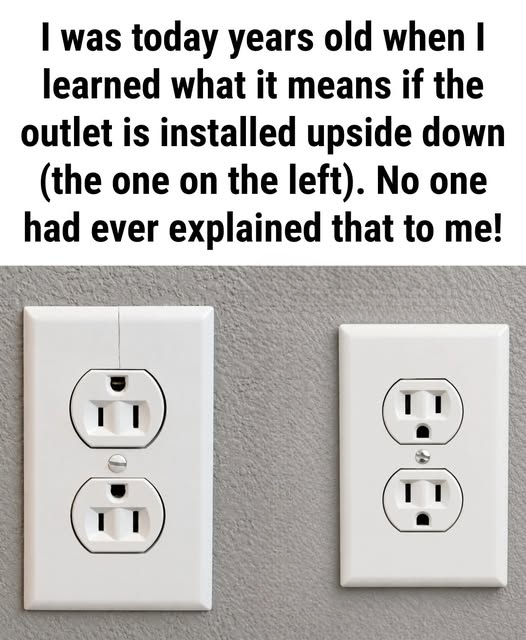
Most wall outlets in American homes are installed with the round grounding opening at the bottom. When someone notices an outlet with the grounding opening at the top, it is easy to assume that the installer made a mistake.
In many cases, however, the orientation is intentional.
A ground-up outlet may identify a receptacle controlled by a wall switch, reflect an electrician’s preferred installation method, or follow a local building convention. It may also have no special meaning at all.
The orientation alone cannot tell you how an outlet is wired. Before drawing conclusions, it helps to understand the practical reasons electricians sometimes install receptacles differently.
Does an Upside-Down Outlet Mean It Is Switch-Controlled?
Sometimes—but not always.
In bedrooms, living rooms, dens, and other spaces without built-in ceiling lights, a wall switch may control an electrical receptacle. This allows a table or floor lamp to operate like a permanent room light.
Some electricians install these switched receptacles with the grounding opening at the top. The reversed position provides a quick visual clue that the outlet may function differently from the others in the room.
This practice can help:
- Homeowners identify the outlet intended for a lamp
- Electricians recognize a switched circuit
- Renters understand what an apparently unused wall switch controls
- Future maintenance workers identify a nonstandard wiring arrangement
However, orientation is only an informal convention. It does not create the switched function, and it does not guarantee that the receptacle is connected to a wall switch.
The Entire Outlet or Only Half May Be Switched
A standard duplex receptacle contains two places to connect plugs. Depending on the wiring configuration, a wall switch may control:
- Both halves of the receptacle
- Only the upper half
- Only the lower half
- A different outlet elsewhere in the room
In a half-switched configuration, one portion remains energized continuously while the other responds to the wall switch.
This can be convenient beside a bed or sofa. A lamp can be connected to the switched half, while a clock or another device can use the always-powered half.
The two halves may look identical from the outside. Their different behavior comes from how the receptacle was wired inside the electrical box—not from its physical orientation.
Is Ground-Up Installation Required by the National Electrical Code?
Generally, the National Electrical Code does not require ordinary vertical wall receptacles to be installed with the grounding opening either up or down.
Electrical-industry guidance explaining NEC Article 406 notes that the grounding contact can generally face upward, downward, or sideways. Local rules, project specifications, healthcare-facility standards, or an individual contractor’s practices may still affect a particular installation. Electrical Construction & Maintenance
The term “face-up” in electrical codes can create confusion. It commonly refers to a receptacle installed horizontally with its slots facing toward the ceiling, such as directly on a countertop—not merely a wall outlet rotated so its grounding opening is at the top.
Those are different situations.
Because jurisdictions adopt different editions of electrical codes and may add local amendments, a licensed electrician or local building authority is the best source for requirements applying to a specific property.
Why Some Electricians Prefer the Grounding Opening at the Top
Some electricians believe the ground-up orientation may offer a limited safety advantage.
If a plug becomes partially disconnected and a thin metal object falls between the plug and the cover plate, the object may contact the grounding pin first when that pin is positioned at the top.
With the grounding opening at the bottom, a falling object might instead contact the energized blades.
This reasoning helps explain why ground-up receptacles are sometimes seen in commercial, industrial, or institutional buildings. However, orientation is not a substitute for secure plugs, intact cover plates, proper grounding, modern protective devices, and code-compliant wiring.
It also does not make a ground-down outlet automatically unsafe.
Why Many Homes Use the Ground-Down Position
The ground-down orientation remains familiar in residential construction.
Many people find it easier to recognize, and some right-angle plugs or cords naturally hang better in that position. Installers may also prefer to keep all outlets visually consistent throughout a property.
In other homes, every receptacle is installed ground-up simply because the electrician or builder selected that standard.
Therefore, finding several reversed outlets does not necessarily mean all of them are controlled by switches. It may only reflect the installer’s preferred orientation.
How to Test for a Switched Outlet Safely
You do not need to remove the cover plate or touch any wiring to perform a basic functional test.
Use a small lamp that you already know works correctly.
- Turn the lamp’s own switch on.
- Plug it into the first half of the receptacle.
- Operate the nearby wall switches one at a time.
- Observe whether the lamp turns on and off.
- Repeat the process using the other half of the receptacle.
If one half responds to the switch while the other remains powered, you likely have a half-switched receptacle.
If neither half responds, the switch may control:
- Another receptacle in the room
- An exterior light
- A ceiling fixture
- A disconnected fixture
- Wiring that was changed during remodeling
Do not remove the receptacle or insert a tool into its slots to investigate further. Anything requiring access to the electrical box should be handled by someone qualified to perform electrical work.
Why an Apparently Dead Outlet May Not Be Broken
Switch-controlled receptacles are often mistaken for failed outlets.
A new homeowner may plug in a charger or vacuum cleaner and assume the receptacle has no power. The real explanation may be that a nearby wall switch is in the off position.
This is especially common when:
- The switch has no label
- The room does not contain a ceiling fixture
- Furniture hides the intended lamp location
- A previous resident never explained the arrangement
- Only one half of the receptacle is switched
- The outlet was replaced without preserving its visual cue
Before reporting a dead outlet, test both halves with a working lamp and try the wall switches in the room.
If it remains unpowered, check whether a circuit breaker or GFCI device has tripped. If you are uncertain, or the receptacle repeatedly loses power, arrange an inspection rather than attempting internal repairs.
Outlet Orientation Does Not Determine Electrical Safety
A receptacle is not safe or unsafe simply because its grounding opening faces up or down.
Safety depends on factors such as:
- Correct wiring
- Secure electrical connections
- Proper grounding
- The condition and rating of the receptacle
- Correct circuit protection
- Appropriate GFCI or AFCI protection where required
- A securely installed cover plate
- Compliance with applicable codes
- The absence of overheating or physical damage
OSHA electrical standards emphasize that grounding contacts must be properly connected to the circuit’s equipment-grounding conductor. The visible orientation does not establish whether that connection is correct. OSHA grounding requirements
Similarly, a GFCI receptacle remains a GFCI whether its grounding opening faces up or down. Its protective function comes from the device and wiring, not its direction on the wall.
Warning Signs That Require Attention
Stop using an outlet and contact a qualified electrician if you notice:
- A warm or hot cover plate
- A burning or melting-plastic odor
- Dark marks or discoloration
- Crackling or buzzing sounds
- Visible sparks
- A plug that repeatedly falls out
- Flickering lights on the same circuit
- An outlet that works intermittently
- A breaker that repeatedly trips
- A damaged or cracked receptacle
The U.S. Consumer Product Safety Commission warns that unusually warm or hot outlets can indicate an unsafe wiring condition. Consumers should stop using the affected outlet and have it examined by a qualified electrician. CPSC electrical-safety guidance
A switched outlet that is off should simply have no power. It should not become hot, buzz, smell burned, or show physical damage.
Choose Carefully What You Connect
If only one half of a receptacle is controlled by a switch, connect devices according to how they should operate.
The switched half may be appropriate for:
- A table lamp
- A floor lamp
- Certain decorative lighting
- Another device specifically intended for switched operation
The continuously powered half may be preferable for:
- An alarm clock
- A router or modem
- A medical device
- A security system
- Equipment that should not lose power unexpectedly
Be cautious with computers, internet equipment, and storage devices. Accidentally turning them off at the wall could interrupt work, updates, or data transfers.
Never assume that a receptacle can support unlimited equipment because it contains two plug positions. Both halves remain part of an electrical circuit with a defined capacity.
Avoid Overloading the Receptacle
Power strips do not increase the amount of electricity a branch circuit can safely provide. They only create more connection points.
High-wattage equipment requires particular care. Portable space heaters, for example, should not be powered through an extension cord or power strip. The CPSC recommends stopping use if the heater’s plug, outlet, or faceplate becomes hot and having the equipment inspected. CPSC portable-heater guidance
Always follow the appliance manufacturer’s instructions and avoid connecting several high-demand devices to the same receptacle or circuit.
Should You Turn an Outlet Around for Appearance?
Rotating an outlet may look like a simple cosmetic project, but it requires working inside an electrical box.
That can involve:
- Disconnecting the circuit
- Confirming that power is actually off
- Removing the receptacle
- Preserving correct wire placement
- Maintaining proper grounding
- Securing the connections
- Reinstalling the device without damaging conductors
- Confirming that a half-switched configuration still works correctly
An error can create shock, overheating, arcing, or fire hazards. The risk may be greater in older homes containing fragile insulation, unusual wiring arrangements, or aluminum branch-circuit wiring.
If the outlet works correctly and has no signs of damage, changing its orientation is generally unnecessary. If you still want it rotated, ask a licensed electrician to inspect the wiring and perform the change safely.
Renters should also obtain permission from the landlord or property manager before requesting electrical modifications.
Do Not Rely on Orientation When Buying a Home
A reversed outlet can provide a clue about how a room was designed, but it should not replace an electrical inspection.
During a home tour, you can use a small outlet tester or lamp if the owner permits it. However, a basic plug-in test cannot detect every wiring problem.
A qualified inspection may be especially valuable when:
- The home is old
- Outlets are loose or damaged
- Some receptacles have two slots instead of three
- Different outlet styles appear throughout the property
- Breakers trip frequently
- Extension cords are being used as permanent wiring
- There are signs of previous unpermitted renovations
The CPSC’s home-wiring guidance is intended to help consumers recognize hazards, but it is not a repair manual. Electrical defects should be evaluated by qualified professionals. CPSC home-wiring guide
Frequently Asked Questions
Is an upside-down outlet wired backward?
Not necessarily. Physical orientation and electrical polarity are separate issues. A properly wired receptacle can be installed ground-up or ground-down.
Does every reversed outlet operate from a wall switch?
No. Some electricians use that orientation as a visual marker, while others install every outlet the same way. Test it with a lamp rather than relying on appearance.
Can only one plug position be switched?
Yes. A duplex receptacle can be wired so that one half is controlled by a switch and the other remains continuously powered.
Why does a wall switch appear to do nothing?
It may control an outlet rather than a ceiling light. Test suitable receptacles in the room using a working lamp.
Is ground-up safer than ground-down?
Some installers believe ground-up positioning may reduce one specific type of contact risk involving a partially exposed plug. However, overall safety depends much more on correct wiring, grounding, circuit protection, secure connections, and proper use.
Should I repair a switched outlet myself?
Basic testing with a lamp does not expose wiring. Repairs or changes inside an electrical box should be performed only by someone with appropriate training and knowledge of local requirements.
The Bottom Line
An upside-down wall outlet is not necessarily an installation mistake.
It may indicate a receptacle controlled by a wall switch, particularly in a bedroom or living area designed for lamp lighting. It may also reflect an electrician’s preferred ground-up orientation or have no special meaning.
Because the practice is not universal, test the outlet safely with a working lamp before reaching a conclusion. If it becomes hot, buzzes, smells burned, feels loose, or behaves unpredictably, stop using it and contact a licensed electrician.