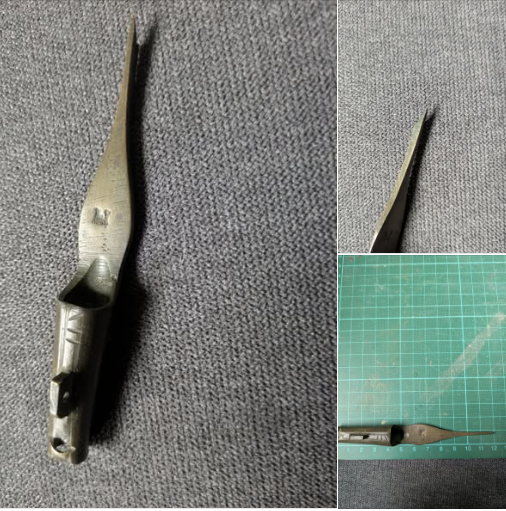
At first glance, this unusual metal object looked like a miniature blade. It had a hollow tube at one end and a long, pointed extension at the other. An engraved letter “M,” along with three small notches, made the discovery even more intriguing.
Was it part of a knife? A specialized hand tool? A decorative fitting? Without context, nearly every theory seemed possible.
The mystery began to clear when a similar component was spotted underneath the barrel of a Brown Bess reproduction musket. Once the loose object was compared with the installed fitting, its practical purpose became much easier to understand.
The item appears to be a type of Brown Bess ramrod guide, commonly called a ramrod pipe. It was a relatively small component, but it played an important role in keeping a muzzle-loading musket prepared for use.
Why the Object Looks Like a Tiny Blade
When separated from the firearm, the fitting has a misleading shape. Its long, tapered extension resembles a spear point or narrow blade, while the tubular section looks like the socket of an unfamiliar tool.
However, the pointed portion was not intended for cutting.
The tube remained visible underneath the musket’s barrel, allowing the ramrod to pass through it. The extended section helped position or anchor the fitting within the wooden stock, depending on the particular design and method of construction.
Because much of the component was concealed when installed, a loose example can look incomplete or strangely shaped. Its design makes far more sense once it is viewed in its original position.
What Is a Ramrod Guide?
A ramrod guide is a fitting that helps hold and align a musket’s ramrod beneath the barrel. Several guides could be positioned along the underside of the stock to keep the rod secure while the firearm was being carried.
The ramrod needed to remain close to the weapon because it was an essential part of the loading process. A soldier could remove the rod, use it when loading or maintaining the musket, and then return it to its storage position beneath the barrel.
Without the guides, the rod could shift, become difficult to carry, or be lost more easily. The fittings created a simple but effective storage system that kept it accessible.
Different models and production periods used variations of these components. Collectors may refer to them as pipes, thimbles, guides, or ramrod fittings.
Why the Ramrod Was Important
The Brown Bess was a muzzle-loading firearm, meaning its ammunition was loaded through the open front of the barrel rather than through the rear.
The ramrod was used to move the loading components down the barrel toward the breech. Because the musket depended on this loading system, the ramrod was not merely an optional accessory. It was a fundamental part of the equipment.
A missing or damaged ramrod could create serious practical problems for the person relying on the musket. That made the fittings responsible for carrying it more important than their modest appearance might suggest.
These small components demonstrate how historical equipment depended on many carefully fitted pieces. Barrels, locks, and stocks usually receive the most attention, but even the largest components were supported by less noticeable hardware.
The Brown Bess and Its Place in History
“Brown Bess” is the familiar name associated with several versions of the British Army’s Land Pattern musket. These smoothbore flintlock muskets were used in various forms for more than a century.
They became closely connected with the expansion of the British Empire and appeared in numerous conflicts involving British forces. Different patterns were produced over the years, so not every Brown Bess had identical dimensions or fittings.
Changes could be seen in features such as:
- Barrel length
- Stock shape
- Lock design and markings
- Sling hardware
- Ramrod construction
- Placement and design of the ramrod pipes
- Other brass furniture
This variation is important when identifying an isolated component. A fitting that resembles a Brown Bess part may match one pattern, a later copy, or a modern reproduction without matching every historical version.
What Collectors Mean by “Furniture”
In the language of antique firearms, the term “furniture” does not refer to household objects. It describes the various metal fittings attached to the wooden stock.
The furniture of a musket may include:
- The butt plate
- Trigger guard
- Side plate
- Sling fittings
- Escutcheons
- Nose cap
- Ramrod pipes
Many Brown Bess muskets are recognized for their brass furniture. Brass was practical because it could be shaped relatively easily and did not rust in the same way as iron.
Over time, brass develops a darker surface known as patina. Its appearance may change according to handling, environmental conditions, cleaning, polishing, and storage.
The object in question shows scratches, discoloration, and darker sections. Although these details give it an aged appearance, visible wear alone cannot confirm that it came from an original military musket.
What Could the Engraved “M” Mean?
One of the most interesting details is the engraved letter “M.” Marks like this can have several possible explanations.
It might represent:
- A maker or workshop
- An inspector
- An assembler
- An inventory designation
- An owner’s initial
- A later collector’s mark
The style and placement of the letter may provide clues, but a single initial is rarely enough to establish a firm origin. Similar marks could have been applied during manufacture, while the musket was in service, or many years later.
Historical firearms and their parts frequently passed through numerous owners. They could be repaired, modified, separated, reused, or incorporated into reproduction projects. A mark that appears old may not necessarily date from the object’s original manufacture.
For that reason, the “M” should be treated as a clue rather than definitive evidence.
Why Are There Three Notches?
The three notches are another feature that invites speculation.
Before modern mass-production techniques, gunmakers frequently fitted individual components by hand. Parts that looked nearly identical were not always perfectly interchangeable. Assembly marks could help craftspeople keep a specific fitting matched with the stock prepared for it.
The three lines may therefore have served as a simple workshop or assembly reference. They might also represent an inventory number, a repair mark, or an informal notation added by an owner.
There is also the possibility that the notches were added later for reasons unrelated to the original musket. Without clear documentation or comparison with authenticated examples, their precise meaning cannot be confirmed.
The most responsible conclusion is that they may have assisted with identification or assembly, while acknowledging that other explanations remain possible.
Is It an Original Brown Bess Component?
Its shape appears consistent with a ramrod fitting, especially when compared with a similar component mounted beneath a Brown Bess reproduction. However, identifying the type of object and confirming its age are two separate questions.
Modern companies produce functional reproductions of historical muskets for collectors, museums, film productions, and reenactment activities. Replacement fittings are also manufactured for repairs and restoration projects.
A reproduction part can acquire convincing wear through regular handling. Some pieces are also intentionally aged to match the appearance of an older firearm.
Determining whether the object is genuinely historical would require closer examination of several characteristics:
- Exact measurements
- Metal composition
- Casting or forming techniques
- Tool marks
- Pin or mounting details
- Shape of the tube and extension
- Nature of the surface patina
- Comparison with documented period examples
The object’s reported length of approximately 12 centimeters appears reasonable for an extended ramrod fitting, but measurements alone cannot authenticate it.
Why Patina Is Not Proof of Age
Collectors often look at patina when evaluating metal objects, but surface color can be deceptive.
Authentic patina usually develops gradually through oxidation, moisture, contact with skin, soil exposure, polishing, and environmental conditions. Nevertheless, modern brass can also darken naturally in a relatively short period.
Artificial aging techniques can create dark spots and color variations that resemble decades of wear. Reproduction parts used outdoors may also become scratched and tarnished during reenactments.
Heavy polishing creates another challenge. An authentic old component may look unusually bright if someone removed its original surface oxidation. Conversely, a recently made piece may appear old because it was deliberately darkened.
Patina should therefore be evaluated together with construction methods, provenance, documented comparisons, and expert examination.
Could It Have Come From Another Musket?
Ramrod pipes were used on many muzzle-loading firearms, not only the Brown Bess. Similar fittings appeared on military muskets, hunting guns, trade guns, and later reproductions inspired by historical designs.
The comparison image provides a strong indication of the object’s general purpose. It seems highly likely to be a ramrod-related fitting. Assigning it to a particular Brown Bess pattern, manufacturer, or production period would require additional evidence.
Small variations in the length, tube diameter, tail shape, and mounting system can be important. An experienced specialist may be able to compare those measurements with established reference examples.
Why Small Historical Parts Matter
A ramrod guide may not look as impressive as a complete musket, but it can still reveal a great deal about historical manufacturing.
It demonstrates how craftspeople combined wood and metal to create equipment that was functional, portable, and suitable for repeated use. Every fitting needed to sit correctly against the stock, remain secure, and allow the ramrod to move without unnecessary resistance.
These parts also tell stories about maintenance and repair. A musket used for many years might receive a replacement guide, a new ramrod, or modifications to the stock. Minor scratches and fitting marks may reflect this working history.
Complete firearms often attract the most attention, but loose components help researchers understand how those firearms were constructed and maintained.
How an Expert Could Examine the Object
Anyone seeking a more definite identification should avoid aggressive cleaning, grinding, or polishing. Altering the surface could remove details that help determine how and when the part was made.
A qualified historical-arms specialist or museum professional could examine:
- The object’s total length and weight
- The internal and external diameter of the tube
- The shape of the mounting section
- Evidence of casting, filing, or hand finishing
- The style of the engraved letter
- The spacing and depth of the notches
- Remaining mounting marks
- Its similarity to verified historical examples
Clear photographs taken from several angles would also help. Including a ruler for scale can make remote comparisons more useful.
Even an expert may not be able to establish the object’s exact date without information about where it was discovered and who previously owned it.
The Most Likely Answer
The mystery is not entirely solved in terms of the part’s age or exact origin. However, its practical identity now appears much clearer.
It is most likely a ramrod guide or ramrod pipe associated with a Brown Bess-style musket or a closely related reproduction. The hollow tube carried and aligned the ramrod beneath the barrel, while the extended section helped attach or position the fitting within the wooden stock.
The letter “M” and the three notches may relate to manufacture, assembly, inspection, ownership, or a later alteration. Their exact meanings remain uncertain.
When viewed alone, the object resembles a miniature blade with an unusual handle. When seen in its proper location beneath a musket barrel, the mystery disappears. It becomes a carefully shaped piece of hardware designed for a clear and necessary purpose.
Sometimes the smallest components provide the most interesting discoveries. This modest brass fitting is a reminder that history is not found only in complete artifacts. It can also survive in the overlooked pieces that once helped those objects function.