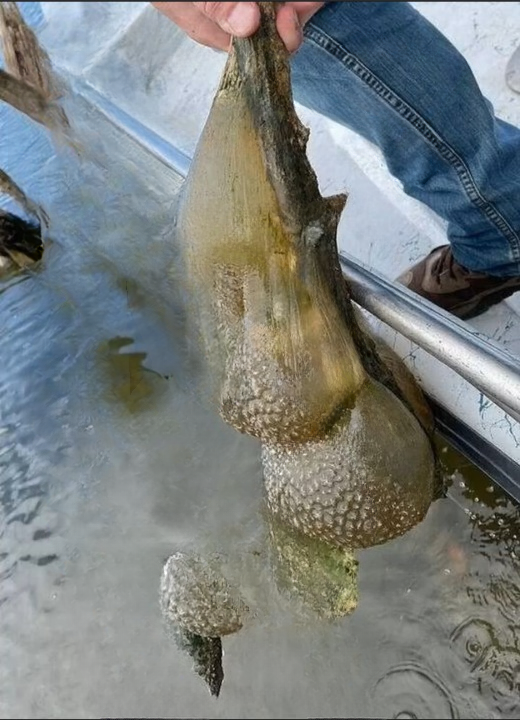
Imagine cruising across a peaceful lake when you suddenly notice strange, transparent blobs hanging from branches beneath the water. At first, they might look like jelly, unusual eggs, or even something from a science-fiction movie. But these mysterious formations may actually be living colonies of tiny freshwater animals.
That is what makes the unusual discovery reported at McGee Creek Reservoir in Atoka County, Oklahoma, in March 2024 so fascinating.
The strange formations are consistent with freshwater bryozoans, sometimes known as moss animals. Although individual creatures are incredibly small, they live together in colonies that can grow into surprisingly large, jelly-like structures.
What Are These Strange Underwater Formations?
Freshwater bryozoans are tiny aquatic invertebrates that live together in organized colonies. Each individual, called a zooid, performs a specific role in the colony.
Some species produce soft, gelatinous masses that attach themselves to submerged branches, rocks, aquatic plants, and other underwater surfaces.
Because the colonies contain numerous tiny animals surrounded by a water-rich substance, they can resemble transparent blobs of jelly.
Their appearance can vary depending on the species and environmental conditions. Some look almost completely clear, while others have cloudy, greenish, or brownish shades.
Despite their unusual appearance, these formations are a natural part of freshwater ecosystems.
How Do These Tiny Animals Find Food?
Bryozoans are filter feeders. Instead of chasing other animals, they collect microscopic food particles floating through the water.
Each individual has a specialized feeding structure called a lophophore, which contains delicate, tentacle-like extensions.
Tiny hairlike structures called cilia create water currents that bring microscopic algae, bacteria, and other suspended particles toward the animal’s mouth.
Because hundreds or even thousands of zooids can work together within one colony, their combined feeding activity allows them to gather food efficiently.
This makes bryozoans an interesting part of the freshwater food web, connecting microscopic organisms with the larger aquatic ecosystem.
An Animal Group With an Ancient History
One particularly fascinating fact is that bryozoans belong to an animal group with a fossil history stretching back hundreds of millions of years.
Scientists have discovered bryozoan fossils in ancient rocks, providing valuable information about prehistoric aquatic environments.
However, the colonies found in modern lakes are not prehistoric creatures that have survived unchanged for millions of years. They are living populations belonging to an ancient animal group.
Some freshwater bryozoans also produce special reproductive and survival structures called statoblasts.
These structures can remain dormant during unfavorable conditions and develop into new colonies when the environment becomes suitable.
This ability helps certain species survive seasonal changes, including colder temperatures and fluctuations in water conditions.
Why Do They Attach Themselves to Underwater Branches?
Submerged branches provide convenient surfaces for aquatic organisms to settle and grow.
Once a tree branch falls into a lake, it can become a miniature underwater habitat. Algae, microorganisms, insects, and other small aquatic organisms may gradually establish themselves on the wood.
Bryozoans can also attach to these surfaces and develop colonies.
Their gelatinous appearance sometimes makes them look as though they are floating freely underwater, even when they are firmly attached to a branch.
Environmental conditions such as water temperature, available nutrients, sunlight, and water movement can influence where these colonies develop.
Should People Be Worried About Them?
The good news is that correctly identified freshwater bryozoans are generally harmless to humans.
They do not normally bite, attack people, or behave like parasites. Their unusual jelly-like appearance is not a reason to assume they are poisonous or dangerous.
However, not every mysterious gelatinous formation in a lake is necessarily a bryozoan colony. Certain egg masses, algae, and other aquatic materials can look remarkably similar.
Anyone encountering an unfamiliar formation should avoid handling it unnecessarily. Taking a photograph and asking a local environmental specialist for identification is a better approach.
If unusual formations appear alongside dead fish, strong odors, or significant water discoloration, contacting local environmental authorities may also be appropriate.
Are They Bad for Fish or the Environment?
Freshwater bryozoans are generally part of the natural aquatic community rather than a direct threat to fish.
Their colonies can provide additional surfaces for microscopic organisms and other tiny aquatic life.
Their presence does not automatically indicate pollution, contamination, or an invasive species problem.
Determining whether a particular species is native or introduced requires proper identification and information about its distribution.
Scientists consider several factors before deciding whether an organism is having a negative effect on an ecosystem.
Why Are People Suddenly Noticing Them?
These organisms may have existed in a lake for years without attracting much attention.
Their visibility depends on seasonal growth, water clarity, changing water levels, and the availability of suitable underwater surfaces.
A colony that was previously too small or too deep to notice may eventually become large enough to catch someone’s attention.
Photographs shared online can also introduce people to organisms they have never encountered before.
A Reminder of How Much Life Exists Beneath the Water
The strange jelly-like formations associated with McGee Creek Reservoir offer a fascinating reminder that freshwater lakes contain far more life than most visitors realize.
What initially looks like an unusual underwater mystery may actually be a colony of tiny animals working together as part of a complex ecosystem.
From their remarkable feeding structures to their unusual reproductive strategies and ancient evolutionary history, freshwater bryozoans demonstrate just how diverse aquatic life can be.
So the next time you spot something strange beneath the surface of a lake, remember: nature often has a perfectly fascinating explanation for things that initially seem mysterious.