Choose the Glass With the Most Water: Your Answer May Reveal Something Interesting About Your Personality
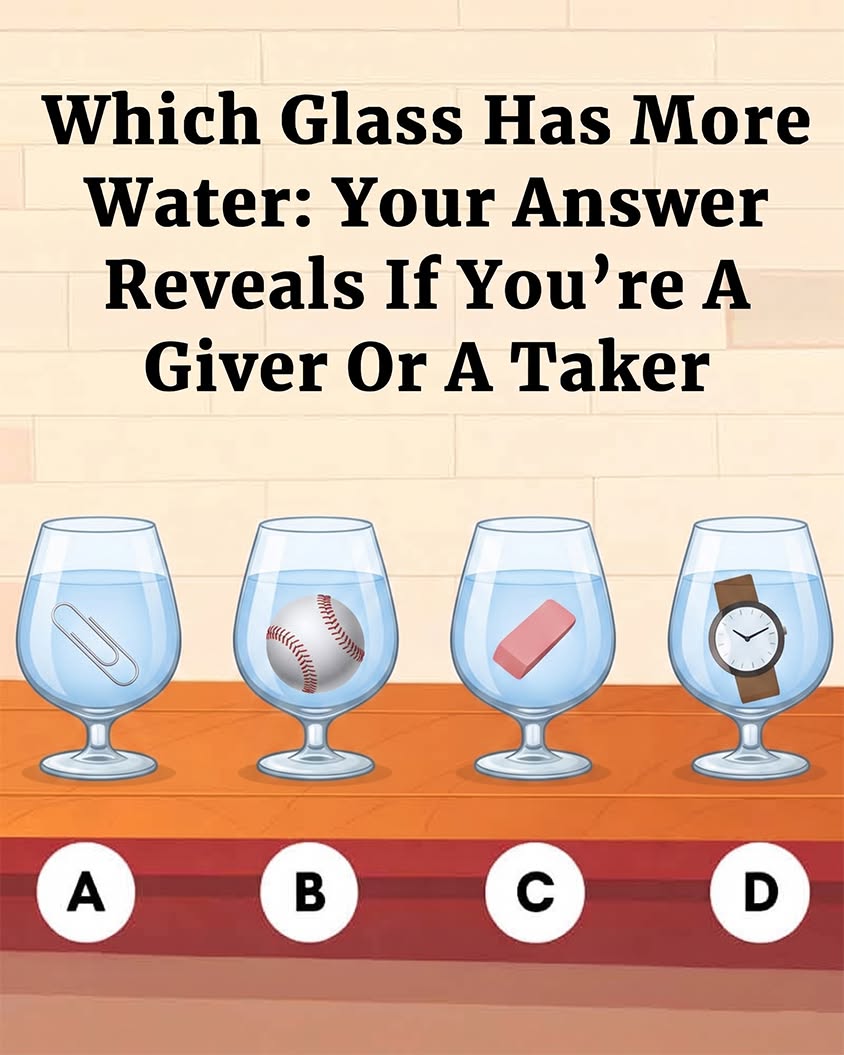
At first glance, this puzzle looks like a simple test of observation. Four identical glasses, labeled A, B, C, and D, are placed side by side. Each glass appears to contain approximately the same amount of water. However, there is one important difference: every glass contains a different object.
Glass A contains a paperclip, glass B holds a baseball, glass C contains an eraser, and glass D has a wristwatch.
Your challenge is straightforward: Look carefully at the four glasses and decide which one contains the greatest amount of water.
It may seem like an easy question, but the answer requires more than simply looking at the water levels. You need to think about what is happening inside each glass and how the objects affect the amount of water it can hold.
Interestingly, this little visual puzzle can also serve as an entertaining personality exercise. Your choice may offer an opportunity to reflect on how you approach everyday decisions, whether you notice small details, and how you balance giving and receiving in your relationships.
Before discovering the answer, take a moment to examine the four options and make your own choice.
The Puzzle: Which Glass Contains the Most Water?
Imagine that all four glasses are exactly the same size and shape. Each has been filled to a similar level, but each contains a different object.
- Glass A: A small paperclip.
- Glass B: A baseball.
- Glass C: An eraser.
- Glass D: A wristwatch.
Which glass do you think contains the most actual water?
Some people immediately choose the glass containing the largest object, while others focus on the visible water level. However, the correct answer depends on a basic principle of physics that is easy to overlook.
If you have already selected your answer, keep reading to discover whether your choice was correct and what the different options supposedly say about your personality.
The Science Behind the Answer
The secret to solving this puzzle is a scientific principle known as water displacement.
Whenever an object is placed inside a container of water, it takes up space. As a result, some of the space that could otherwise be occupied by water is taken up by the object.
The amount of water displaced depends on the volume of the portion of the object submerged in the water.
This means that, assuming all four glasses have the same internal dimensions and identical water levels, the glass containing the smallest submerged object will contain the greatest amount of actual water.
Think about what happens when you place a large object inside a glass. Even if the water level rises, the object occupies part of the available space. Therefore, the amount of water inside the glass may be smaller than it appears.
The same principle applies to smaller objects, but their effect is much less significant.
The Correct Answer: Glass A
<badge color=”success”>Correct answer: A</badge>
Glass A contains the paperclip, which is the smallest object among the four options. Because it takes up the least amount of space, it displaces the least water.
Consequently, Glass A contains the greatest volume of actual water, provided the paperclip is fully submerged and the glasses have otherwise identical conditions.
The baseball in Glass B occupies considerably more space, meaning less water can fit inside the glass at the same water level. The eraser in Glass C and the wristwatch in Glass D also displace water according to their submerged volumes.
This is a simple example of how appearances can sometimes be misleading. All four glasses may look almost identical, but what is hidden beneath the waterline makes a difference.
Now that you know the scientific answer, let’s explore the personality interpretations associated with each choice.
What Your Choice May Say About Your Personality
This part of the puzzle is designed for entertainment and self-reflection rather than scientific personality assessment. Your selection cannot reliably determine whether you are generous, selfish, thoughtful, or analytical. Nevertheless, the descriptions can be an interesting way to think about your habits and decision-making style.
If You Chose A: The Paperclip
You Notice the Little Things
Choosing the paperclip may suggest that you pay attention to details that other people sometimes overlook. Rather than immediately focusing on the biggest or most noticeable object, you may prefer to examine the entire situation before making a decision.
You might be someone who appreciates small gestures, thoughtful actions, and meaningful details. In relationships, you may believe that generosity does not always have to involve grand gestures. Sometimes, remembering something important, offering support, or simply being present can mean much more.
You may also enjoy solving problems logically. Instead of rushing toward an obvious answer, you take time to consider the details that could change the outcome.
The paperclip represents the idea that even the smallest things can have a significant impact.
If You Chose B: The Baseball
You Notice What Stands Out
If you selected the baseball, you may naturally pay attention to things that are immediately visible or make a strong impression.
You might be attracted to bold ideas, noticeable opportunities, and straightforward solutions. When making decisions, you may prefer to focus on the bigger picture rather than spending too much time examining minor details.
In the context of the giver-versus-taker personality interpretation, this choice is sometimes associated with someone who focuses on what is immediately available or beneficial.
That does not mean you are selfish or unwilling to help others. Instead, it may simply suggest that you respond more strongly to what is obvious and noticeable.
Taking an extra moment to examine the details of a situation could sometimes help you discover opportunities or considerations you initially overlooked.
If You Chose C: The Eraser
You Believe in Balance and Fairness
Choosing the eraser may symbolize a balanced approach to life. You may prefer to consider different perspectives before reaching a conclusion.
People who identify with this description often value fairness, cooperation, and mutual understanding. They recognize that relationships involve both giving and receiving, and they appreciate situations in which everyone feels respected.
You may also be adaptable. Depending on the circumstances, you can take the lead, offer support, or step back and allow someone else to make decisions.
In friendships and relationships, you may believe that both people should contribute. You understand that generosity is important, but you also recognize the importance of maintaining healthy personal boundaries.
The eraser represents flexibility, balance, and the ability to correct mistakes when necessary.
If You Chose D: The Wristwatch
You Think Carefully Before Making Decisions
If you selected the wristwatch, the interpretation suggests that you may be someone who considers time, meaning, and context before acting.
You might spend considerable time thinking about the possible consequences of your decisions. Rather than reacting immediately, you prefer to understand the situation and consider how your actions could affect other people.
You may also place great importance on timing. You understand that even a good decision can produce different results depending on when and how it is made.
When it comes to relationships, you may be thoughtful and emotionally aware. You might enjoy helping others, but you also recognize that your time and energy are valuable.
However, thinking too much can sometimes make simple decisions unnecessarily complicated. Learning when to trust your judgment and move forward may help you avoid overanalyzing situations.
The wristwatch symbolizes patience, reflection, and awareness of how valuable time can be.
Giver or Taker: What Really Matters?
One interesting idea behind this puzzle is the difference between giving and taking.
In everyday life, people often demonstrate both behaviors. Sometimes we offer help without expecting anything in return. At other times, we need support, understanding, or assistance from the people around us.
Neither receiving help nor accepting something from others automatically makes someone a taker.
Healthy relationships depend on a balance of generosity, appreciation, communication, and mutual respect.
A person who gives constantly without considering their own needs may eventually feel exhausted or unappreciated. Similarly, someone who always expects others to give without offering support in return may struggle to maintain meaningful relationships.
The important thing is recognizing when to offer help, when to accept it, and when to establish healthy boundaries.
Rather than using one answer to define your personality, consider it an opportunity to reflect on your everyday choices.
A Few Questions Worth Asking Yourself
After completing the puzzle, think about how you approached the decision.
- Did you immediately notice the smallest object?
- Did you focus on the largest object because it attracted your attention?
- Did you compare all four options before choosing?
- Did you spend time thinking about what each object represented?
- Do you usually make decisions quickly, or do you prefer to examine every detail?
Your answers may reveal something about your problem-solving habits and the way you approach unfamiliar situations.
Of course, a single puzzle cannot provide a complete picture of your personality. People are complex, and their behavior changes depending on their experiences, relationships, and circumstances.
Final Thoughts: Sometimes, the Smallest Details Matter Most
This simple glass puzzle demonstrates how a small difference can change the answer to an apparently straightforward question.
Although all four glasses appear similar, the objects inside them affect how much actual water each one contains. Understanding the principle of water displacement makes the correct answer clear: Glass A, containing the paperclip, holds the most water.
Beyond the science, the puzzle offers a fun reminder to look beyond appearances and consider details before making judgments.
Perhaps you are someone who notices the little things, someone who focuses on the bigger picture, or someone who carefully weighs every possibility.
Whatever glass you selected, remember that your answer does not define who you are.
Sometimes, the most interesting discoveries come from asking simple questions and looking at familiar things from a different perspective. And occasionally, the smallest object in the glass can teach us the biggest lesson.