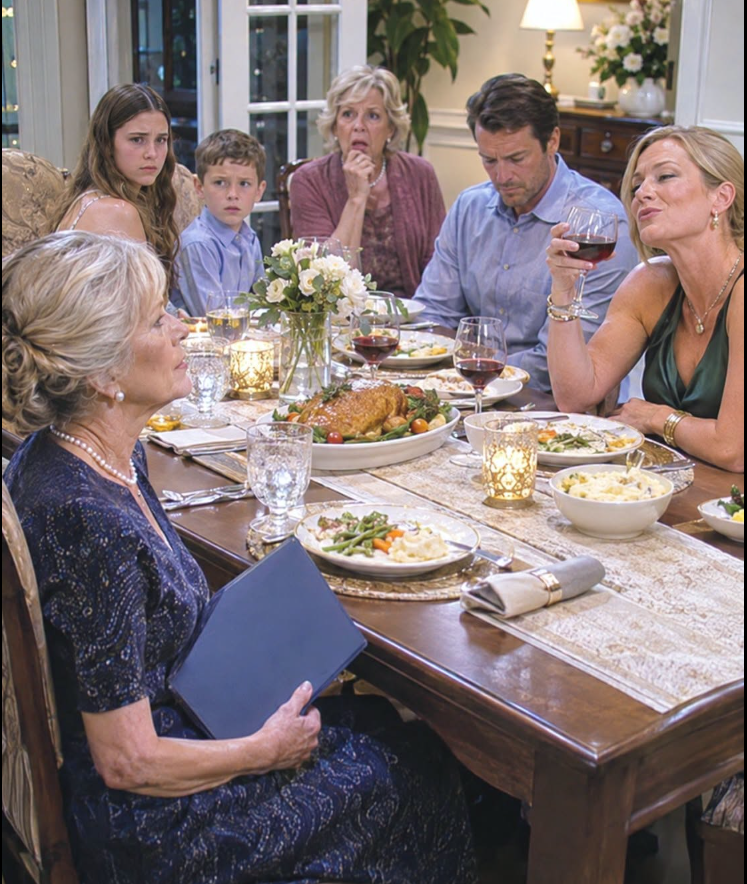
“ We finally bought our own house, Mom,” Melinda announced, holding up her wine glass with a wide smile.
Everyone seated around the table congratulated her and my son, Connor, while my grandchildren instantly began asking about their rooms, what colors they could choose, and whether the house came with a backyard.
I smiled as well, because I honestly was happy that they had finally purchased a home.
But Melinda continued watching me over the edge of her glass.
After sharing the same roof for twelve years, I knew that expression. It was the look she always had when there was something more she wanted to say, something she had been waiting to deliver at precisely the right moment.
The news about their new house had been for everyone. What came next was intended specifically for me.
She settled back into her chair and smiled.
So now,” she said, “you can finally figure out how to live by yourself.”
Every bit of laughter stopped.
My sister Ruth froze with her fork halfway toward her mouth. My grandson Jackson stopped chewing, while twelve-year-old Lily suddenly seemed deeply interested in staring at her plate.
Connor, my only son, kept his eyes on his dinner as though something beside the mashed potatoes had suddenly become incredibly important.
I waited for him to speak up.
To say anything at all.
He said nothing.
His silence hurt worse than Melinda’s words because it was so familiar. For years, Connor had refused to confront his wife whenever she went too far with me.
His silence always seemed to communicate the same message:
Please, Mom. Don’t make this more complicated. Just let it go.
Melinda laughed softly, acting as though her comment had simply been a joke.
Then she made it even worse.
“And thanks for living here all these years without paying for anything,” she said. “But now that Connor and I have our own place, we honestly don’t need you living here anymore.”
For a moment, I wondered if I had misunderstood what she said.
Then I noticed Jackson watching me.
Children might not know anything about deeds, mortgages, inheritance, or property law, but they recognize humiliation.
He understood that his grandmother had just been dismissed in front of the entire family. Lily understood as well, and the expression on her face told me she wanted to vanish.
I looked slowly around my dining room.
The table was mine. The dinner had been purchased with my money and cooked inside my kitchen. The house itself had belonged to me years before Melinda ever walked through its front door, yet somehow she had rewritten twelve years of history until I was the one being treated like a dependent.
The truth was almost embarrassingly straightforward.
Twelve years earlier, Connor lost his job while Melinda was pregnant.
They showed up at my house with suitcases, money problems, and more fear than either of them wanted to admit. My husband, Thomas, had already passed away, and at the time, the house felt much too big and much too quiet for me anyway.
“I’ll only need a couple of months, Mom,” Connor had said.
“Stay as long as you need to,” I told him.
I meant it completely.
At first, I was thankful for the noise. Then Jackson arrived, followed by Lily, and the house began to feel alive again.
Connor found another job, Melinda eventually went back to work, and the two of them started talking about saving money for a home of their own.
But somehow there was always another reason to wait.
Daycare. Cars. School costs. Vacations. A promotion. One more year to save.
I never made them pay rent.
Eventually, they contributed to groceries and utilities, and Connor took care of repairs whenever anything broke.
I appreciated everything they contributed. But somewhere over those years, Melinda started confusing helping with owning.
First, she reorganized my kitchen.
Then she replaced the curtains without asking me first.
Then my husband’s old study was transformed into a playroom.
Our holiday traditions changed because Melinda preferred doing things “her way.”
Family decisions started being settled before anyone even considered asking for my opinion.
Each incident seemed too minor by itself to justify starting a war, so I kept quiet.
That was the mistake I made.
Every time I buried my anger for the sake of keeping peace, Melinda learned she could push me without facing consequences.
And Connor learned that he never needed to decide whether something was right or wrong because his mother would always eventually back down.
For years, I told myself that I was keeping our family together.
Six months before that dinner, I finally realized that somewhere along the way, I was disappearing inside it.
So when Melinda told me they no longer needed me, she was expecting tears.
I could see that clearly in her expression.
She expected panic, perhaps even embarrassment. She probably imagined I would ask how long I had before I needed to find somewhere else to stay.
Maybe she had already pictured herself telling her friends how difficult it had been to persuade her elderly mother-in-law that it was finally time to become independent.
Instead, what I felt was completely different.
Relief.
Because at last, she had said out loud what I had been feeling for years.
In Melinda’s eyes, I wasn’t the woman who had welcomed them into her home when they had nowhere else to go.
I wasn’t the grandmother who had helped raise her children or the mother who had provided Connor with stability when everything in his life fell apart.
I had become an inconvenience standing between her and something she had slowly begun to think belonged to her.
And she had made one enormous mistake.
She believed I still thought silence meant kindness.
I folded my napkin neatly and placed it next to my plate.
“That’s wonderful, Melinda,” I said calmly.
Her smile weakened slightly.
“I’m happy you’ve finally decided to start building a life of your own.”
Connor finally lifted his eyes.
His expression immediately shifted.
Neither of them had expected me to sound so pleased.
“Because,” I continued, “I have some news of my own.”
Melinda slowly brought her wine glass down.
Nobody at the table moved.
I reached beside my chair and picked up the blue folder I had left there before dinner.
Connor stared at the folder, then looked at me, as if some instinct had finally warned him that this conversation was no longer moving in the direction his wife had planned.
“Twelve years ago, when you came to live in this house after Connor lost his job, I made a decision,” I said. “And six months ago, I made another one.”
Melinda’s face grew tense.
I opened the folder.
“Ninety minutes before dinner,” I said, “my attorney filed the final documents.”
For the first time that night, all the confidence drained from her eyes.
Connor stared at the papers in my hands.
“Mom,” he whispered. “What did you do?”
PART 2: THE HOUSE THEY NEVER OWNED
“What I should have done years ago.”
My voice was quieter than I expected. Connor stared at me. Melinda leaned forward. Ruth slowly lowered her fork.
And my grandchildren watched as I removed the first document. It was a certified property record. My name appeared near the top. Below it was the name of the Eleanor Bennett Living Trust.
Melinda frowned.
“What is that supposed to be?”
I placed the document on the table.
“Something that protects this house.”
Connor reached for it. I let him take it. He studied the first page. Then the second.
His expression changed.
“Mom, you transferred the house?”
“Into a trust.”
“When?”
“Six months ago.”
He looked at me.
“Without telling us?”
I almost smiled.
“Did you tell me you were planning to remove me?”
He went silent. Melinda reached across the table.
“Give me that.”
Connor hesitated. Then passed her the papers. She skimmed the first page. Her expression shifted from confusion to something much less pleasant.
“What does this mean?”
I folded my hands.
“It means I remain the person controlling this home.”
“The trust holds the title.”
“I’m its current trustee.”
“And I retain my right to live here for my lifetime.”
Melinda stared.
“But Connor is your son.”
I nodded.
“I’m aware.”
She looked genuinely irritated.
“Then why would you do that?”
“Because I wanted my wishes documented.”
Connor swallowed.
“What wishes?”
I looked directly at him.
“That nobody gets to decide when I must leave my home.”
The room became completely silent. For twelve years, my son had been welcome here. His wife had been welcome. Their children had grown up beneath this roof.
But welcome wasn’t ownership. And generosity wasn’t permission to erase the person providing it. Melinda pushed the document away.
“That’s ridiculous.”
Ruth raised an eyebrow.
“Which part?”
Melinda turned sharply.
“Excuse me?”
“Which part is ridiculous?”
Ruth placed her fork down.
“That Eleanor owns her house?”
“Or that she intends to keep it?”
Melinda flushed.
“This is a private family matter.”
Ruth smiled without warmth.
“I’m her family too.”
I almost laughed. But Connor was still staring at the trust document.
“Mom, what happens to the house after you’re gone?”
There it was. Not whether I was comfortable. Not whether I was healthy. Not whether I needed anything.
He wanted to know what would happen after my death. I looked at him carefully.
“That information is also documented.”
He swallowed.
“And?”
“The trust includes provisions for the grandchildren.”
Jackson looked up.
“For us?”
I smiled gently.
“Yes, sweetheart.”
Melinda’s eyes widened.
“And Connor?”
I turned toward her.
“What about him?”
“He’s your only son.”
“I know.”
“Then surely he’ll inherit the house.”
I considered my answer.
“Not automatically.”
Her face changed. I continued.
“The trust has specific instructions.”
“Those instructions protect my grandchildren and provide for my own needs.”
“Connor doesn’t have the authority to sell or mortgage this property.”
“And neither do you.”
For several seconds, nobody spoke. Then Melinda laughed. It sounded forced.
“Well, that’s unnecessarily dramatic.”
I looked at her.
“Is it?”
“Of course.”
She gestured toward Connor.
“We have our own home now.”
“Why would we want yours?”
I held her gaze.
“That’s an excellent question.”
Then I opened the second folder.
***
Six months earlier, I’d discovered something that changed how I viewed the past twelve years. It happened on an ordinary Tuesday. I was cleaning Thomas’s old study.
Melinda had turned it into a playroom years earlier. At first, I hadn’t objected. Jackson needed somewhere for his toys. Then Lily was born.
And the room gradually filled with games, books, and art supplies. But over time, something else happened. Thomas’s photographs disappeared. His old drafting desk was removed.
The bookshelves were replaced. And the small brass plaque he’d received after thirty years at the engineering firm was placed inside a storage box. One afternoon, I found the plaque beneath a stack of broken toys.
I remember sitting on the floor with it in my hands. Thomas Bennett. Thirty Years of Dedicated Service. I traced his name.
My husband had died suddenly from a heart attack when Connor was twenty-six. We’d been married thirty-four years. We bought this house together when Connor was six. Thomas repaired nearly everything himself.
He built the deck. Installed the garden fence. And planted the maple tree outside the kitchen window. When he died, the house passed entirely to me.
No mortgage remained. No outstanding property loan. Just a home filled with memories. I had always planned to remain there as long as I was physically able.
But six months before dinner, I began realizing that everyone else’s plans were quietly replacing mine.
***
That Tuesday, I decided to reclaim the study. I moved the toys carefully. Sorted them into storage bins.
Then brought Thomas’s photographs downstairs. As I cleared the old filing cabinet, I discovered an envelope I’d never seen before.
It was addressed to Connor. The return address belonged to a real estate company. Inside was a property valuation. For my house.
The date was three weeks earlier. The estimated value was $875,000. I stared at the number. Not because it surprised me.
The neighborhood had become desirable. Several houses nearby had sold for substantial amounts. But I hadn’t requested an appraisal. And Connor hadn’t mentioned one.
There was another page. A preliminary marketing proposal. It included photographs of my living room, kitchen, bedrooms, and backyard. Some were taken recently.
I recognized Melinda’s new curtains. The framed family photograph above the fireplace. And the expensive dining chairs she’d convinced me to purchase. I sat very still.
Someone had arranged a valuation of my home without asking me. Then I found something worse. A handwritten note on the bottom of the proposal.
“Owner relocation expected before closing.”
I read it three times. Owner relocation. Those two words made my stomach turn. I was the owner.
And somebody was discussing my relocation as though it had already been decided. I placed the papers inside my own folder. Then I called Ruth.
***
My sister answered immediately.
“Eleanor?”
“Are you busy?”
“Not for you.”
I sat at Thomas’s old desk.
“Something strange is happening.”
Her voice changed.
“What kind of strange?”
I told her about the valuation. The photographs. The proposed listing. And the note about relocation.
Ruth remained silent. Then she asked,
“Did you authorize any of this?”
“No.”
“Did Connor?”
“I assume so.”
“That wasn’t my question.”
I sighed.
“I don’t know.”
Ruth took a breath.
“Eleanor, you need to speak with an attorney.”
I almost laughed.
“Over a real estate brochure?”
“Over someone making plans for property they don’t own.”
I looked at the papers. She continued.
“You’ve spent twelve years letting them make decisions.”
“Perhaps it’s time someone started asking what you actually want.”
I stared at Thomas’s photograph. Then whispered,
“I want my house back.”
Ruth was quiet. Finally, she said,
“Then that’s where we begin.”
***
The attorney’s name was Natalie Price. She was forty-eight, with short dark hair and a calm, direct manner. Her office overlooked a small downtown park. I brought the valuation papers.
My original deed. Thomas’s death certificate. Property tax statements. And copies of our household expenses.
Natalie reviewed everything. Then asked a question I hadn’t expected.
“Mrs. Bennett, what do you want?”
I looked at her.
“To keep my house.”
She smiled faintly.
“That’s an excellent starting point.”
I explained that Connor and Melinda had lived with me for twelve years. That they paid no rent. That they’d gradually assumed responsibility for some household decisions. And that I had never transferred ownership to anyone.
Natalie listened carefully. Then asked,
“Have you signed any documents authorizing them to sell or finance the property on your behalf?”
I shook my head.
“Not that I’m aware of.”
She looked up.
“That’s important.”
I hesitated.
“Why?”
“Because I want to verify the current recorded title.”
“And check for any unusual filings.”
She examined the valuation again.
“Someone is treating your relocation as part of a property transaction.”
“That deserves an explanation.”
I looked toward the window.
“Do you think Connor knows?”
Natalie considered the question.
“I can’t determine that yet.”
“But we can establish the records.”
She turned another page.
“There’s another matter.”
“What?”
“Have you prepared an estate plan?”
I shook my head.
“Thomas and I had wills.”
“But they’re old.”
She nodded.
“Then we should review those too.”
I looked down.
“Do I really need all this?”
Natalie leaned forward.
“Mrs. Bennett, you deserve clarity about your own property.”
I sat quietly. Then nodded.
“Let’s do it.”
***
The following week, Natalie obtained the property records. The house remained entirely mine. There were no recorded mortgages.
No valid transfer of ownership. And no evidence that Connor or Melinda held any legal title. I felt relieved. But Natalie had also found something concerning.
The real estate agent who prepared the valuation had received information identifying Connor and Melinda as the property’s future decision-makers. The agent believed I intended to move into a smaller residence. I stared at Natalie.
“Who told them that?”
She examined her notes.
“Your daughter-in-law.”
My chest tightened.
“Melinda?”
“Yes.”
“Did she say I’d agreed?”
“According to the agent’s account, she said it was a family decision.”
I looked away. That phrase was familiar. A family decision. Melinda used it whenever she’d made up her mind and expected everyone else to accept the outcome.
Where we’d spend Christmas. Which relatives could visit. What furniture belonged in each room. Whether I should keep
Thomas’s old desk. Even which groceries I ought to purchase. Family decisions.
Except I was rarely included. Natalie continued.
“The agent hadn’t been retained to sell the property.”
“At least not through a valid owner authorization.”
I nodded slowly.