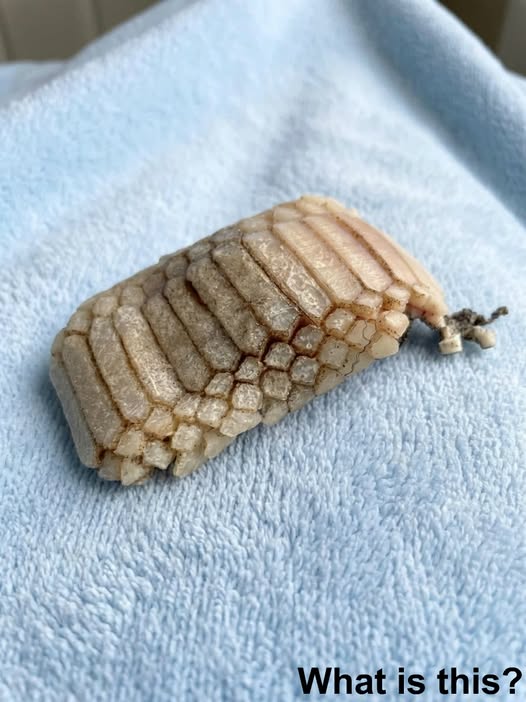
At first glance, it’s easy to understand why something like this would spark alarm. A strange object washed up along the shoreline, unfamiliar in shape and unsettling in detail, can quickly ignite the imagination. Social media fills with guesses, some dramatic, others outright fearful. Words like “monster” or “unknown creature” start to circulate. But in this case, the reality is far more grounded and, in many ways, more impressive.
What many people mistake for something mysterious or even dangerous is actually the underside of a chiton, a quiet and unassuming resident of rocky coastlines around the world. These creatures are rarely noticed because they blend so well into their environment. Seen from above, a chiton looks simple and even a bit dull, covered by eight overlapping plates that form a protective shell. It resembles a small, armored shield pressed tightly against the rock.
The surprise comes when it is turned over.
The underside of a chiton reveals a completely different appearance. Instead of smooth plates, you see a broad muscular foot surrounded by structures that can look strangely mechanical or even tooth-like. To someone unfamiliar with marine life, it can easily resemble something unnatural or even threatening. This is where confusion begins. Our brains are wired to react quickly to unfamiliar patterns, especially those that resemble sharp edges or repeating “teeth-like” forms.
But what looks intimidating is actually harmless.
These structures are part of what allows the chiton to survive in one of the most challenging environments along the coast. Waves crash with incredible force against rocks, and yet these small creatures manage to stay firmly attached. Their muscular foot acts like a natural suction system, gripping surfaces tightly so they are not swept away. The unusual appearance is simply the result of a highly specialized design shaped by evolution.
Even more fascinating is how they feed. Chitons graze on algae that grow on rocks, playing a small but important role in maintaining the balance of their ecosystem. To do this, they use a structure known as a radula, which functions like a tongue covered in tiny teeth. What makes this even more remarkable is the material those teeth are made from.
Chiton teeth are reinforced with magnetite, a naturally occurring mineral that gives them extraordinary strength. In fact, these teeth are considered among the toughest biological materials known in nature. This allows the chiton to scrape algae off hard rock surfaces without damaging its feeding structures. What might look like something out of a machine is actually one of nature’s most efficient tools.
This combination of strength and simplicity is what makes the chiton so successful. It does not rely on speed, size, or aggression. Instead, it survives through adaptation, quietly doing its job while remaining largely unnoticed. It is a reminder that not all remarkable creatures stand out at first glance. Some of the most interesting ones are hidden in plain sight.
The viral nature of such discoveries often says as much about human perception as it does about the object itself. When people encounter something unfamiliar, especially in a context like a beach where surprises are common, the first reaction is often uncertainty or fear. Without context, even ordinary things can seem extraordinary or threatening.
This is a natural response. Humans have always relied on quick judgments to assess potential danger. But in today’s world, where images spread instantly, those reactions can be amplified. A single photo can reach thousands of people within minutes, each adding their own interpretation. Before long, something completely harmless can take on a life of its own online.
What makes this particular case interesting is how quickly fear can turn into curiosity once the truth is revealed. Learning that the object is part of a chiton often shifts the reaction from alarm to fascination. People begin to ask questions, to look closer, and to appreciate the details they initially found unsettling.
It also highlights the importance of perspective. From one angle, the chiton appears simple and unremarkable. From another, it looks complex and almost alien. Neither view is wrong, but each tells a different part of the story. Understanding both sides gives a more complete picture of what the creature really is.
Encounters like this serve as a reminder of how much there is still to learn about the natural world. Even in places we think we know well, like a local beach, there are countless organisms living just out of sight. Many of them have evolved features that seem strange only because we are not used to seeing them.
In reality, the ocean is filled with forms and structures that challenge our expectations. What we perceive as unusual is often perfectly normal in a different context. The chiton is just one example of this, a small creature that reveals how diverse and creative life can be.
There is also something valuable in the way these moments capture attention. While the initial reaction may be fear or confusion, they create an opportunity for learning. People who might not normally think about marine biology suddenly become interested, asking questions and seeking answers. In that sense, even a misunderstanding can lead to greater awareness.
The next time something strange appears on the shore, it is worth taking a closer look before jumping to conclusions. More often than not, the explanation will be rooted in nature rather than mystery. And sometimes, as in this case, the truth is far more interesting than the speculation.
What began as a moment of uncertainty becomes a reminder of how perception shapes our understanding. A simple marine mollusk, viewed from an unfamiliar angle, can look like something entirely different. But once we understand what we are seeing, the fear fades, replaced by appreciation.
In the end, the story is not about a monster or an unknown creature. It is about how easily appearances can mislead us, and how much beauty and complexity can exist in even the smallest forms of life.