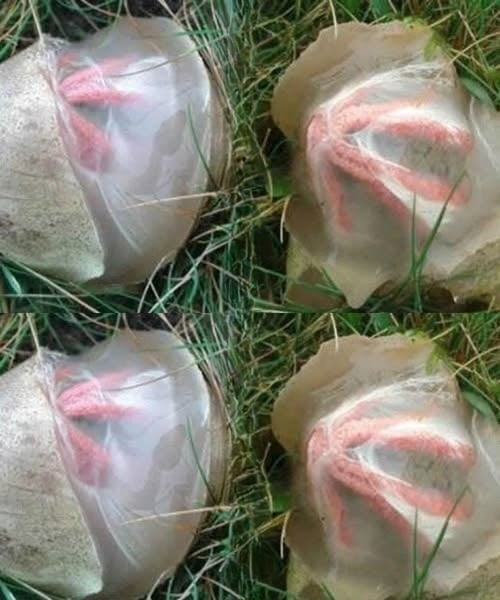
If you’ve ever taken a walk through a damp forest and noticed something that looked oddly out of place—almost like a strange egg or a plant from another world—you may have encountered one of nature’s most unusual fungi. Despite the dramatic nickname, what you’re seeing is not dangerous or aggressive. It’s a fascinating organism known as the stinkhorn mushroom.
Its reputation doesn’t come from harm, but from appearance and smell.
A Strange Beginning: The “Witch’s Egg”
The life cycle of this fungus begins in a stage that surprises almost everyone who sees it. Before it grows into its recognizable form, it appears as a small, pale, rubbery sphere partially buried in soil or leaf litter. This early stage is often called a “witch’s egg.”
At this point, it doesn’t even look like a mushroom. It can resemble a soft shell, a plant bulb, or something entirely unfamiliar. Inside, however, a complex structure is already forming—protected by a jelly-like layer that keeps it moist and ready for rapid growth.
A Rapid and Unexpected Transformation
What makes this organism even more intriguing is how quickly it changes. In the right conditions—usually warm and damp—the egg can split open, and a tall stalk emerges within hours. Some species of stinkhorn mushrooms are among the fastest-growing fungi known.
This sudden transformation is one reason people find them so surprising. You might walk through the same area one day and see nothing, then return the next morning to find a fully formed mushroom standing where there was none before.
The mature structure typically includes a hollow, sponge-like stalk and a cap coated in a sticky substance.
The Smell That Gives It Its Name
The most talked-about feature of the stinkhorn mushroom is its strong odor. Once fully developed, it releases a scent often compared to decaying organic matter. While unpleasant to humans, this smell serves a very important purpose.
Instead of relying on wind to spread spores like many other mushrooms, stinkhorns use insects. The sticky coating on the cap—called the gleba—contains spores along with the scent. Flies and beetles are drawn to the smell, land on the surface, and then carry the spores away as they move on.
This method of reproduction is highly effective, even if it seems unusual.
Why the Name Sounds So Dramatic
The phrase “nature’s most terrifying creatures” is more about appearance and surprise than actual danger. The combination of rapid growth, unusual shape, and strong odor can make stinkhorn mushrooms seem unsettling at first.
But in reality, they are harmless fungi that play a useful role in the environment.
They help break down organic material like fallen wood, leaves, and plant debris. This process returns nutrients to the soil, supporting healthy ecosystems.
Where You Might Find Them
Stinkhorn mushrooms are commonly found in:
- Forests and wooded areas
- Gardens with rich soil or mulch
- Compost piles
- Damp environments after rainfall
- Areas with decaying plant material
They often appear during warm seasons when moisture levels are higher.
Are They Dangerous?
Despite their dramatic look and smell, stinkhorn mushrooms are not dangerous to people or pets when simply observed. They are part of the natural decomposition cycle.
However, like with all wild fungi, it’s best not to touch or consume unknown mushrooms without proper knowledge. If they appear in gardens, some people remove them mainly due to the odor rather than any safety concern.
Why They Fascinate People
Part of the appeal comes from how unexpected they are. Their life cycle, speed of growth, and unusual strategy for spreading spores make them stand out among fungi.
They also challenge expectations. Most people imagine mushrooms as simple, quiet organisms. Stinkhorns show that even the smallest parts of nature can have complex and surprising behaviors.
Final Thought
The stinkhorn mushroom may look strange and smell even stranger, but it is far from something to fear. Its dramatic reputation comes from its appearance and clever survival strategy, not from any real threat.
In truth, it’s a reminder that nature often works in ways we don’t expect. What seems unusual at first glance is often just another example of how diverse and inventive the natural world can be.