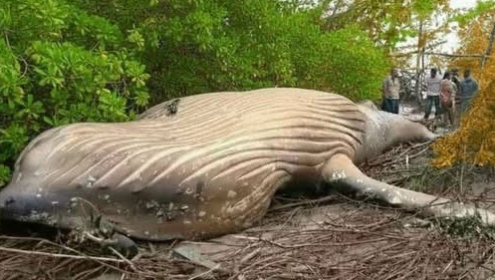
The discovery of a humpback whale far from the shoreline on Brazil’s Marajó Island shocked both local residents and scientists. Finding a large marine animal surrounded by dense vegetation and tangled roots created immediate confusion because whales are rarely seen anywhere near inland jungle environments.
For many people, the image felt surreal.
An eight-meter humpback whale calf lying among trees and muddy vegetation seemed almost impossible to explain at first glance. Social media quickly filled with speculation, theories, and dramatic interpretations about how such a massive ocean animal could end up so far from open water.
But researchers say the explanation is most likely connected to natural environmental conditions rather than anything mysterious.
Where the Whale Was Found
Marajó Island sits near the mouth of the Amazon River and contains a complex landscape of:
- Mangroves
- Flooded forests
- Tidal waterways
- Marshland
- Coastal jungle
Because the region experiences powerful tides and seasonal flooding, the boundary between ocean water and land can sometimes shift dramatically.
During certain periods, water levels rise high enough to push marine animals into areas that later appear isolated once the water recedes.
Scientists Believe Tides Played a Major Role
Researchers investigating the whale’s death believe strong tidal movement and flooding likely carried the young whale inland.
The most widely accepted explanation is that:
- The whale became stranded during high tide or flooding
- Water levels later dropped
- The animal was left trapped in dense vegetation
Because humpback whale calves are still developing strength and navigation skills, they can be especially vulnerable to:
- Disorientation
- Strong currents
- Injury
- Separation from their mothers
Scientists do not believe the whale intentionally entered the jungle area.
Why Whale Strandings Happen
Whale strandings occur in many parts of the world and can happen for several reasons.
Possible causes include:
- Illness
- Injury
- Tidal changes
- Navigation errors
- Weakness or exhaustion
- Environmental stress
- Separation from the group
Young whales are particularly at risk because they rely heavily on their mothers during migration and feeding periods.
In this case, experts believe the calf may already have been weakened before becoming stranded.
The Challenges of Investigating a Whale in a Remote Area


Recovering and studying such a large animal in a remote jungle environment created major logistical difficulties.
Authorities and researchers needed to:
- Access difficult terrain
- Protect surrounding wildlife
- Examine the carcass safely
- Determine the whale’s age and condition
- Investigate possible injuries
Large marine animals decompose quickly in tropical environments, making scientific investigation time-sensitive.
Researchers focused on gathering evidence rather than speculation in order to understand the event accurately.
Why the Story Captured Global Attention
The image of a whale appearing “in the jungle” spread rapidly online because it seemed so unusual and visually dramatic.
Many people were drawn to the mystery because it combined:
- Wildlife
- Nature
- Unusual geography
- Scientific uncertainty
- Emotional reactions
Some online posts exaggerated the situation or framed it as something supernatural, but scientists emphasize that natural environmental processes are the most likely explanation.
Understanding Marajó Island’s Unique Environment
Amazon River and surrounding coastal regions create one of the world’s most complex tidal ecosystems.
On Marajó Island:
- Ocean tides interact with river systems
- Floodwaters can spread across large areas
- Water channels shift constantly
- Mangrove forests become partially submerged
These environmental conditions can occasionally create rare situations where marine animals end up far from what people normally consider the coastline.
The Importance of Marine Conservation
The discovery also renewed conversations about whale conservation and environmental monitoring.
Humpback whale populations have recovered significantly in some regions after decades of conservation efforts, but they still face challenges including:
- Pollution
- Ship strikes
- Fishing entanglement
- Climate change
- Habitat disruption
Scientists say unusual strandings help researchers better understand whale migration, behavior, and environmental pressures.
Final Thoughts
The whale discovered deep inside vegetation on Marajó Island may have looked mysterious, but scientists believe the explanation is rooted in natural tidal movement, flooding, and the vulnerability of a young marine animal.
While the image sparked shock and speculation online, the event also highlighted the power of nature and the importance of careful scientific investigation.
Sometimes the most unbelievable scenes in nature are not supernatural at all—they are reminders of how complex and unpredictable the natural world can be.