Nature has a way of presenting us with things that seem almost impossible at first glance.
Recently, while walking through a neighborhood park, I noticed something unusual lying beneath a large tree. At first, I assumed it was some kind of decoration, perhaps something that had fallen from a holiday display or been dropped by a passerby. But the closer I looked, the stranger it appeared.
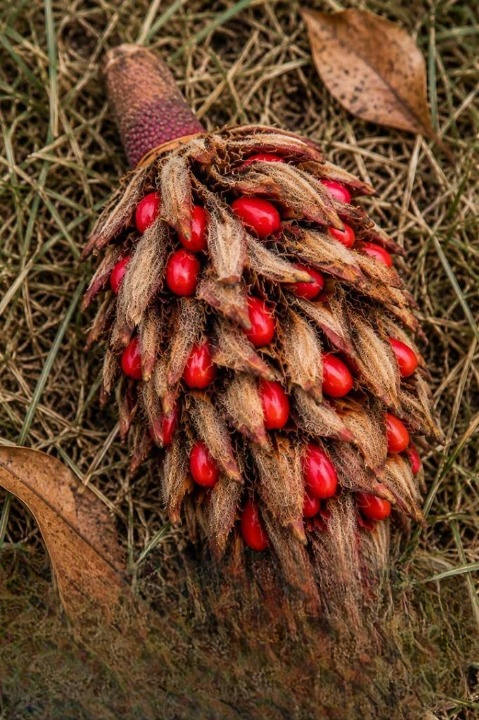
It was shaped like a small cone and covered with bright red, glossy structures that seemed almost artificial. Against the brown leaves scattered across the ground, the vivid color stood out immediately. I had never seen anything quite like it before.
Naturally, curiosity took over.
I snapped a few photos and began searching for answers. What I discovered turned out to be far more interesting than I expected.
The mysterious object wasn’t a decoration, an unusual fungus, or something man-made at all. It was actually a magnolia seed pod—a remarkable part of one of the oldest flowering tree groups on Earth.
A Hidden Stage in a Magnolia Tree’s Life Cycle
Most people recognize magnolia trees by their large, elegant flowers. Their blooms are among the most admired in gardens and landscapes, often appearing in shades of white, pink, purple, or cream.
What many people don’t realize is that the tree continues producing fascinating structures long after the flowers disappear.
Once a magnolia flower has been pollinated, it begins developing a seed pod. Over time, this pod grows and matures, gradually transforming into a cone-like structure that contains the tree’s seeds.
During the early stages, the pod is typically green and blends in with the surrounding foliage. As it matures, it becomes brown, woody, and slightly textured.
Then something remarkable happens.
The pod begins to open.
Why the Seeds Are Bright Red
As the mature seed pod splits apart, brilliant red seeds emerge from inside.
The contrast is striking. Against the brown pod, the red seeds almost appear to glow.
This vivid color isn’t random.
Nature often uses bright colors as a signal, and magnolia trees are no exception.
The red coating surrounding the seeds helps attract birds and other wildlife. When animals notice the colorful seeds, they may feed on the fleshy outer covering and transport the seeds to new locations.
This process helps magnolia trees spread naturally and establish new growth areas over time.
It’s a simple yet highly effective reproductive strategy that has worked for millions of years.
An Ancient Tree With a Remarkable History
Perhaps the most fascinating aspect of magnolia trees is their age.
Scientists believe magnolias belong to one of the oldest groups of flowering plants still existing today. Their ancestors were growing on Earth long before many modern plant species evolved.
In fact, magnolias are thought to have existed for more than 90 million years.
That means these trees were already thriving during the age of dinosaurs.
Unlike many flowering plants that evolved alongside bees, early magnolias developed before bees became widespread pollinators. Instead, they relied on beetles and other insects for pollination.
This ancient evolutionary history helps explain some of the unique characteristics magnolia trees still display today.
When Seed Pods Typically Appear
If you’ve never noticed magnolia seed pods before, timing may be the reason.
The pods generally begin developing after flowering season and continue maturing throughout the warmer months.
By late summer or early autumn, many pods start opening to reveal their bright red seeds.
During this period, they become much more visible and often fall from the tree, where they attract attention from curious observers.
Because the pods look so unusual, they frequently become the subject of questions online, with people wondering whether they’ve discovered a rare plant, a fungus, or even something artificial.
The answer is usually much simpler—and much more interesting.
Can You Grow a Tree From the Seeds?
One question many gardeners ask after discovering a magnolia seed pod is whether the seeds can be used to grow a new tree.
The answer is yes.
However, patience is required.
Magnolia seeds typically need a period of cold treatment before they will germinate successfully. This process, known as stratification, helps mimic natural winter conditions and prepares the seed for growth.
Even under ideal circumstances, growing a magnolia tree from seed can take time.
For gardening enthusiasts, though, the process can be a rewarding way to witness a tree’s life cycle from the very beginning.
Wildlife Loves Them
Magnolia seed pods don’t just attract human curiosity.
Many species of birds are drawn to the bright red seeds.
Small mammals may also feed on them, contributing to the natural distribution of the tree throughout its environment.
This relationship between plants and animals is one of nature’s most effective partnerships. The tree provides food, while wildlife helps transport seeds to locations where new trees can grow.
It’s a perfect example of how interconnected ecosystems truly are.
A Reminder to Stay Curious
What began as a simple mystery beneath a tree turned into a fascinating lesson about botany, wildlife, and natural history.
It’s easy to overlook the small details around us, especially in places we see every day. Yet nature is filled with unusual structures, adaptations, and survival strategies that often go unnoticed until something catches our attention.
The next time you spot a strange cone-like object covered in bright red seeds, you’ll know exactly what you’re looking at.
Rather than something mysterious or concerning, it’s a magnolia seed pod—a small but remarkable part of a tree lineage that has survived for tens of millions of years.
Sometimes the most surprising discoveries aren’t hidden deep in remote forests or distant wilderness areas. They’re sitting quietly beneath a tree, waiting for someone curious enough to stop and take a closer look.