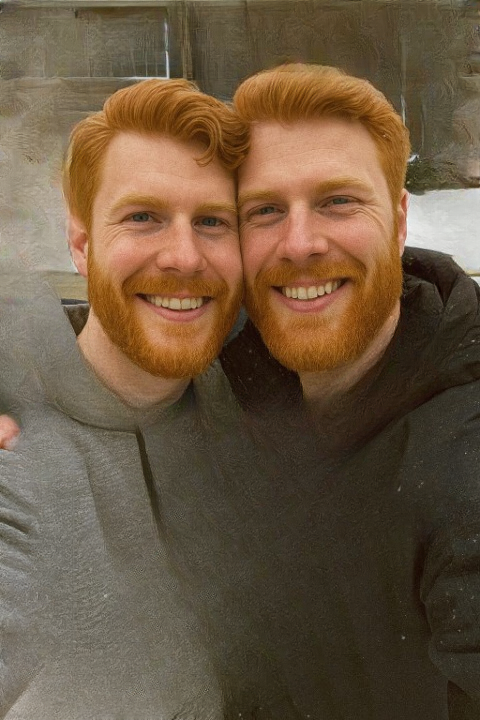
Hidden Brother, Stolen Past
When Family Silence Rewrites Identity
Introduction: The Question That Would Not Let Go
Some questions do not arrive loudly. They do not demand attention or announce themselves as life-changing. Instead, they settle quietly into the mind and refuse to leave.
For me, it was a single word spoken by a man I had only just met—my brother, though I did not yet know how to hold that truth.
“Do you remember the fire?”
He said it carefully, as if the word itself carried weight. Not fear exactly, but gravity. The way his voice slowed on that single syllable made it feel less like a question and more like an invitation into something unfinished.
At first, I told myself I was simply listening out of courtesy. After all, people often bring stories when they discover shared history. But my body responded before my mind could assemble an explanation. A tightening in my chest. A reflexive flinch at distant sounds. A warmth along my arms that felt unfamiliar yet known.
Long before the truth was spoken aloud, my body remembered what my life story did not.
The Architecture of Memory
Memory is not a single archive. It does not live only in the mind. Neuroscientists have long noted that experiences—especially those from early childhood—can embed themselves in the body even when conscious recall fades.
I had always assumed my own gaps were ordinary. Everyone forgets early childhood. Everyone grows up with stories told by others, filling in the blank years with photographs and anecdotes.
What I did not realize was that some gaps are not empty. They are sealed.
Daniel’s memories arrived slowly, as if he feared overwhelming me. He spoke of ordinary things: two small bikes leaning against a fence, a bright plastic slide in a backyard, summer evenings marked by laughter and simple rituals. Nothing dramatic. Nothing that sounded like loss.
Yet every detail landed with strange familiarity. The way certain smells lingered. The rhythm of shared play. The sense of belonging that seemed both intimate and unreachable.
These were not new images. They were echoes.
Growing Up With a Clean Story
My childhood story, as I had always understood it, was straightforward. I was adopted young. My parents had been open about that fact, framing it as a narrative of rescue and opportunity. I was loved, supported, and given stability.
There was no cruelty in that story. No villain. It was neat, functional, and survivable.
But it was also incomplete.
Adoption narratives often focus on beginnings and endings: before and after. What they rarely dwell on is the middle—the ambiguous space where loss and continuity coexist. For many adoptees, identity is constructed not from what is known, but from what is chosen to be shared.
In my case, what was shared had been carefully edited.
Meeting Daniel: Recognition Without Context
When I met Daniel, it was not dramatic. There were no tears or sudden revelations. We sat across from each other, two adults trying to understand why our faces shared certain lines, why our laughter carried the same cadence.
He was cautious. Not guarded, but respectful. As if he had rehearsed restraint for years.
He did not accuse. He did not demand. He simply spoke.
And as he spoke, something inside me kept answering.
The Body as Witness
Trauma specialists often explain that early experiences can imprint themselves somatically—through sensation rather than story. This can manifest as reactions that feel disconnected from conscious memory: sudden fear, unexplained tension, physical responses without obvious cause.
I had lived with those reactions for years, dismissing them as quirks. A discomfort around certain smells. A tendency to startle at sharp sounds. A vague sense of unease in warm, enclosed spaces.
Listening to Daniel, those sensations rearranged themselves into something almost coherent. Not a memory, exactly—but a recognition.
The Confession That Was Not Cinematic
When my parents finally spoke, it was not dramatic. There were no raised voices, no emotional monologues. Just the quiet weight of truth finally acknowledged.
They did not deny Daniel’s existence. They did not challenge his memories. Instead, they explained their choice in terms that were heartbreakingly practical.
They had been advised to simplify. To present a “clean” adoption file. To focus on the child who could be placed, documented, and integrated without complication.
In that version of events, I survived.
Daniel became the variable they could not manage.
Paper Survival and Emotional Cost
Institutions require clarity. Files must be consistent. Stories must be linear.
But families are not institutions.
By choosing the version of me that survived on paper, my parents believed they were protecting everyone involved. They believed that silence would stabilize, that omission would soften the past.
What they underestimated was how silence does not erase loss—it preserves it in fragments.
The Ethics of Silence
Silence is often framed as kindness. In families, it is frequently used to avoid pain, protect children, or preserve stability. But silence also has consequences.
When truths are withheld, they do not disappear. They resurface as confusion, anxiety, and identity fractures that have no obvious source.
In adoption studies, researchers have consistently found that withheld information—even when well-intentioned—can disrupt an individual’s sense of self. Not because the truth itself is always traumatic, but because the absence of truth creates instability.
Standing Between Two Lives
Learning about Daniel did not erase my life as I knew it. My adoptive parents are still my parents. My experiences are still real.
But now, they exist alongside another life I did not get to live.
One version of me grew up with a brother.
Another grew up believing herself alone.
Neither is false. Both are incomplete.
The Question of Loss
People often ask which loss hurts more: the event itself or the knowledge that it was hidden.
There is no simple answer.
Loss acknowledged can be mourned. Loss concealed becomes something else entirely—a distortion of identity that shapes perception without explanation.
The fire, whatever its precise details, took something once.
The silence took it again.
Reclaiming Narrative Without Rewriting the Past
Reclaiming a stolen past does not mean undoing the present. It means allowing complexity to exist without demanding resolution.
Daniel does not replace my life.
I do not erase his.
We are not halves of a broken whole. We are two continuations of a story that was interrupted and redirected.
The Role of Forgiveness
Forgiveness is often misunderstood as absolution. In reality, it is closer to clarity.
Understanding why my parents chose silence does not mean I agree with it. It means I can see them as people navigating fear, social pressure, and limited guidance.
Forgiveness, in this context, is not forgetting. It is refusing to let the absence of truth define the future.
Identity Beyond Certainty
Identity is not a static object. It is a process.
For adoptees and others with fragmented histories, identity often involves holding contradictory truths without collapsing under them.
I am both the child who was chosen and the child whose past was altered.
I am both connected and disconnected.
I am not required to simplify myself for anyone’s comfort.
The Broader Context: Adoption, Records, and Reform
Stories like mine are not rare. Across many countries, adoption records were historically sealed or altered to protect institutions rather than individuals.
In recent years, advocacy groups have pushed for:
-
Greater transparency in adoption records
-
Trauma-informed family counseling
-
The recognition of sibling separation as a significant loss
These reforms acknowledge what individuals have long known: identity thrives on truth, even when that truth is complicated.
Memory as Reconstruction
Psychologists emphasize that memory is not playback—it is reconstruction. Each time we revisit the past, we assemble it from fragments, emotions, and context.
Meeting Daniel did not restore a lost childhood. It reshaped how I understand the present.
That reshaping is ongoing.
What Remains
Some questions will never be fully answered. Some memories will never surface. And some grief will always exist in conditional tense—what might have been.
But there is also agency.
I can choose to know my brother.
I can choose to name the silence.
I can choose not to pass that silence forward.
Conclusion: Living With the Whole Story
Standing between two lives does not mean being torn apart. It means being expanded.
The fire, whatever it took, did not erase me.
The silence, however, tried to define me.
Now, I define myself.
Not by what was hidden.
Not by what was lost.
But by the courage to hold the truth without letting it consume me.