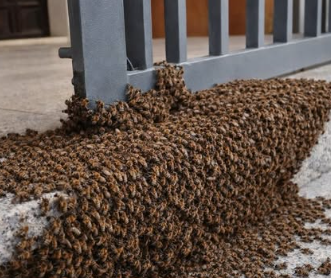
Bee swarms often appear alarming to the general public due to their size, movement, and loud buzzing. However, despite the common misunderstanding, swarms are not dangerous, aggressive, or permanent. They are a natural and essential part of honeybee biology and play a critical role in maintaining ecological balance and global food production.
This article provides a comprehensive analysis of bee swarm behavior, the ecological importance of migratory bees, practical guidance on how to respond when encountering a swarm, and scientific explanations of why protecting bees is vital for agriculture and human survival. The purpose is to present factual information without emotional language.
1. What a Bee Swarm Actually Is
A bee swarm occurs when a colony becomes overcrowded and divides. The original queen leaves the hive with a portion of the worker bees, while the remaining colony raises a new queen. This process is a natural method of colony reproduction and population management.
During a swarm:
-
The bees travel as a group in search of a new nesting location.
-
They temporarily stop to rest because the queen cannot fly long distances continuously.
-
The swarm forms a dense cluster, often on branches, fences, walls, or other structures.
-
Scout bees are dispatched to locate suitable new nesting sites.
This temporary formation is not a hive and is not a permanent settlement. In most cases, the swarm remains in place for 12 to 24 hours before relocating.
2. Why Swarms Look Dangerous but Are Not
The appearance of a swarm often leads to incorrect assumptions about aggression. However, scientific observation shows that swarming bees are at their least defensive stage.
Reasons include:
-
They have no hive to protect.
-
They carry limited resources and are focused on survival.
-
They are not guarding honey, eggs, or larvae.
-
Their energy is directed toward following the queen and relocating safely.
When bees are defending a hive, they may exhibit defensive behavior. In contrast, swarming bees usually do not sting unless provoked or threatened. This distinction is key to understanding why swarms should not cause panic.
3. Common Misconceptions About Swarms
Several misconceptions contribute to fear and unnecessary intervention:
3.1 “A swarm means bees are attacking.”
Incorrect. Swarms are not in attack mode. Bees become defensive only when their established hive is threatened.
3.2 “A swarm will create a new hive in this exact location.”
False. Temporary resting clusters are not permanent hives. Bees will move to a new site once scouts return with information.
3.3 “Calling emergency services is the best solution.”
Not necessarily. Firefighters or non-trained personnel often remove or exterminate swarms. In many cases, local beekeepers can relocate swarms safely and without harm.
3.4 “Bees are replaceable.”
Not accurate. Declining bee populations pose a significant risk to agriculture and environmental stability.
4. Appropriate Actions When Encountering a Swarm
If you encounter a resting bee swarm, the recommended response is minimal disturbance.
4.1 Do Not Disturb
Avoid touching, spraying, moving, or attempting to remove the cluster. Disturbance increases the risk of defensive behavior.
4.2 Maintain Distance
Keep a safe distance of several meters. Inform children or pets to stay away.
4.3 Wait 12–24 Hours
Most swarms relocate naturally within a short period.
4.4 Optional: Provide Sugar Water
If conditions are cold, rainy, or windy, placing a shallow tray of sugar water nearby may help the bees maintain energy. The mixture should be:
-
1 part sugar
-
1 part water
The tray must be placed at a distance, not poured on the bees.
4.5 Call a Local Beekeeper if the Swarm Does Not Leave
If the swarm remains longer than 48 hours, a licensed beekeeper can safely relocate it.
5. The Ecological Role of Bees
Bees are among the most important pollinators in terrestrial ecosystems. Their activities influence plant reproduction, biodiversity, and food availability for multiple species.
5.1 Pollination Function
Bees transfer pollen from male to female plant structures, allowing fertilization and seed production. More than 75% of global food crops depend on pollinators.
Bees are responsible for pollinating:
-
fruit trees
-
vegetable crops
-
herbs
-
berries
-
nuts
-
oilseed plants
5.2 Biodiversity Support
Thousands of plant species rely on bees. Without pollination, many would decline or disappear, reducing habitat quality for animals, insects, and birds.
5.3 Contribution to Agricultural Productivity
Crop yields increase significantly in fields where bees are present. Many commercial farming industries rely on bees for effective pollination.
6. What Happens If Bees Decline
The decline of global bee populations is a scientifically documented concern. Reduced bee numbers directly affect food production and ecological stability.
6.1 Reduced Crop Output
Many crops require bee pollination. Without it, yields could drop by over 50%, depending on the species.
6.2 Economic Impact
Bees contribute billions of dollars to global agriculture annually. Declines could increase food prices and reduce availability.
6.3 Loss of Nutrient-Dense Foods
Fruits, vegetables, nuts, and seeds would become limited. Diets would shift toward starch-based foods, reducing nutritional quality.
6.4 Livestock Impact
Many livestock animals depend on bee-pollinated plants for feed. Declines in bee populations would affect meat and dairy industries.
6.5 Ecosystem Collapse
Pollinators are foundational to ecosystem health. Their decline would affect forests, meadows, and wildlife populations.
7. Threats to Global Bee Populations
Bee populations face multiple pressures:
7.1 Pesticides
Certain chemicals disrupt bee neurological functions, reduce reproduction, and cause colony collapse.
7.2 Loss of Habitat
Urban expansion, deforestation, and monoculture farming reduce flower diversity and nesting areas.
7.3 Climate Change
Temperature extremes and unpredictable weather affect bee foraging, migration, and survival.
7.4 Parasites and Diseases
Bee populations suffer from parasitic mites, viral infections, and bacterial diseases.
7.5 Pollution
Air pollution interferes with bees’ ability to navigate using scent.
8. Why Migratory Bees Must Be Protected
Migratory swarms are essential to the reproduction and expansion of bee colonies. Each swarm represents a future hive that will contribute to pollination, biodiversity, and food production.
Protecting migratory swarms helps:
-
maintain population stability
-
support agricultural pollination
-
prevent ecological imbalance
-
preserve plant species
-
sustain the food chain
Destroying a swarm not only harms bees but also disrupts broader natural systems.
9. How Communities Can Support Bees
Communities play an important role in reducing unnecessary hive destruction and promoting bee conservation.
9.1 Public Awareness
Education reduces fear and helps people make informed decisions when encountering swarms.
9.2 Access to Beekeepers
Local governments can maintain lists of beekeepers willing to relocate swarms safely.
9.3 Safe Treatment Guidelines
Municipal guidelines can instruct residents on proper handling of bee encounters.
9.4 Planting Bee-Friendly Plants
Public spaces can be designed to support pollinators by planting flowers and shrubs that provide nectar and pollen.
9.5 Avoiding Harmful Pesticides
Promoting safe, bee-friendly agricultural practices reduces large-scale losses.
10. Practical Steps Individuals Can Take
Even without access to a garden or land, individuals can contribute to bee conservation.
10.1 Provide Flowers
Planting flowering plants in balconies or windowsills supports bee feeding.
10.2 Provide Water
A shallow water dish with stones allows bees to drink safely.
10.3 Avoid Chemical Sprays
Reducing pesticide use in yards or balconies helps bee survival.
10.4 Support Local Honey Producers
Purchasing locally-produced honey supports responsible beekeeping practices.
10.5 Share Information
Educating others reduces unnecessary fear and destruction of swarms.
11. The Scientific Value of Bee Protection
Research consistently shows that bees are a key indicator species. Their health reflects the overall condition of the environment.
11.1 Indicators of Environmental Quality
Declines in bee populations often correlate with pollution or habitat loss.
11.2 Major Role in Biological Cycles
Bees facilitate plant reproduction, seed formation, and fruiting cycles.
11.3 Contribution to Genetic Diversity
Pollination promotes genetic exchange among plants, strengthening resilience.
11.4 Supporting Research
Protected bee populations allow scientists to study diseases, reproduction, and environmental changes.
12. Conclusion
Bee swarms may appear threatening, but scientific evidence shows that they are non-aggressive, temporary, and essential to the reproduction and survival of honeybee populations. Understanding swarm behavior reduces unnecessary fear and prevents harmful interventions. Migratory bees contribute to pollination, ecosystem stability, biodiversity, and agricultural productivity.
Protecting swarms and supporting bee-friendly practices helps sustain global food systems and environmental health. The recommended response to a swarm is simple: do not disturb it, keep distance, wait for natural relocation, and call a beekeeper only if necessary.
Bees are not a threat. They are a critical part of the natural world and require informed, practical human support.