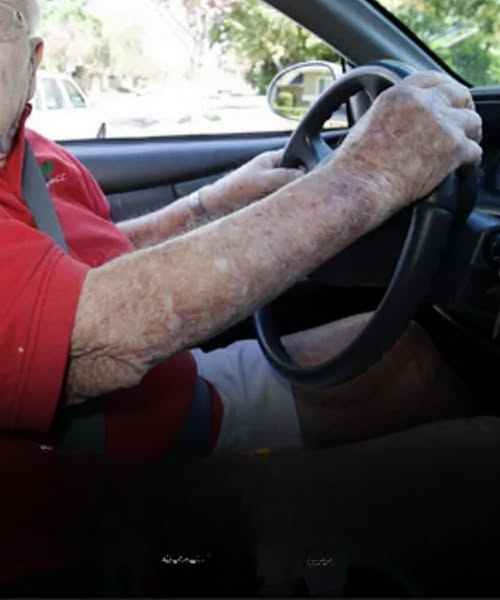
1. The Biological Realities: How Aging Affects Driving
Driving is a complex task that requires the seamless integration of visual, cognitive, and motor skills. While age is not a direct indicator of incompetence, several physiological changes naturally occur as we enter our 7th and 8th decades.
Visual Impairment and Processing
Vision provides approximately 90% of the information needed to drive. With age, the eye undergoes several changes:
-
Decreased Contrast Sensitivity: Making it harder to see pedestrians or lane markings in low light.
-
Slower Dark Adaptation: Older drivers take longer to recover from the glare of oncoming headlights.
-
Narrowing Peripheral Vision: This can lead to “missing” vehicles at intersections or failing to see cyclists.
Cognitive and Motor Skills
The ability to process multiple streams of information simultaneously—such as watching a GPS, monitoring speed, and anticipating the movement of other cars—slows down. Reaction times (the time between seeing a hazard and hitting the brake) can increase significantly. Furthermore, physical conditions like arthritis may limit the range of motion required to look over one’s shoulder or turn the steering wheel quickly.
2. Comparing the Extremes: Seniors vs. New Drivers
Statistically, there is a fascinating and sobering parallel in road safety data. The Road Safety Authority often notes that drivers over 75 are involved in accidents at a frequency similar to those aged 18 to 24.
| Driver Age Group | Primary Cause of Accidents | Risk Level |
| 18–24 Years | Risk-taking, speeding, inexperience | High |
| 75+ Years | Failure to yield, misjudgment of speed, medical episodes | High |
While young drivers often crash due to overconfidence or speed, senior drivers are more likely to be involved in accidents at intersections or during complex maneuvers where multi-tasking is required. This data suggests that while the reasons for accidents differ, the risk to the public remains a critical point of concern for policymakers.
3. The Legislative Landscape: The French Exception
In France, the “Permis B” (standard driving license) is historically valid for life. Unlike many of its European neighbors, France does not require mandatory medical check-ups or cognitive tests for private vehicle drivers based solely on age.
Comparisons Across Europe
-
Spain and Italy: Require medical exams and license renewals every few years once a driver reaches a certain age (typically 65 or 70).
-
The United Kingdom: Drivers must self-certify their fitness to drive every three years once they reach 70.
-
The Netherlands: Requires a medical examination every five years for those over 75.
The lack of such a system in France is currently being challenged by advocacy groups who argue that a “lifetime” license is an outdated concept in a world where vehicle technology and road density have increased significantly.
4. The Human Element: Independence vs. Safety
We must also acknowledge the emotional depth of this issue. For many seniors, a driver’s license is the ultimate symbol of independence. In rural areas, such as the regions surrounding La Rochelle, a car is often the only link to the pharmacy, the grocery store, and social circles.
Removing a license is not merely a legal act; it can lead to social isolation, depression, and a rapid decline in mental health. Therefore, any move toward mandatory testing must be accompanied by robust investment in senior-friendly public transportation and community shuttle services.
5. Moving Toward a Balanced Solution
The goal of road safety legislation should not be to “punish” the elderly, but to ensure that everyone on the road—including the drivers themselves—is safe. Potential solutions currently being discussed include:
-
Mandatory Medical Screenings: A simple vision and reflex test every 2–5 years after age 70.
-
Voluntary “Refresher” Courses: Providing seniors with the opportunity to practice with modern vehicle safety features (like lane-assist and automatic braking).
-
Graduated Licensing: Restricting older drivers to daytime driving or local “safe zones” rather than high-speed motorways.
Conclusion: A Collective Responsibility
The “sad news” for drivers over 70 is not necessarily a loss of freedom, but a call for increased vigilance. The tragic accident in La Rochelle serves as a reminder that the cost of inaction is too high. As a society, we must find a way to honor the dignity of our elders while prioritizing the safety of our children on the streets.
The conversation is no longer about if changes will come, but how we can implement them with compassion and efficiency.