The Changing of the Guard: Bumpy Johnson, Frank Lucas, and the Power Vacuum of 1968 Harlem
In the annals of American history, certain dates serve as silent hinges upon which the fate of entire neighborhoods turn. July 7, 1968, is one such date for Harlem. While the “Summer of Love” was fading into the rearview mirror of the national consciousness, and the Civil Rights Movement was grappling with the recent assassination of Dr. Martin Luther King Jr., a localized but seismic shift was occurring on the streets of Upper Manhattan.
The death of Ellsworth Raymond “Bumpy” Johnson did more than end the life of a local legend; it dismantled a social contract that had kept Harlem’s complex ecosystem in a state of delicate equilibrium for decades. What followed was the rise of Frank Lucas—a transition that would redefine the narcotics trade, the relationship between local communities and law enforcement, and the very concept of the “American Dream” viewed through a dark, distorted lens.
Chapter I: The Philosophy of Bumpy Johnson
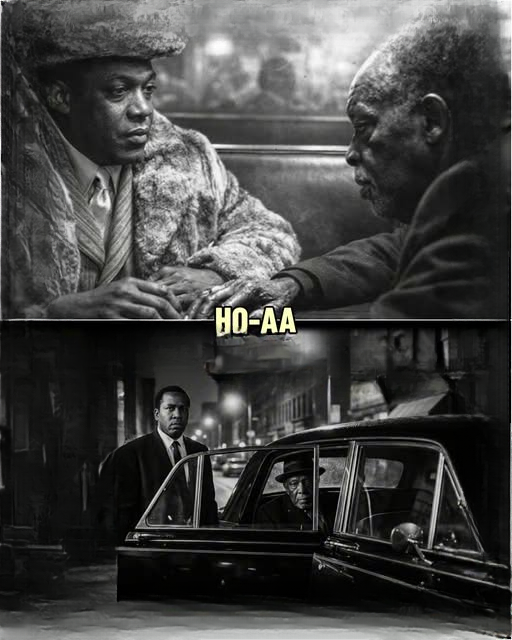
To understand the weight of that July morning, one must understand the man in the back of the Cadillac. Bumpy Johnson was not merely a “tough guy” or a street figure. He was a tactician who navigated a world of systemic exclusion.
Born in 1905, Johnson came of age during an era where African Americans were systematically denied access to traditional banking, legal protection, and political power. In this vacuum, figures like Johnson emerged as “informal governors.” He was a man of contrasts: a poet who studied chess and history, and a strategist who understood that for Harlem to thrive—or even survive—it had to remain independent of the “Five Families” of the Italian Mafia.
The Statistics of an Era
By the mid-1960s, Harlem’s economy was a microcosm of the racial disparities in the United States.
-
Unemployment: In 1968, the unemployment rate for Black men in urban centers like Harlem was often double that of their white counterparts, hovering near 12% to 15%.
-
Housing: Over 50% of the housing units in Harlem were classified as dilapidated or deteriorating during this period.
-
The Underground Economy: Because traditional capital was unavailable, the underground economy became a primary source of “liquidity” for the neighborhood.
Johnson managed this economy with a philosophy of “limited harm.” He understood that while vice was inevitable, it should be managed by those who lived in the community, ensuring that a portion of the proceeds stayed within Harlem’s borders.
Chapter II: The Silent Observer — Frank Lucas
Beside Johnson sat Frank Lucas, a man from North Carolina who had spent fifteen years as Johnson’s shadow. Lucas was the quintessential “apprentice.” He did not seek the spotlight; he sought knowledge.
Lucas observed how Johnson negotiated with figures like Lucky Luciano and the Genovese family. He saw that power was not just about the ability to exert force, but the ability to maintain order. When Johnson’s heart began to fail in that Cadillac on 146th Street, the lessons of fifteen years culminated in a single, desperate drive.
The Final Directive: “Trust Nobody”
The dying words of a mentor are often prophetic. Johnson’s warning to Lucas—”Trust nobody”—wasn’t just a cynical remark. It was a strategic assessment of the coming landscape. Johnson knew that without his presence, the Italian Mafia would see Harlem as “unclaimed territory.” He also knew that the younger generation of Harlem’s street figures lacked the discipline to resist the lure of quick, short-term partnerships that would ultimately lead to their subservience to outside interests.
Chapter III: The 1968 Power Vacuum and the Economic Shift
When a leader of Johnson’s stature passes, the immediate result is usually chaos. However, Frank Lucas utilized a tactic of “visible commitment” to freeze the chaos before it could begin.
The Funeral Statement
At the Abyssinian Baptist Church, Lucas’s act of placing $100,000 in the casket was a calculated move in game theory. In 1968, $100,000 had the purchasing power of approximately $850,000 in 2026 currency. By laying his entire net worth on the line, Lucas signaled to the community and to downtown rivals that he was not a mere employee, but a successor with the resources and the will to hold the line.
Chapter IV: The Birth of “Blue Magic” and Vertical Integration
The most significant contribution Frank Lucas made to the history of organized crime—and the most devastating to the social fabric of Harlem—was his application of “Vertical Integration.”
In traditional business, vertical integration is when a company owns its supply chain, from raw materials to the retail storefront. Before Lucas, the heroin trade followed a fractured path:
-
Source: Opium grown in the Golden Triangle (Southeast Asia).
-
Refiners: French or Corsican syndicates in Marseille (The “French Connection”).
-
Importers: The Italian Mafia in New York.
-
Wholesalers: Mid-level distributors.
-
Retailers: Local street dealers in Harlem.
Each “hand” that touched the product took a percentage of the profit and “cut” (diluted) the purity. By the time it reached Harlem, the product was often only 5% to 10% pure, yet extremely expensive.
The Southeast Asia Pivot
Capitalizing on the chaos of the Vietnam War, Lucas bypassed every middleman. He traveled to the source, dealing directly with producers in the Golden Triangle.
-
Purity Levels: Lucas began importing “Blue Magic,” which boasted a purity level of nearly 90% to 100% before being cut for the street.
-
Price Point: By eliminating the Mafia middlemen, he could sell a superior product for a lower price while maintaining higher profit margins.
From a purely clinical, economic perspective, Lucas was a “disruptor.” However, the social cost of this disruption was a public health crisis that would haunt Harlem for a generation.
Chapter V: The Sociological Impact on Harlem
The rise of the Lucas empire coincided with a period of profound social change. As the “Blue Magic” era took hold, the demographic and social health of Harlem shifted.
Addiction Statistics and Social Decay
By the early 1970s, the impact of high-purity heroin was visible.
-
The Addiction Spike: Estimates suggest that the number of heroin addicts in New York City rose from roughly 50,000 in the mid-60s to over 200,000 by the mid-70s.
-
The Crime Rate: As addiction grew, so did the “subsistence crime” rate—thefts and burglaries committed to fund a habit.
-
The Family Unit: The “crackdown” era that followed Lucas’s reign would eventually lead to the mass incarceration crisis, but the roots were planted in the high-availability era of the early 70s.
Chapter VI: Law Enforcement and Systemic Corruption
Lucas’s ability to operate so openly for so long was not merely due to his cleverness; it was fueled by systemic failures within the New York Police Department (NYPD) and federal agencies.
The “Special Investigations Unit” (SIU) of the NYPD became a focal point of the Knapp Commission, which investigated police corruption in the 1970s. It was discovered that a significant percentage of officers assigned to narcotics were actually facilitate the trade—stealing money from dealers, selling confiscated drugs back into the community, and protecting figures like Lucas in exchange for a “cut.”
This era proved that when the underground economy becomes large enough, it doesn’t just sit alongside the “legal” world—it begins to absorb it.
Chapter VII: The Legacy of the “Trust Nobody” Doctrine
Frank Lucas was eventually apprehended in 1975. His decision to cooperate with the government—leading to the arrest of scores of corrupt police officers and rival dealers—was perhaps the ultimate application of the “Trust Nobody” rule.
He realized that the “loyalty” he had been taught by Bumpy Johnson was a one-way street in the modern era. To survive, he had to dismantle the very system he had built.
Conclusion: Lessons from a Dark History
The story of the Cadillac on 146th Street is a tragedy of missed potential. It is the story of two men with the intelligence and discipline to lead industries, who instead channeled those talents into an enterprise that ultimately scarred their community.
Bumpy Johnson’s era was defined by “Control.” Frank Lucas’s era was defined by “Capital.” Both, however, were products of a society that offered few other avenues for Black ambition. Today, we look back at this history not to celebrate the figures, but to understand the conditions that created them.
Harlem has since undergone a renaissance, but the echoes of that July morning—the silent car, the hand on the chest, and the passing of a heavy, troubled torch—still linger in the history of New York.