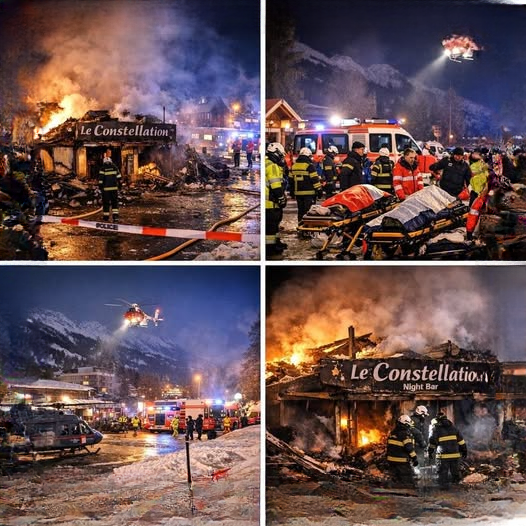
The Constellation Tragedy: Analyzing the Night the Music Stopped in Crans-Montana
The Swiss Alps are synonymous with serenity, luxury, and the pursuit of winter joy. The resort town of Crans-Montana, perched in the Valais canton, has long been a crown jewel for global travelers seeking the ultimate New Year’s Eve experience. However, the transition into 2026 will forever be marked by the “Constellation Tragedy”—a devastating fire at a premier venue that transformed a night of celebration into a catalyst for national mourning and a rigorous re-evaluation of public safety.
The Event: From Celebration to Catastrophe
On the evening of December 31, the venue known as Le Constellation was at peak capacity. Guests from around the world had gathered for an evening of music and high-altitude fireworks. Witnesses describe an atmosphere of vibrant energy that shifted into a nightmare with terrifying speed.
The Physics of Rapid Ignition
Initial reports suggest the fire may have ignited near the stage area. In enclosed public spaces, several factors contribute to what fire scientists call “flashover”—the point where every combustible surface in a room ignites simultaneously.
-
Fuel Load: The interior decor, acoustic paneling, and festive installations provided a significant “fuel load.” Many modern synthetic materials produce toxic “black smoke,” which contains carbon monoxide and hydrogen cyanide.
-
The Chimney Effect: In mountain structures, the layout often encourages vertical air movement. Once the fire breached the main hall, the cold alpine air rushing in through opened exits may have acted as an accelerant, fueling the flames further.
The Human Element: Panic and the “Maze of Fear”
As visibility vanished within seconds, the psychological impact on the crowd was immediate. When a familiar space is filled with smoke, the “cognitive map” we use to navigate—identifying exits and landmarks—collapses.
Crowd Dynamics in Crisis
Survivors described a “maze of fear.” In high-stress environments with limited visibility, human behavior often shifts toward “competitive flight.”
-
The Exit Problem: People naturally tend to leave through the same door they entered, even if emergency exits are closer. When that main entrance becomes a bottleneck, the risk of crush injuries increases significantly.
-
The Role of Sound: The music, which had been a source of joy, became a disorienting wall of sound that initially masked the crackle of fire and the shouts of the staff.
The Response: Heroism Amidst the Alpine Chill
The Crans-Montana fire department and regional first responders faced a logistical nightmare. The narrow, snow-covered roads of a mountain resort are not designed for the rapid influx of heavy fire suppression equipment.
Emergency Medical Triage
With 100 individuals injured, local medical facilities were quickly overwhelmed. Triage centers were established in nearby hotels, turning luxury lobbies into makeshift wards.
-
Inhalation Injuries: For the 100 survivors, the primary medical challenge was not burns, but respiratory damage from the superheated air and toxic particulates.
-
The Flight to Sion: The most critical cases were airlifted to the regional hospital in Sion, a testament to the efficiency of the Swiss air-rescue system (Rega).
Analysis: Seeking Accountability and Prevention
In the wake of the forty lives lost, the Swiss Federal Office for Civil Protection has launched a comprehensive inquiry. The investigation focuses on three critical pillars:
-
Safety Infrastructure: Were the sprinkler systems functional, and were the building’s materials compliant with the latest Swiss fire safety codes (VKF)?
-
Capacity Management: Did the ticket sales exceed the safe occupancy limits of the structure?
-
Emergency Lighting: Witnesses reported a total “blackout” early in the event. The failure of emergency lighting is often the deciding factor in whether people can find exits in a smoke-filled room.
The Psychological Legacy: Moving Through Grief
For the survivors and the families of the forty victims, the tragedy has left a “heavy emotional toll.” Post-Traumatic Stress Disorder (PTSD) is a common outcome for those who survive large-scale structural fires, often manifesting as a fear of enclosed spaces or loud, sudden noises.
Community Resilience
Crans-Montana is a town that depends on hospitality and the gathering of people. The tragedy has forced a reimagining of how the town views public gatherings. There is a move toward “Safety-First Tourism,” where rigorous inspections and visible safety protocols are becoming as essential to the guest experience as the skiing itself.
Conclusion: A Night Frozen in Time
The Constellation tragedy is a somber reminder that safety is not a passive state but an active, ongoing responsibility. As the town heals, the memory of those lost serves as a catalyst for change. New Year’s Eve in the Valais Alps will eventually regain its festive spirit, but it will be a spirit tempered by wisdom and a profound respect for the fragility of life.
By honoring the victims through better regulation and deeper community care, Crans-Montana ensures that while the night ended in goodbyes, the lessons learned will save lives for generations to come.