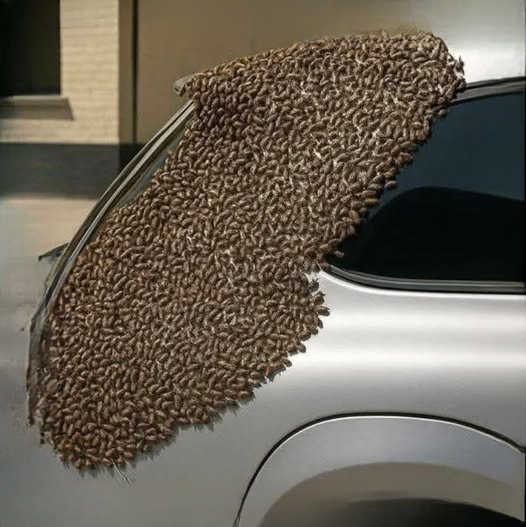
The Living Cloud: Understanding the Mystery and Majesty of the Bee Swarm
Introduction: A Spectacle of Nature
It often begins as a distant hum, a low-frequency vibration that seems to shake the air itself. Within minutes, a dark, swirling cloud of thousands of honeybees may descend upon a backyard, a park bench, or a tree limb. For the uninitiated, this sight can trigger an immediate sense of alarm. The instinctual response is often to reach for the phone to call emergency services or, worse, to reach for a can of pesticide.
However, modern ecology tells a very different story. This phenomenon, known as swarming, is not an act of aggression, but a miraculous act of reproduction. It is the way a single honeybee colony becomes two. When you encounter a swarm, you are witnessing one of the most sophisticated social behaviors in the animal kingdom. Understanding why bees swarm—and how to react with patience—is a vital step in preserving the delicate balance of our environment.
Chapter 1: The Biology of the Swarm
To lose our fear of the swarm, we must first understand its purpose. Swarming is the natural “birth” of a new colony.
The crowded hive
A healthy honeybee colony is a masterpiece of efficiency. During the spring and early summer, as flowers bloom and nectar flows, the queen bee increases her egg-laying dramatically. Eventually, the hive becomes congested. When the bees feel they have outgrown their current home, the “scout” bees begin to make preparations for a split.
The departure of the Queen
In a fascinating reversal of what many expect, it is the old queen who leaves the hive. About half of the worker bees gorge themselves on honey—stockpiling energy for the journey—and fly out with their queen. They leave behind a smaller group of workers and several “queen cells” containing larvae that will soon hatch to become the new monarch of the original hive.
The “Bivouac” Phase
The cluster of bees you see hanging from a branch is a temporary stopover, known as a bivouac. They are not nesting there; they are simply waiting. While the mass of bees protects the queen in the center of the cluster, scout bees fly out in every direction to find a permanent home, such as a hollow tree or a specialized bee box.
Chapter 2: Why You Should Not Be Afraid
The most important fact for any homeowner to remember is this: Swarming bees are at their most docile state.
-
No Home to Defend: Bees are most aggressive when they are defending their honey stores and their developing brood (babies). A swarm has neither. Without a hive to protect, they have no reason to attack.
-
Full Bellies: Before leaving the hive, swarming bees consume as much honey as they can hold. Biologically, a bee with a full stomach finds it very difficult to curve its abdomen into the position required to sting. They are essentially in a “food coma.”
-
A Singular Focus: The bees have one goal—protecting the queen and finding a home. They are entirely uninterested in humans, pets, or property, provided they are left undisturbed.
Chapter 3: The “Do’s and Don’ts” of Swarm Encounters
When a swarm arrives on your property, your actions can determine the survival of tens of thousands of pollinators.
What NOT to do:
-
Do Not Call Firefighters: Unless the swarm is an immediate threat to public safety in a high-traffic area, emergency services are not equipped to handle bees. Their intervention often results in the unnecessary destruction of the colony.
-
Do Not Use Water or Pesticides: Spraying a swarm with a hose or poison is not only cruel but often ineffective. It can cause the bees to scatter, making them harder to remove safely and potentially making them more defensive.
-
Do Not Throw Objects: Disturbing the cluster will only cause the bees to take flight in a confused state, increasing the duration of their stay.
What TO do:
-
Keep Your Distance: You can safely observe a swarm from a few meters away. Use binoculars for a closer look at the incredible geometric patterns the bees form.
-
Keep Pets and Children Indoors: While the bees are unlikely to sting, a curious dog or a playing child might accidentally disturb the cluster.
-
Wait It Out: In 90% of cases, the swarm will depart on its own within 24 to 48 hours once the scouts have selected a permanent location.
Chapter 4: The Role of the Professional Beekeeper
If a swarm has settled in a location that is truly problematic—such as near a school entrance or a doorway—the best course of action is to contact a local beekeeper or bee rescue group.
Many beekeepers are thrilled to “catch” a swarm. For them, it is a source of free, healthy, and vigorous bees. A professional beekeeper will use a specialized box or a gentle vacuum to collect the queen. Once the queen is in the box, the rest of the workers will follow her pheromones and walk right in. The beekeeper then relocates them to a managed apiary where they can thrive and produce honey for years to come.
Chapter 5: The Broader Context—Why Every Bee Matters
Our global food security is inextricably linked to the health of honeybees. One out of every three bites of food we eat is the result of pollination.
Bees in Crisis
In recent decades, bee populations have faced “Colony Collapse Disorder,” driven by habitat loss, pesticide use, and climate change. When we choose to save a swarm rather than destroy it, we are making a micro-contribution to a global solution. Every colony that is allowed to survive and find a home contributes to the genetic diversity and resilience of the local ecosystem.
Conclusion: From Fear to Stewardship
The sight of a bee swarm is one of the most profound displays of natural coordination on Earth. It is a reminder that we live in a world that is vibrant, alive, and interconnected. By choosing patience over panic, we protect a vital ally. The next time you see a “living cloud” of bees, take a deep breath, keep your distance, and appreciate the rare privilege of witnessing nature’s intricate design in motion.