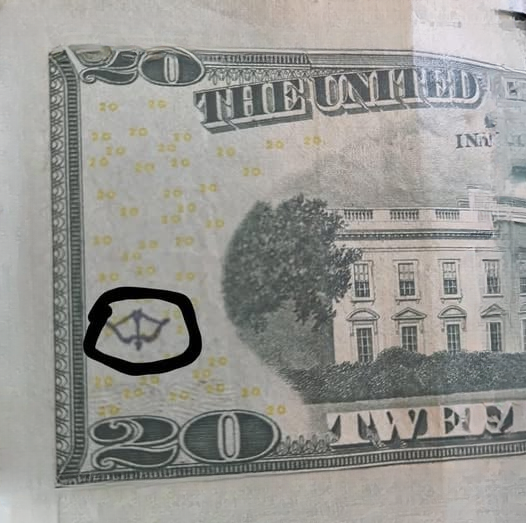
At first glance, a U.S. dollar bill appears familiar and uniform. The green ink, engraved portraits, serial numbers, seals, and intricate patterns are instantly recognizable to anyone who has used American currency. Yet from time to time, people encounter something unexpected: a small stamped symbol, an unusual marking, or a tiny shape that does not appear to be part of the original design. Among the most curious of these are symbols resembling a bow and arrow, small characters, or compact stamps pressed into the paper.
For many, discovering such a mark raises questions. Is the bill damaged? Is it counterfeit? Does the symbol have a hidden meaning? Or is it part of a secret system?
The truth is far less mysterious—but far more fascinating.
These markings, commonly known as chop marks, tell a quiet story about the global journey of money, international trade, trust, and the long history of how people across cultures verify value. Far from being errors or hidden codes, these symbols are evidence that a dollar bill has traveled well beyond U.S. borders and participated in the complex, interconnected world economy.
This article explores the origins, meaning, and significance of chop marks, including symbols that resemble a bow and arrow, while placing them in a broader historical, cultural, and economic context.
A Closer Look at Unexpected Marks on U.S. Currency
Most U.S. paper currency printed today is designed to look identical, aside from serial numbers and Federal Reserve indicators. When a bill appears with extra symbols, it naturally draws attention.
These marks are usually:
-
Small stamps
-
Ink impressions
-
Simple shapes or characters
-
Often placed away from portraits or seals
They are not added by the U.S. government, nor are they part of the official design. Instead, they are added by people who handle money in other parts of the world.
To understand why, it helps to step back and consider how money functions beyond national borders.
The U.S. Dollar as a Global Currency
Unlike most national currencies, the U.S. dollar has long played a dual role:
-
Domestic currency within the United States
-
International reserve and trade currency used worldwide
In many countries, U.S. dollars circulate alongside local currency or are held as savings. They are often used in:
-
International trade
-
Tourism-based economies
-
Regions with unstable local currencies
-
Cross-border business transactions
Because of this widespread use, U.S. dollar bills often change hands far from American banks, sometimes in places with limited access to modern verification technology.
What Are Chop Marks?
Chop marks are small stamps or impressions applied to currency by money handlers—such as traders, merchants, or money changers—to indicate that the bill has been examined and accepted as genuine.
The term “chop” originates from historical trade practices and refers to a seal or stamp used to signify approval or verification.
Purpose of Chop Marks
Chop marks serve several functions:
-
Confirm authenticity
-
Indicate prior inspection
-
Signal trustworthiness to future handlers
-
Reduce the risk of counterfeit circulation
In environments where counterfeit bills are a concern and electronic verification tools are unavailable or impractical, these marks provide reassurance.
Why Do Some Chop Marks Look Like a Bow and Arrow?
The appearance of chop marks varies widely. Some are simple initials, while others are symbols or stylized shapes. A mark that resembles a bow and arrow is not symbolic in a narrative or political sense. Rather, it reflects the personal or institutional stamp of the individual or business that applied it.
These symbols may represent:
-
A merchant’s logo
-
A simplified character or emblem
-
A traditional sign used consistently by a specific exchanger
The resemblance to a bow and arrow is usually coincidental, arising from stylized design rather than intentional imagery.
The Deep Historical Roots of Chop Marking
Origins in Ancient Trade
The practice of marking currency to verify authenticity dates back centuries. Long before modern banks, traders needed ways to confirm that coins were genuine and of proper weight.
In ancient trade systems:
-
Coins were weighed
-
Inspected visually
-
Stamped after verification
These stamps became known as chop marks.
China’s Role in the Development of Chop Marks
The word “chop” is derived from historical Chinese trade terminology. In imperial China, silver ingots and coins were often stamped by merchants and officials to certify:
-
Purity
-
Weight
-
Authenticity
As trade expanded, these practices spread beyond metal currency and were later applied to paper money.
Chinese merchants trading internationally extended the system to foreign currencies, including European and later American bills.
From Coins to Paper Money
When paper currency became more widely used in global trade, the same challenges remained:
-
How to confirm authenticity
-
How to signal trust quickly
-
How to prevent fraud
Paper bills could not be weighed like coins, but they could be inspected and stamped.
Thus, chop marking evolved into a practice applied to paper money, especially in regions where foreign currency circulated heavily.
Why U.S. Dollars Became Commonly Chop Marked
Several factors made U.S. dollars particularly likely to receive chop marks:
-
High Global Circulation
The dollar is one of the most widely used currencies in the world. -
Perceived Stability
The dollar is often viewed as a stable store of value. -
Frequent Counterfeiting Attempts
Popularity makes the currency a target for counterfeiters. -
Use in Informal Markets
Dollars are often exchanged in settings without formal banking infrastructure.
In these contexts, chop marks became practical tools.
Geographic Regions Where Chop Marks Are Most Common
Chop-marked U.S. bills are most often associated with regions where:
-
Cash transactions dominate
-
Currency exchange occurs informally
-
Verification technology is limited
These regions include:
-
Parts of Southeast Asia
-
Areas of Africa
-
Sections of Latin America
-
Historical trade hubs
In these locations, chop marks are understood as normal and practical, not suspicious.
The Emotional Side of Currency Trust
Money is not just paper—it is trust made tangible.
For someone handling foreign currency:
-
Trust must be established quickly
-
Mistakes can be costly
-
Verification is a form of security
Chop marks represent reassurance. They say, “This has been checked. Someone before you trusted it.”
This emotional aspect of trust is often overlooked in modern, digital economies but remains vital in cash-based systems.
Are Chop-Marked Bills Legal in the United States?
Yes, chop-marked bills are legal tender in the United States.
U.S. Law on Currency Alteration
U.S. law prohibits mutilating currency only if the damage renders it unusable or significantly reduces its value. Minor markings, stamps, or writing that do not interfere with the bill’s function are not illegal.
Chop marks:
-
Do not invalidate a bill
-
Do not reduce its face value
-
Do not make it counterfeit
As a result, such bills remain legal tender.
Practical Limitations of Chop-Marked Bills
Although legally valid, heavily marked bills may occasionally face practical challenges.
Possible Issues Include:
-
Rejection by vending machines
-
Hesitation from automated cash handlers
-
Temporary refusal by cautious businesses
In these cases, banks can usually exchange the bill for a cleaner one without issue.
Chop Marks vs. Counterfeit Indicators
It is important to distinguish chop marks from signs of counterfeiting.
Chop Marks:
-
Added after printing
-
Used to confirm authenticity
-
Often small and localized
Counterfeit Indicators:
-
Incorrect paper texture
-
Missing security features
-
Poor print quality
A chop mark does not indicate a counterfeit bill.
Collectors and Chop-Marked Currency
For some collectors, chop-marked bills are especially interesting.
Why Collectors Value Them
-
Evidence of international circulation
-
Historical trade connections
-
Cultural exchange reflected in currency
These bills tell a story that unmarked bills do not.
However, value depends on:
-
Rarity
-
Condition
-
Historical context
Not all chop-marked bills are valuable, but many are culturally significant.
The Global Journey of a Single Dollar Bill
A single dollar bill might:
-
Begin its life in a U.S. mint
-
Travel overseas through trade
-
Be exchanged multiple times
-
Receive verification marks
-
Return to the United States
Each mark reflects a moment in that journey.
Seen this way, chop marks are not imperfections—they are travel stamps.
Modern Technology and the Decline of Chop Marks
With the spread of:
-
Electronic verification tools
-
Digital payments
-
Banking infrastructure
The use of chop marks has declined in many regions. However, they still appear in places where cash remains central to daily life.
Their persistence highlights the uneven pace of financial modernization around the world.
Misconceptions and Myths
Chop marks sometimes give rise to misconceptions, including:
-
Hidden messages
-
Secret organizations
-
Government signals
In reality, chop marks are practical, not symbolic. They reflect commerce, not conspiracy.
Why Understanding Chop Marks Matters
Learning about chop marks encourages:
-
Financial literacy
-
Cultural awareness
-
Appreciation for global trade history
It reminds us that money connects people across borders and systems.
Broader Lessons About Money and Meaning
Currency is often seen as static, but it is deeply dynamic. Every bill carries:
-
Economic value
-
Social trust
-
Cultural history
Marks like the bow-and-arrow-shaped chop are reminders that money is shaped by human interaction.
Conclusion: Small Symbols, Big Stories
The next time you encounter a U.S. dollar bill with an unfamiliar symbol—whether it resembles a bow and arrow or another mark—pause before dismissing it as damage.
That mark is evidence of:
-
Global circulation
-
Historical trade practices
-
Trust built across cultures
Chop marks are quiet storytellers. They reveal where money has been, how it was trusted, and the human systems that keep commerce moving.
In a world increasingly dominated by digital transactions, these small stamps serve as tangible reminders of money’s long, shared journey through history.