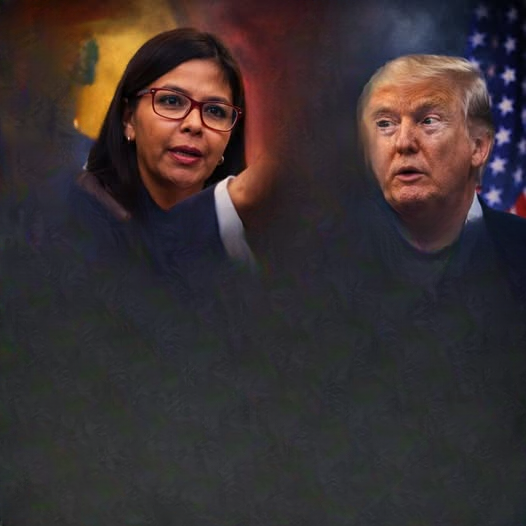
Venezuela has entered one of the most consequential and uncertain periods in its modern political history. A dramatic change in leadership, triggered by the removal of long-standing President Nicolás Maduro and the appointment of Delcy Rodríguez as interim president, has reshaped the country’s political landscape and sent shockwaves through international diplomatic circles.
This unexpected transition has drawn intense attention from governments around the world, particularly from the United States, where President Donald Trump issued a series of forceful and controversial statements regarding Venezuela’s future. The unfolding situation has raised critical questions about constitutional legitimacy, national sovereignty, international law, and the role of external powers in shaping political outcomes within sovereign states.
At its core, this moment represents more than a leadership change. It is a test of Venezuela’s institutional resilience, a challenge to regional stability, and a reflection of broader geopolitical tensions that extend well beyond South America. This article offers an in-depth, neutral examination of how Venezuela arrived at this point, the implications of Delcy Rodríguez’s interim presidency, the responses from domestic and international actors, and the potential paths forward for a nation standing at a historic crossroads.
A Sudden and Unprecedented Shift in Power
In early January 2026, Venezuela experienced a rapid and highly unusual change in governance. A U.S.-led operation resulted in the detention of President Nicolás Maduro and his spouse, who were transferred to the United States to face a series of legal accusations related to international criminal activity. The operation marked one of the most direct interventions by the United States in the internal affairs of a Latin American nation in recent decades.
The removal of Maduro created an immediate power vacuum at the highest level of the Venezuelan government. With limited warning and little time for public preparation, state institutions were forced to respond quickly to prevent administrative paralysis. Political factions, government officials, and ordinary citizens alike were left grappling with uncertainty as the country entered an uncharted phase.
Within days of Maduro’s removal, Delcy Rodríguez, who had been serving as vice president, was sworn in as interim president. Her appointment followed constitutional provisions that allow the vice president to assume leadership in cases where the sitting president is unable to fulfill their duties. However, the extraordinary circumstances surrounding Maduro’s absence ensured that the transition would remain heavily contested.
Delcy Rodríguez: Background and Political Trajectory
Delcy Rodríguez is a seasoned political figure with deep roots in Venezuela’s governing establishment. Prior to becoming interim president, she held several influential positions, including vice president and minister of petroleum. These roles placed her at the center of both political decision-making and economic management in a country where oil revenue has long shaped national policy.
Rodríguez’s political identity is closely linked to the Bolivarian movement, the ideological framework established by former President Hugo Chávez. This movement emphasizes state control over key industries, social welfare programs, and resistance to perceived foreign interference. Over the years, Rodríguez has emerged as a loyal and capable administrator within this system, known for her ability to navigate complex institutional structures.
Her rise to interim leadership represents continuity in governance rather than a sharp ideological departure. Even as Venezuela faces extraordinary challenges, Rodríguez’s leadership signals the persistence of the political philosophy that has guided the country for more than two decades.
The Removal of Nicolás Maduro: Legal and Political Controversy
The circumstances surrounding Nicolás Maduro’s detention remain among the most contentious aspects of the crisis. U.S. authorities framed the operation as a law enforcement action aimed at holding individuals accountable for alleged international crimes. Maduro, however, has consistently denied all allegations and maintains that his detention violates international legal norms.
Within Venezuela, reactions to Maduro’s removal have been deeply polarized. Supporters of the former president have described the event as an unlawful act that undermines national sovereignty and sets a dangerous precedent. Others, including some critics of Maduro’s administration, have viewed the event as a potential turning point after years of economic hardship and political stagnation.
The episode has reignited long-standing debates about the limits of extraterritorial law enforcement, the protections afforded to heads of state, and the balance between accountability and sovereignty in international relations.
Constitutional Succession and Questions of Legitimacy
Under Venezuela’s constitution, the vice president may assume executive authority on an interim basis if the president is unable to serve. This provision formed the legal basis for Delcy Rodríguez’s appointment. The swearing-in ceremony, conducted by members of the national legislature, was intended to provide continuity and stability during a period of upheaval.
Despite this constitutional framework, many Venezuelans have expressed uncertainty about the legitimacy of the transition. Conflicting official statements, limited public communication, and the unprecedented nature of the situation have fueled speculation and confusion. Some citizens have questioned whether the constitutional process was fully observed, while others have raised concerns about external influence shaping domestic outcomes.
These doubts reflect broader issues within Venezuelan governance, including weakened institutions, limited public trust, and a history of contested political authority.
Early Messaging from the Interim President
Upon assuming office, Delcy Rodríguez addressed the nation with a carefully balanced message. She strongly criticized the foreign operation that led to Maduro’s removal, describing it as an infringement on Venezuela’s sovereignty. At the same time, she emphasized the need to maintain institutional order and fulfill constitutional obligations during a time of crisis.
In subsequent statements, Rodríguez adopted a more conciliatory tone toward the international community. She expressed openness to dialogue and cooperation, particularly with the United States, provided that such engagement respected Venezuela’s independence and legal frameworks.
This dual approach—defending national sovereignty while signaling willingness to engage diplomatically—underscored the complexity of her position. Rodríguez faced the challenge of reassuring domestic supporters of continuity while addressing the expectations of powerful external actors.
The United States Responds: Strategy and Rhetoric
The U.S. response to Venezuela’s leadership change was immediate and assertive. President Donald Trump publicly described the situation as an opportunity to stabilize the country and protect American strategic interests. His remarks suggested a temporary U.S. role in overseeing Venezuela’s transition, a statement that sparked intense international debate.
Trump’s comments frequently emphasized economic considerations, particularly Venezuela’s energy resources. He portrayed U.S. involvement as a means of restoring order and reviving economic productivity, while also warning that non-cooperation could result in severe consequences.
At the same time, Trump expressed conditional support for Rodríguez’s interim presidency, indicating that continued U.S. engagement would depend on her alignment with American objectives. This approach highlighted a transactional view of diplomacy that has characterized much of Trump’s foreign policy rhetoric.
Conditional Support and Diplomatic Pressure
The United States’ stance toward Rodríguez has been marked by a mix of endorsement and warning. On one hand, American officials signaled a willingness to recognize her leadership under certain conditions. On the other, they made clear that failure to meet U.S. expectations could lead to economic or political repercussions.
This strategy placed Rodríguez in a difficult position. Accepting U.S. conditions risked domestic backlash and accusations of compromising sovereignty, while rejecting them could deepen Venezuela’s isolation and economic challenges.
The situation illustrates the asymmetry of power that often defines relations between smaller nations and global superpowers, particularly during moments of internal vulnerability.
Rodríguez’s Diplomatic Balancing Act
In response to international pressure, Rodríguez has sought to articulate a diplomatic vision grounded in mutual respect and peaceful coexistence. Her public statements emphasize cooperation without subordination and engagement without surrendering national identity.
By framing Venezuela as open to dialogue while firmly rejecting external control, Rodríguez aims to navigate a narrow path that preserves both stability and autonomy. This strategy reflects an understanding that outright confrontation or unconditional compliance could both carry significant risks.
Her approach also signals an attempt to redefine Venezuela’s international posture, moving away from isolation while maintaining ideological continuity.
Domestic Reactions: Hope, Fear, and Uncertainty
Within Venezuela, public reaction to the transition has been complex and deeply divided. Some citizens view Rodríguez’s interim presidency as a necessary step to prevent chaos and ensure continuity. Others see it as an imposed arrangement shaped by foreign intervention.
In cities like Caracas, daily life has been marked by uncertainty. Questions about economic policy, public services, and political freedoms loom large, and many Venezuelans are unsure whether the transition will bring meaningful change or prolong existing challenges.
These mixed reactions highlight the emotional and psychological toll of prolonged political instability on a population already strained by years of hardship.
International Perspectives and Legal Questions
Globally, reactions to Venezuela’s situation have varied widely. Some governments have expressed concern over the use of force and the implications for international law. Others have focused on the need for humanitarian assistance and diplomatic solutions.
International legal experts have debated the implications of Maduro’s detention, including issues of jurisdiction, diplomatic immunity, and the precedent it sets for future conflicts. The situation has prompted discussions within multilateral institutions about how best to uphold international norms while addressing complex political realities.
Challenges Facing the Interim Government
As interim president, Rodríguez faces a daunting set of challenges. Domestically, she must address economic instability, social inequality, and political polarization. Restoring public trust in institutions will require transparency, dialogue, and tangible improvements in daily life.
Externally, she must manage relations with powerful governments, regional allies, and international organizations, all while defending Venezuela’s sovereignty. Balancing these competing demands will test her leadership and the resilience of the state.
Broader Implications for the Region
Venezuela’s crisis has implications that extend beyond its borders. The situation affects regional migration patterns, energy markets, and diplomatic relations throughout Latin America. It also serves as a case study in how global power dynamics influence domestic political outcomes.
For the United States, the episode reflects a broader strategy of assertive engagement in the Western Hemisphere. For neighboring countries, it underscores the importance of regional cooperation and conflict prevention.
Looking Ahead: Possible Paths Forward
The future of Venezuela remains uncertain. Much will depend on the decisions made by Rodríguez, the responses of domestic political actors, and the actions of foreign governments. Whether the country moves toward reconciliation and recovery or deeper division will be shaped by how these forces interact in the coming months.
Dialogue, institutional reform, and respect for international norms could provide a foundation for stability. Conversely, continued confrontation and external pressure risk prolonging instability and hardship.
Conclusion: A Nation at a Turning Point
Venezuela stands at a defining moment in its history. The transition from Nicolás Maduro to Delcy Rodríguez is not merely a change in leadership but a test of the nation’s capacity to navigate crisis, assert sovereignty, and engage constructively with the world.
As global attention remains fixed on Caracas, the choices made today will shape Venezuela’s trajectory for years to come. Whether this moment becomes a step toward renewal or another chapter of contention will depend on leadership, diplomacy, and the will of the Venezuelan people.