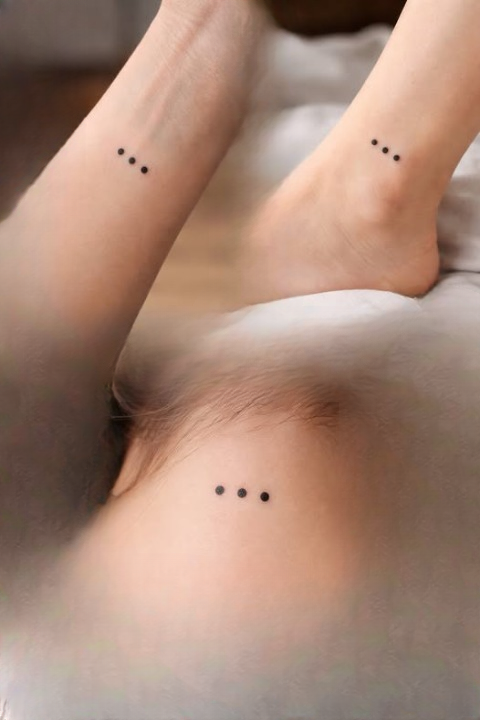
While the exact origin of the three-dot tattoo is difficult to pinpoint, it has appeared in various cultures and periods, often with distinct interpretations. Some sources link it to the “Three Wise Monkeys” motif, originating in Japan, which conveys the principle of moral restraint: “see no evil, hear no evil, speak no evil.” In this interpretation, the tattoo serves as a reminder to live mindfully, exercise self-control, and avoid harmful influences.
In European and North American tattoo culture, the three dots began to emerge in the mid-20th century, often adopted by people in marginalized communities as a discreet form of expression. For some, it was a subtle marker of belonging, conveying a sense of shared identity without overtly declaring membership in a group or movement.
Three Dots in Prison Culture
One of the most widely discussed meanings of the three-dot tattoo is its association with prison culture. In this context, the tattoo typically symbolizes loyalty, solidarity, and the acceptance of consequences within the system. The three dots can also represent “mi vida loca” or “my crazy life,” a phrase that conveys a willingness to live outside conventional norms and endure hardships.
- Loyalty: The dots often signify allegiance to a particular group or code of conduct.
- Experience: For some, additional dots are added over time to mark years spent incarcerated or milestones within that lifestyle.
- Caution: The tattoo can serve as a reminder to maintain discretion and avoid betraying trust.
While it is most commonly associated with Latin American and U.S. prison subcultures, variations of the meaning exist worldwide, emphasizing personal hardship and resilience rather than solely criminal affiliation.
Cultural Variations
Beyond prison symbolism, the three-dot tattoo has meanings that reflect personal philosophy, spirituality, or life experience:
- Latin America: Often linked to “Mi Vida Loca,” the tattoo can represent someone who has endured struggles, embraced chaos, or taken risks.
- Southeast Asia: Some people interpret three small dots as representing spiritual balance or life’s three essential principles.
- Western Popular Culture: The tattoo is sometimes viewed as a fashion or aesthetic choice, its meaning more symbolic than literal, chosen for minimalism and subtlety.
These examples highlight that the tattoo’s meaning depends heavily on cultural context, personal intent, and social environment.
Misinterpretations and Social Perception
Because the three-dot tattoo carries multiple interpretations, it is often subject to assumptions and misjudgments:
- Workplace Challenges: In certain professional environments, visible tattoos like this may lead to stereotyping, regardless of the wearer’s personal story.
- Legal Misunderstandings: Law enforcement or other authorities may misinterpret the tattoo as evidence of gang affiliation in regions where criminal associations are common.
- Cultural Sensitivity: What is a symbol of personal resilience in one community may be viewed as rebellious or dangerous in another.
This duality underscores an important principle: a symbol’s meaning is shaped both by the wearer’s intent and by the observer’s perspective.
Personal and Modern Interpretations
Today, many people get the three-dot tattoo as a personal statement rather than a literal affiliation with a subculture or prison system. It can serve as:
- A reminder of overcoming hardship.
- A representation of three guiding principles or milestones in life.
- An emblem of minimalism or aesthetic preference in tattoo design.
Some modern tattoo enthusiasts combine the three dots with other elements, such as lines, geometric shapes, or small motifs, to further personalize the design and give it layered meaning.
Final Thoughts
The three-dot tattoo may be small, but it carries a wealth of significance, ranging from spiritual awareness to solidarity, personal resilience, and cultural identity. Its interpretation varies across regions, communities, and individuals, reminding us that tattoos are deeply personal symbols that communicate complex stories beyond their simple appearance.
Ultimately, whether worn as a reflection of life’s struggles, a nod to cultural heritage, or a personal mantra, the three-dot tattoo exemplifies how even minimalistic symbols can speak volumes about identity, experience, and human connection.
The Three-Dot Tattoo in Contemporary Subcultures
In today’s world, the three-dot tattoo has transcended its historical and cultural roots to become a symbol adopted by diverse subcultures, each adding their own layer of meaning. Among street artists, musicians, and youth movements, the dots often represent rebellion, resilience, and the refusal to conform. While the original interpretations of discretion and loyalty remain influential, modern wearers often redefine the tattoo for their personal journeys, creating a hybrid symbol of identity and self-expression.
For example, in urban communities in Mexico and the United States, young adults may choose the three-dot tattoo not as a statement of criminal affiliation but as a marker of personal survival or triumph over adversity. It becomes a subtle badge that conveys a story of resilience: a silent acknowledgment of the struggles they have endured, and the lessons learned along the way. In this sense, the tattoo is less about warning others and more about reminding the wearer of their own strength.
Psychological and Emotional Significance
Tattoo experts and psychologists note that symbols like the three dots serve as tools of psychological anchoring. When a person experiences hardship or undergoes a significant life transformation, getting a tattoo can act as a ritual of closure or affirmation. The three dots, in particular, have a simplicity that is both visually minimal and emotionally potent:
- Memory and Reflection: Each dot can represent a stage of life, a challenge overcome, or a personal loss that shaped the individual.
- Resilience: For many, the tattoo is a reminder to persevere, acting as a private mantra that encourages calm, caution, and thoughtful decision-making.
- Empowerment: The discreet placement of the tattoo allows wearers to carry a meaningful symbol that others may not fully understand, fostering a sense of personal empowerment and autonomy.
In this way, the tattoo is not merely decorative—it carries the weight of personal history and emotional experience, making it a powerful element of self-identity.
Global Perceptions and Cultural Exchange
The three-dot tattoo is an excellent example of how symbols evolve as they travel across cultures. While its meanings in Latin America may emphasize “Mi Vida Loca” or life’s chaos, in East Asian traditions it may evoke spiritual awareness and moral reflection. This cultural fluidity is a testament to the adaptability of symbols, and how human societies reinterpret them based on values, context, and personal experience.
Interestingly, the tattoo has even entered popular media and fashion, appearing in films, music videos, and social media campaigns. Celebrities and influencers who sport three-dot tattoos often frame them as symbols of personal philosophy, individuality, or empowerment, further reshaping public perception. In this way, a design that once carried specific subcultural connotations now operates as a global icon of self-expression, understood and appreciated in diverse contexts.
The Role of Placement and Visibility
One reason the three-dot tattoo remains so meaningful is its strategic placement. Usually found on the hands, fingers, or near the wrist, the tattoo occupies a space of visibility and discretion simultaneously. It is visible enough to spark curiosity, but subtle enough to avoid explicit labeling. This duality enhances its mystique:
- Hands and Fingers: A constant reminder to the wearer, visible during gestures, communication, and work.
- Knuckles or Near the Thumb: A location associated with decision-making and control, symbolically linking the tattoo to choices and moral accountability.
- Behind the Ear or On the Wrist: These more private placements allow for intimate reflection without broadcasting the message to the world.
Placement often reflects intention. Someone seeking public acknowledgment of their life philosophy may choose a highly visible spot, whereas another individual may place the dots more discreetly to mark personal milestones or inner growth.
Stories from People Who Wear the Tattoo
Across the globe, people who carry the three-dot tattoo often have remarkable personal stories. Consider Ana, a young woman in Mexico City, who chose the three dots to represent her journey through personal loss and survival. Each dot represented a painful chapter in her life, a way of acknowledging hardship while reaffirming her resilience.
In California, a former gang member shared that the tattoo was originally a mark of loyalty to a community that kept him alive in difficult circumstances. Over time, as he left that life behind, the tattoo transformed into a symbol of reflection and redemption, reminding him of lessons learned rather than allegiances maintained.
Even outside subcultural contexts, students, artists, and travelers choose the three dots as a minimalist statement of identity. Some interpret the dots as a reminder to speak, see, and hear wisely, echoing the ancient wisdom of moral restraint. Others adopt it purely as a visual aesthetic, appreciating the clean, geometric simplicity of the design.
Misconceptions and Cautions
Despite its evolving meanings, the three-dot tattoo can still generate misunderstandings. In regions where gang symbolism is heavily policed, authorities may assume the tattoo indicates affiliation, even when it does not. This can result in unwarranted suspicion or social stigma.
Tattoo enthusiasts and cultural commentators stress the importance of understanding the tattoo’s multiple layers of meaning. While it may have subcultural roots, it has also grown into a global symbol of identity, resilience, and personal philosophy. Awareness and context are key: the same tattoo may evoke different reactions in different communities.
The Intersection of Art, Identity, and Symbolism
Ultimately, the three-dot tattoo demonstrates the interconnectedness of art, identity, and cultural symbolism. Its simplicity allows it to adapt and evolve, while its historical weight ensures it remains meaningful. By examining the three-dot tattoo, we see how small, seemingly minor symbols can carry deep personal, cultural, and emotional significance.
From prisons in Latin America to fashion circles in Europe and Asia, the tattoo functions as both a marker of belonging and a statement of individuality. Its versatility reflects the broader human desire to communicate experiences, philosophies, and identity visually.
More Than Just Dots
The three-dot tattoo is far more than a minimalist design. It is a living symbol, evolving across cultures, generations, and personal experiences. Whether it signifies loyalty, chaos, personal growth, or moral restraint, the tattoo remains a potent emblem of the human experience.
For those who wear it, the dots are a silent reminder of who they are, where they’ve been, and what they value. For observers, the tattoo sparks curiosity, questions assumptions, and invites conversation about identity, culture, and the ways humans communicate through symbols.
As tattoos continue to grow in popularity worldwide, the three-dot design remains a timeless example of how something small can carry a story larger than life itself. In the end, these three simple dots reflect a universal truth: even the smallest marks can hold profound meaning.