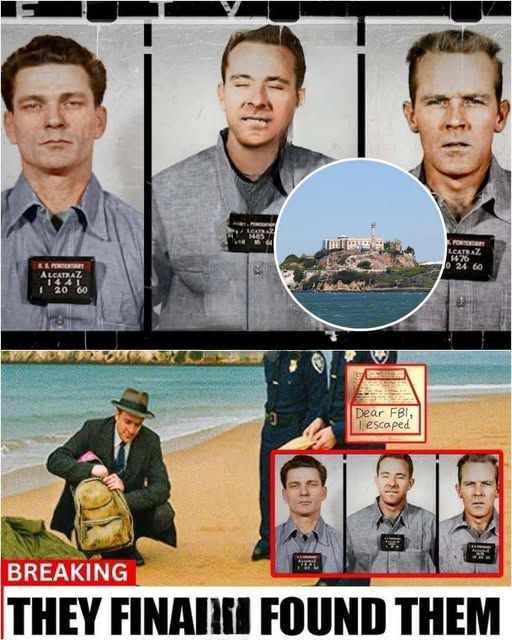
For more than half a century, the escape from Alcatraz has fascinated, frustrated, and captivated the American imagination. In the early hours of June 11, 1962, three men—Frank Morris, along with brothers John and Clarence Anglin—vanished from the most secure prison in the country. Official reports claimed they drowned in the icy waters of San Francisco Bay, yet no bodies were ever recovered. This lack of evidence allowed the story to occupy the murky space between legend and reality, sparking endless debates, movies, and documentaries.
Now, more than 55 years later, previously overlooked evidence, combined with new investigative techniques, suggests the impossible may have happened: the three men survived.
The Infamous Escape of 1962
Alcatraz Federal Penitentiary, located on a rocky island in San Francisco Bay, was designed to hold the country’s most dangerous and incorrigible criminals. Its reputation for inescapability was earned over decades, reinforced by its harsh isolation and the freezing, shark-infested waters that surrounded it.
Frank Morris, known for his intelligence and resourcefulness, and the Anglin brothers, who were determined and inventive, meticulously planned their breakout. Their preparations included crafting crude tools from everyday objects, such as spoons and saw blades, to widen vents and loosen cell walls. They molded lifelike dummy heads using a mixture of soap, toothpaste, and hair to fool the nightly guards, and they stitched together a makeshift raft from over 50 raincoats.
On the night of June 11, the three men climbed through the widened air vents, navigated a network of utility corridors, and emerged on the roof of the cellhouse. From there, they made their way to the shore, launched the raft, and disappeared into the foggy expanse of the bay.
The following morning, prison officials discovered the empty cells and the dummy heads, triggering a massive manhunt. Coast Guard boats, police teams, and helicopters scoured the waters and surrounding areas. Yet, despite exhaustive searches, no trace of the men was found. The official conclusion: they likely drowned. But over the years, suspicion and speculation persisted.
Clues That Were Overlooked
The official narrative held for decades, in part because investigators focused heavily on the assumption that survival was impossible. But several clues suggested otherwise:
- Ocean Debris: Small pieces of material linked to the escape were discovered in locations that aligned with tidal currents moving away from the bay rather than directly into it. Early investigators miscalculated these currents, assuming that anyone escaping by raft would have been swept into open water. New oceanographic analysis indicates that, under the right conditions, a carefully timed escape could have allowed the men to reach shore safely.
- Family Testimonies: Over the years, the Anglin family has maintained that the brothers survived. They cited anecdotal evidence such as untraceable phone calls and Christmas cards allegedly received from the brothers years after the escape. These claims were long dismissed as wishful thinking, but recent investigations have begun to give them more credibility.
- Letters from Frank Morris: A letter allegedly written by Morris surfaced decades later, claiming he survived and had lived under an assumed identity. While initially disregarded, advances in forensic handwriting analysis and aging technology now suggest the letter may indeed have originated from Morris himself, decades after the breakout.
- Photographs in South America: A photograph was uncovered showing two men bearing a striking resemblance to John and Clarence Anglin, taken several years after the escape. Facial recognition technology confirmed similarities sufficient to merit serious reconsideration by investigators.
The Challenges of Historical Investigation
Investigating an event that occurred more than half a century ago presents unique challenges. Many witnesses are no longer alive, physical evidence is scarce, and memories fade or become distorted over time. Yet, modern technology—particularly digital forensics, oceanographic modeling, and facial recognition—allows investigators to revisit cold cases with unprecedented accuracy.
In the Alcatraz case, these tools provided fresh insight. Ocean current simulations suggested the men could have paddled to Angel Island, a small landmass within San Francisco Bay, or even reached the northern California coast. Forensic analysis of letters and photographs added a layer of credibility to previously dismissed claims.
Even law enforcement officials admitted that the old assumption of drowning was never fully proven. Instead, it became a convenient narrative to close the case. For decades, the public was told one story, but the truth may have been far more remarkable.
The Human Element
Part of what makes the Alcatraz escape so compelling is the human story behind it. Frank Morris and the Anglin brothers were not only prisoners but also skilled individuals who demonstrated extraordinary ingenuity under extreme constraints. Their planning involved months of effort, patience, and secrecy. They took calculated risks that most would deem impossible.
This daring act resonates with the public imagination. The escape is often portrayed as the ultimate David versus Goliath story: three men outsmarting a powerful institution. Their survival, if confirmed, would not only vindicate their skill but also challenge long-held assumptions about what is possible.
Cultural Impact and Media Coverage
The Alcatraz escape has inspired books, films, and documentaries for decades. It has become part of American folklore, symbolizing ingenuity, persistence, and the allure of freedom. The story has appeared in popular culture, from Clint Eastwood films to investigative documentaries, cementing its place in the national imagination.
Netflix and other streaming platforms have also revisited the case, blending historical analysis with modern investigative techniques. These programs allow new generations to explore the mystery and participate in ongoing discussions about the escape’s outcome.
The Legacy of Alcatraz
Alcatraz is now a museum, attracting hundreds of thousands of visitors each year. Its cells remain frozen in time, preserved as a testament to the men who were deemed irredeemable yet managed to challenge the system. The escape remains the pinnacle of Alcatraz lore—not only for its audacity but also for the possibility that the men actually survived.
For prison historians, the case is a reminder that systems can be fallible, assumptions can mislead, and legends may be closer to reality than previously believed. The story also underscores the importance of revisiting historical events with a critical eye, incorporating new evidence and technology to challenge long-held conclusions.
What the Future Holds
If further evidence confirms that Morris and the Anglin brothers survived, it would fundamentally rewrite a chapter of American criminal history. It would demonstrate that even the most secure institutions are vulnerable to human ingenuity and that legends often have a basis in fact.
While definitive proof—such as DNA confirmation—may never be obtained, the combination of letters, photographs, and tidal modeling has created a compelling case for survival. The story continues to evolve, inviting researchers, historians, and the public to reconsider what they think they know about one of the greatest prison escapes in history.
Conclusion
For 55 years, the Alcatraz escape occupied the gray area between myth and reality. What was once considered a doomed attempt may, in fact, have been a brilliant and successful operation. Newly uncovered letters, photographs, and oceanographic evidence suggest that Frank Morris and the Anglin brothers could have survived, challenging decades of official conclusions.
Alcatraz remains a symbol of confinement, fear, and order, yet the story of the escape reminds us that ingenuity and determination can triumph over even the most formidable obstacles. Whether or not the men survived, their daring acts have left an indelible mark on American history, inspiring fascination and admiration for generations.
This case reminds us that history is not always written by truth but sometimes by what is convenient to believe. After 55 years, the escape from Alcatraz may no longer be just a legend—it may very well be the greatest prison break in American history, and it may have actually worked.