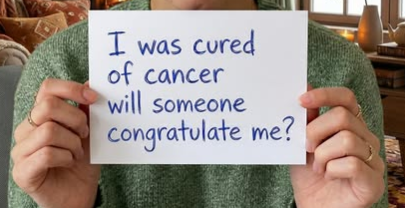
I didn’t expect silence… not after everything I had been through.
Somehow, I thought the hardest part was behind me. The treatments, the pain, the long nights filled with fear—those were supposed to be the real battle. I believed that once it was all over, life would return to normal. That I would feel relief. Closure. Maybe even happiness.
But I was wrong.
Being told I was “cured” didn’t feel like the ending of my story. It felt like stepping into something unfamiliar—something I didn’t know how to face.
The Quiet After the Storm
The day after I wrote the note, I left it on the kitchen table without saying a word. There was nothing dramatic about it. No big announcement, no emotional scene. I simply walked away and sat by the window, watching the world outside.
Snow was falling gently, covering the street in a soft white blanket. Everything looked calm, untouched, almost perfect. It was the kind of peaceful scene people write about in books or capture in photographs.
But inside me, there was no peace.
My thoughts were loud, restless. My chest felt heavy, like I was carrying something I couldn’t explain. I kept staring outside, hoping that maybe if I focused hard enough on the quiet beauty of the snow, something inside me would settle.
It didn’t.
When the Truth Is Finally Seen
A few hours later, my mom found the note.
I heard the faint scrape of a chair from the kitchen. Then silence.
Not just any silence—but the kind that fills a room completely. The kind that presses against your ears and makes your heart beat louder.
Then her voice.
“Emily…” she called softly.
I didn’t answer right away. My throat tightened, and suddenly, I wasn’t sure what I wanted anymore. Did I want her to understand? Or was I afraid that she finally would?
She walked into the room slowly and sat beside me. I could feel her presence before I even looked at her. Her eyes lingered on me—on the visible signs of everything I had gone through. The bruises that hadn’t fully faded. The bandage that still marked where healing was happening. The subtle ways I had changed.
“I didn’t know you felt like this,” she said quietly.
The Weight of Unspoken Feelings
That sentence hit harder than I expected.
Not because it was wrong—but because it was completely true.
How could she have known?
I hadn’t said anything. I hadn’t given her the words, the space, or even the permission to see what I was really feeling. On the outside, I had done what everyone expected. I smiled when I needed to. I nodded when people told me how strong I was. I accepted their congratulations, their relief, their belief that everything was finally okay.
But inside, things were different.
“I didn’t know how to say it,” I whispered. “Everyone looks at me and sees that I’m okay now. But I’m not… not really.”
Saying those words out loud felt strange, like I was breaking a rule I didn’t even know existed. As if admitting I wasn’t okay somehow erased everything I had survived.
My mom reached for my hand.
For a brief moment, I hesitated.
Not because I didn’t want comfort—but because it felt unfamiliar. Like I had forgotten how to let someone in. Like closeness itself had become something I needed to relearn.
Eventually, I let her hold my hand.
The Pressure of Being “Strong”
“You’re strong,” she said.
It was something I had heard many times before. From doctors. From friends. From people who didn’t even know me.
At first, those words felt encouraging. They gave me something to hold onto when things were at their worst.
But now… they felt different.
I shook my head slowly.
“I’m tired of being strong.”
The words came out softer than I expected, but they carried more truth than anything else I had said.
Strength had become something people placed on me—something they expected me to carry without question. But no one talked about how heavy it was.
No one talked about what happens when you don’t want to be strong anymore.
A Different Kind of Fear
Tears filled my mom’s eyes, and for the first time, I saw something I hadn’t noticed before.
She was scared too.
Not in the same way I had been—but in her own quiet, constant way.
“I was afraid,” she said, her voice breaking. “Every day, I was afraid of losing you. So when the doctor said you were cured… I thought I could finally breathe again. I thought we could all just… move on.”
Her words hung in the air between us.
Move on.
It sounded so simple. So logical. Like a natural next step.
But nothing about this felt simple.
When Healing Isn’t the End
The truth is, healing doesn’t always look the way people expect.
There’s this idea that once the hardest part is over, everything falls back into place. That life resumes where it left off. That the pain fades and is replaced by gratitude and relief.
And yes, there is gratitude.
There is relief.
But there’s also confusion. And exhaustion. And moments where you don’t recognize yourself anymore.
Because surviving something difficult changes you.
It reshapes how you think, how you feel, how you connect with others. It leaves behind questions that don’t have easy answers.
Who am I now?
What do I do with everything I’ve been through?
Why don’t I feel the way I thought I would?
Learning to Speak Again
Sitting there beside my mom, I realized something important.
This wasn’t about going back to who I used to be.
That version of me didn’t exist anymore.
And maybe that wasn’t a bad thing.
But it meant I had to learn how to exist in a new way. To understand myself again. To find words for feelings I had never had before.
“I don’t think I can just move on,” I said quietly.
My mom squeezed my hand gently.
“Then we won’t,” she replied. “We’ll take it one step at a time.”
The Beginning of Something New
For the first time in a long while, I didn’t feel pressure to pretend.
There was no expectation to be strong. No need to have everything figured out.
Just a quiet understanding that healing isn’t a straight line—and that being “okay” doesn’t happen overnight.
Sometimes, the hardest part isn’t surviving.
It’s learning how to live afterward.
Moving Forward, Slowly
That day didn’t fix everything.
I didn’t suddenly feel better. The confusion didn’t disappear. The heaviness didn’t lift all at once.
But something changed.
I wasn’t alone in it anymore.
And maybe that’s where real healing begins—not in the moment you’re told you’re cured, but in the moments when you allow yourself to be honest about how you truly feel.
Even if it’s messy.
Even if it’s uncertain.
Even if it takes time.