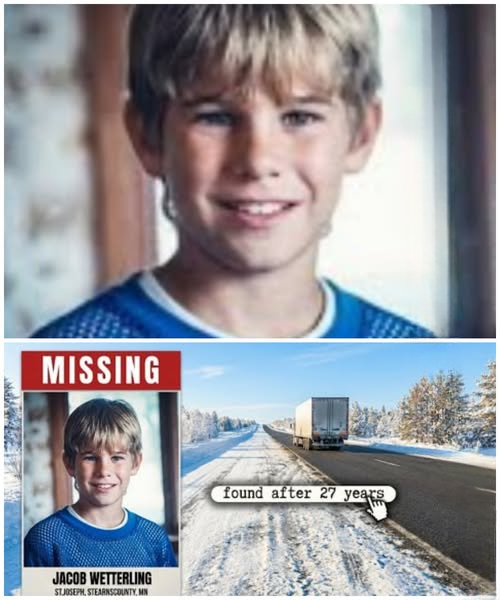
On an ordinary Sunday evening in October 1989, a quiet Minnesota town became the center of one of the most significant criminal investigations in modern American history. What began as a short bike ride turned into a decades-long search that would reshape federal law, transform forensic science, and permanently change how the United States tracks sexual offenders.
It started with a missing child.
It ended with a national legal revolution.
A Small Town, a Simple Plan, and a Life Interrupted
In the town of St. Joseph, Minnesota, life in the late 1980s moved at a slower, more trusting pace. Families left doors unlocked. Children rode bikes freely through neighborhoods and rural roads without fear. Crime, especially violent crime against children, felt distant—something that happened in larger cities, not here.
On October 22, 1989, 11-year-old Jacob Wetterling asked permission to ride his bicycle with his younger brother Trevor and a friend, Aaron. Their destination was a small convenience store less than a mile away.
It was a simple trip.
A familiar route.
A routine moment that should have ended in laughter and snacks.
Jacob never returned home.
The Moment Everything Changed
As the boys made their way back, a masked man suddenly emerged from the darkness along a rural road. He was armed and controlled the situation within seconds.
He ordered the children off their bikes.
He forced them into a ditch.
Then he asked a chilling question—how old each of them was.
After identifying Jacob as the oldest, the man separated the boys. Trevor and Aaron were told to run into the woods and not look back. They obeyed.
Jacob was taken.
And in that moment, a routine evening transformed into a federal kidnapping investigation.
A Massive Search Begins
Within hours, local law enforcement responded. By morning, the case escalated dramatically. The FBI joined the investigation, and the rural landscape of Stearns County became an active search zone.
Roadblocks were established. Helicopters scanned fields. Search dogs tracked every possible scent. Volunteers and officers combed through miles of farmland, forests, and gravel roads.
Despite the massive effort, there was no clear trace of Jacob.
No vehicle description beyond vague details.
No reliable eyewitnesses.
No physical evidence left behind.
Just three bicycles abandoned on a dirt road.
The case quickly went cold in terms of immediate leads—but not in urgency.
A Critical Missed Connection
Nine months before Jacob’s abduction, another violent incident had occurred nearby in Cold Spring, Minnesota. A masked attacker had abducted and assaulted a 12-year-old boy, later releasing him alive.
That survivor provided key information. A description. A composite sketch. And crucial physical evidence, including DNA.
But at the time, investigative tools were limited. DNA databases were not yet widely operational. There was no unified system connecting similar crimes across counties or states.
Because of this, the possible connection between the Cold Spring assault and Jacob’s disappearance was not fully recognized early enough.
That gap would prove devastating.
A Family Refuses to Give Up
As weeks turned into months, and months into years, Jacob’s family refused to let his name fade into statistics.
They organized searches, raised awareness, and pushed lawmakers to address gaps in child protection laws. Their advocacy would eventually lead to one of the most important legislative reforms in U.S. history.
In 1994, Congress passed the Jacob Wetterling Crimes Against Children and Sexually Violent Offender Registration Act.
This law required states to create sex offender registries for the first time, establishing a national framework to track convicted offenders.
It was a turning point in American law enforcement.
But it did not bring Jacob home.
The Cold Case That Refused to Die
For more than two decades, the case remained unsolved. Investigators periodically revisited leads, interviewed suspects, and preserved evidence for future testing.
Then technology changed everything.
In the early 2000s, forensic DNA analysis advanced dramatically. Evidence collected years earlier from the Cold Spring assault was re-examined and entered into CODIS—the national DNA database.
For the first time, investigators could connect crimes across decades with scientific certainty.
And a name began to appear repeatedly in the background of the investigation:
Danny Heinrich
He had been questioned early in the case.
He had lived in the region during the time of the abduction.
And he had a criminal history involving child-related offenses.
Still, no direct evidence linked him to Jacob—until DNA testing changed the equation.
The Breakthrough That Ended 27 Years of Uncertainty
In 2015, forensic testing finally produced a match. DNA from the earlier Cold Spring case matched Heinrich’s genetic profile.
It was a critical breakthrough.
Investigators now had a scientifically verified connection tying him to violent crimes involving children in the same region and timeframe.
He was arrested and charged in federal court.
Facing overwhelming forensic evidence, Heinrich agreed to cooperate with investigators.
The Confession and the Recovery
In 2016, Danny Heinrich confessed to abducting Jacob Wetterling in 1989.
He led investigators to a remote rural area near Paynesville, Minnesota. Using ground-penetrating radar and forensic excavation techniques, authorities confirmed what had long been feared.
Jacob’s remains were recovered.
He had been buried less than 30 miles from where he disappeared.
After 27 years, the case was finally closed.
But the emotional weight of the discovery left a lasting impact on the community and the nation.
What the Investigation Revealed
The Wetterling case exposed several critical failures in early child abduction investigations:
- Lack of centralized national databases for suspects
- Limited DNA technology in the late 1980s
- Weak inter-agency communication between counties and states
- Inconsistent tracking of sex offenders before federal registry laws
- Missed opportunities to connect related cases early
These gaps allowed a dangerous offender to avoid detection for decades.
How One Case Changed an Entire System
The impact of Jacob Wetterling’s case extended far beyond Minnesota.
It directly influenced major reforms, including:
- Creation of national sex offender registration systems
- Expansion of “Megan’s Law” notification requirements
- Improved DNA evidence preservation protocols
- Strengthened federal child exploitation laws
- Enhanced interstate law enforcement cooperation
Today, modern missing child response systems are fundamentally shaped by lessons learned from this case.
A Legacy Built From Loss
The Wetterling case is often studied in law enforcement training not only for what happened—but for what it changed.
It demonstrates how:
- Early investigative limitations can delay justice for decades
- Forensic science can eventually solve even the oldest cases
- Family advocacy can reshape national legislation
- Cold cases remain solvable with evolving technology
Final Reflection
On a quiet October night in 1989, a child left home for a short bike ride.
That moment set off a chain of events that would take nearly three decades to resolve.
Justice came late—but it came with undeniable clarity, revealing the truth and transforming the legal system in the process.
The case of Jacob Wetterling is no longer just a missing child investigation.
It is a turning point in American criminal justice history.
And a reminder that even in the darkest cases, evidence does not disappear—it waits.