Most people interact with coins almost automatically. They pass from hand to hand without much thought—a quick payment at a store, spare change dropped into a jar, or something to fidget with absentmindedly during a quiet moment. Coins feel ordinary, almost too familiar to question.
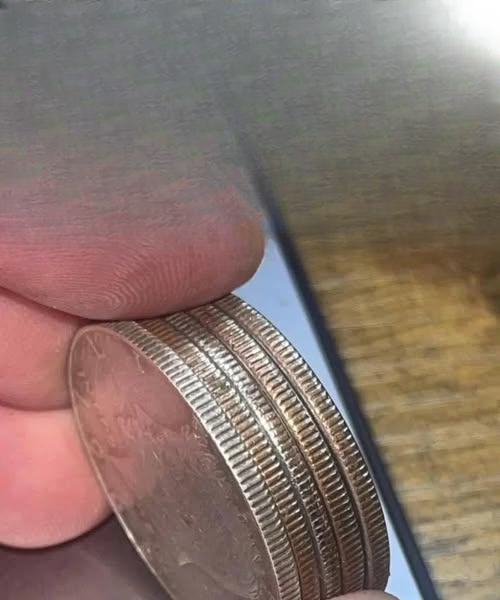
But if you slow down and pay attention for just a second, there’s a small detail that stands out. Run your finger along the edge of many coins, and you’ll notice a series of fine, evenly spaced ridges. They aren’t accidental. They aren’t decorative. They are precise, deliberate, and deeply rooted in history.
These grooves exist for a reason—and that reason traces back to a time when money itself could be quietly diminished without anyone immediately noticing.
To fully understand why coins look and feel the way they do today, it helps to step back into a period when currency was fundamentally different from what we use now. In earlier centuries, coins weren’t just symbolic representations of value. They were the value. Made from precious metals like silver and gold, their worth was directly tied to the material they contained.
And that made them vulnerable in a very specific way.
When Money Could Be Slowly Stolen
Centuries ago, particularly in early modern Europe, a widespread and surprisingly subtle form of financial crime took hold. It was known as coin clipping.
The idea behind it was simple. Individuals would take coins made of precious metals and shave off extremely small amounts from their edges. These tiny fragments—barely noticeable on their own—would be collected over time. Once enough material had been gathered, it could be melted down and reused or sold.
The altered coins didn’t immediately appear suspicious. They still looked legitimate. They still circulated as normal. To the average person, nothing seemed out of place. But in reality, each coin had been slightly reduced in value.
Individually, the loss was minimal. But across thousands or even millions of transactions, the impact became significant. The system was being drained gradually, almost invisibly.
This wasn’t theft in the dramatic sense. There were no confrontations or obvious signs of wrongdoing. Instead, it was a quiet erosion of trust—one that operated beneath the surface of everyday commerce.
As clipped coins continued to circulate, problems began to grow. Merchants became wary. Governments saw reductions in the effective value of currency. People started to question whether the money they received was truly worth what it claimed to be.
Over time, the issue escalated from a minor nuisance to a serious economic concern.
A System Under Pressure
The challenge of coin clipping wasn’t just about individual acts of dishonesty. It was about the structure of the monetary system itself. As long as coins were made from valuable metals and had smooth edges, they were inherently susceptible to this kind of manipulation.
Authorities attempted to address the problem through punishment. Severe penalties were introduced, and those caught clipping coins faced harsh consequences. But enforcement alone proved insufficient.
The core issue remained: the crime was difficult to detect. A slightly shaved coin could easily pass through countless hands without raising suspicion. The risk of being caught was relatively low compared to the potential reward.
Eventually, it became clear that a different approach was needed. Instead of relying solely on punishment after the fact, the system itself had to be redesigned to prevent the problem from occurring in the first place.
This shift in thinking marked an important moment in the evolution of financial security.
A Practical Solution Emerges
By the late 1600s, efforts to reform currency systems were gaining momentum. In England, one of the key figures involved in addressing the issue was Isaac Newton. While widely recognized today for his work in science and mathematics, Newton also played a significant role in monetary reform during his tenure at the Royal Mint.
Faced with widespread counterfeiting and coin clipping, he approached the problem analytically. Rather than focusing only on punishing offenders, he looked for a way to eliminate the opportunity for the crime altogether.
The solution he helped implement was remarkably straightforward: change the physical design of coins.
Instead of leaving edges smooth, coins were produced with finely detailed grooves along their circumference. These became known as reeded edges.
At first glance, the change might seem minor. But its impact was immediate and profound.
How Ridges Changed Everything
The introduction of ridged edges transformed coins into self-monitoring objects. With a consistent pattern running along the edge, any attempt to shave off even a small amount of metal would disrupt that pattern.
A clipped coin would no longer look—or feel—the same. The alteration would be obvious to anyone paying attention. What had once been a nearly invisible act became much easier to detect.
In effect, the coin itself became a built-in security mechanism.
This innovation worked not because it was complicated, but because it made tampering visible. It shifted the balance by removing the subtlety that had allowed coin clipping to thrive.
Instead of relying on external enforcement, the design of the currency itself acted as a deterrent.
It was an early example of embedding security directly into an object—an idea that continues to influence modern design in many fields.
Why Ridges Still Matter Today
Today, coins are no longer made from precious metals in the same way they once were. Their value is largely symbolic, backed by governments rather than intrinsic material worth. Given that, it might seem unnecessary to maintain features designed to protect against metal theft.
And yet, those ridges remain.
There are several reasons for this.
First, modern coins still need to be verified as authentic. Many systems—such as vending machines, transit systems, and automated counters—rely on physical characteristics to identify valid coins. Edge patterns play a role in this process, helping distinguish genuine currency from counterfeit versions.
Second, ridges serve an important accessibility function. For individuals who are blind or visually impaired, the texture of a coin’s edge can help identify its denomination. Different coins often have distinct edge designs, allowing them to be recognized by touch alone.
What began as a defense against theft has evolved into a feature that supports usability and inclusion.
The Role of Smooth Edges
Not every coin has ridges. In many currencies, lower-value coins are intentionally left with smooth edges.
This distinction is not accidental. Historically, coins with little intrinsic metal value were not worth clipping. There was no meaningful profit to be gained from shaving them down.
As a result, adding ridges to these coins was unnecessary.
Over time, this created a subtle visual and tactile hierarchy within currency systems. Higher-value coins were more likely to have ridged edges, while lower-value ones remained smooth.
Even in modern times, this pattern often persists, reflecting its practical origins.
A Feature Hiding in Plain Sight
One of the most interesting aspects of coin ridges is how rarely people notice them. They are part of everyday life, yet they exist just below the level of conscious awareness.
Most people don’t stop to consider why coins feel the way they do. The grooves are simply accepted as part of the object.
And yet, they represent a solution to a very real and historically significant problem.
Long before digital security systems, encryption, or advanced fraud detection, there was a simple idea: make tampering visible.
It’s a reminder that effective solutions don’t always require complexity. Sometimes, the most durable innovations are the ones that are straightforward and intuitive.
A Broader Insight About Design
The story of coin ridges also illustrates a larger principle about how systems evolve.
When a weakness is exploited repeatedly, responses often shift from reactive to proactive. Instead of addressing problems only after they occur, designers look for ways to prevent them entirely.
In the case of coin clipping, laws and punishments were not enough. The system had to change.
By altering the design of coins, the opportunity for undetected tampering was dramatically reduced. The problem didn’t disappear entirely, but it became far more difficult to execute.
This approach—embedding safeguards directly into design—appears in many areas today. From secure packaging to digital authentication systems, the goal is often the same: make misuse obvious or impossible.
A Quiet but Lasting Legacy
The ridges on a coin may seem insignificant, but they carry a legacy that stretches back centuries. They are a physical reminder of a time when trust in money had to be reinforced through design.
They also reflect a shift in thinking—one that prioritized prevention over reaction, and simplicity over complexity.
Today, those tiny grooves continue to serve practical purposes, even as the nature of currency has changed. They help machines function, support accessibility, and maintain continuity with the past.
The Next Time You Hold a Coin
It’s easy to overlook small details, especially in objects we use every day. But sometimes, those details have deeper stories behind them.
The next time you pick up a coin, take a moment to notice its edge. Feel the ridges. Consider what they represent.
They are not just a design choice. They are a solution to a problem that once threatened the stability of entire economies.
They show how a simple adjustment can have a lasting impact.
And they remind us that some of the most effective protections are the ones we barely notice—quietly doing their job, day after day, without drawing attention to themselves.
In a world filled with complex systems and advanced technology, it’s worth remembering that even the smallest details can carry powerful ideas.
Sometimes, all it takes is a slight change in shape to protect something much larger.
And sometimes, the most important innovations are the ones we feel—but rarely stop to see.