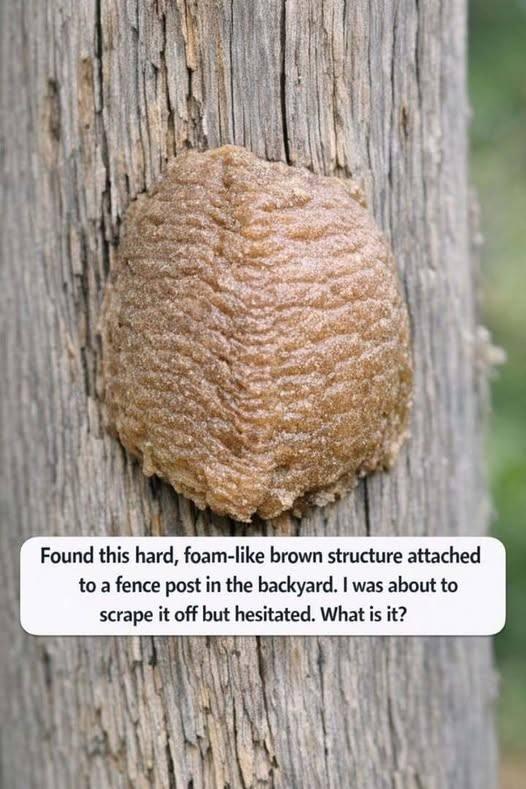
While it might look like something you should scrape away immediately, that strange, foam-like brown mass attached to your fence post could actually be one of the most beneficial things you’ll ever find in your backyard. At first glance, it may seem out of place or even a little concerning. Many people assume it is a nest, fungus, or some kind of unwanted growth. But in reality, what you have discovered is likely a natural structure created by one of the most fascinating insects in North America: the praying mantis.
This unusual object is known as an ootheca, or egg case. It serves as a protective enclosure for hundreds of developing mantis eggs, carefully designed by nature to survive harsh weather and potential predators. Instead of being something harmful, it is actually a sign that your outdoor space is part of a healthy, balanced ecosystem.
When people first encounter this brown, hardened foam structure, their instinct is often to remove it. Its texture resembles dried insulation or expanding foam, and its shape can be irregular, making it look artificial or even invasive. However, taking a closer look reveals a highly sophisticated natural design. The outer shell is firm and slightly ridged, built to withstand rain, cold temperatures, and even curious animals.
The formation of this egg case is a remarkable process. During late summer or early fall, the female praying mantis produces a frothy substance from her body. As she lays her eggs, she coats them in this foam, which quickly hardens when exposed to air. Inside, the structure contains dozens to hundreds of small compartments, each holding a single egg. This ensures that the next generation is safely protected throughout the winter months.
One of the most surprising aspects of finding an ootheca is what it represents for your yard or garden. praying mantis are known as beneficial predators. They feed on a wide variety of common pests, including flies, mosquitoes, moths, crickets, and caterpillars. For homeowners and gardeners, this makes them incredibly valuable allies. Instead of relying on chemical pesticides, having mantises nearby can help naturally control insect populations.
This natural form of pest management is particularly appealing for those looking to maintain an eco-friendly outdoor space. The presence of an egg case suggests that your environment supports beneficial wildlife. It means that your garden may soon host dozens, or even hundreds, of tiny hunters ready to keep pest populations in check.
You might be wondering where these egg cases are usually found. While fence posts are a common location, they can appear in many different places. Female mantises choose spots that offer both protection and proximity to future food sources. These locations often include shrubs, tall grass, sturdy plant stems, wooden rails, and even outdoor furniture. The goal is to keep the eggs safe while ensuring that the young mantises will have access to food as soon as they hatch.
Despite how unusual it may look, there is no need to worry about safety. An ootheca is completely harmless to humans, pets, and structures. It does not damage wood, spread disease, or attract dangerous insects. In fact, removing it could do more harm than good by destroying the developing insects inside.
Inside a single egg case, there can be anywhere from 100 to 400 eggs. Throughout the winter, these eggs remain dormant, protected by the tough outer shell. As temperatures begin to rise in spring, development resumes. Eventually, the case will open, and the young mantises will emerge.
The hatching process is one of nature’s most fascinating events. In mid to late spring, tiny mantis nymphs begin to emerge from the case, often all at once. At first, they appear pale and delicate, but within a short time, they darken and become more active. Each one looks like a miniature version of an adult mantis, complete with the characteristic front legs used for hunting.
Once they emerge, the young mantises quickly disperse into the surrounding area. This is an important step, as it reduces competition for food. They begin hunting almost immediately, feeding on small insects and continuing the cycle of natural pest control.
If the egg case happens to be in an inconvenient location, it is possible to move it safely. However, this should be done with care. Instead of scraping it off, it is better to gently remove the surface it is attached to, such as a small twig or piece of wood. The case can then be relocated to a sheltered area, like a bush or shrub. It is important to keep it oriented the same way, with the top facing upward, to avoid disrupting the development inside.
One reason many people hesitate when they first see an ootheca is because it can be confused with other objects. Wasp nests, for example, are typically gray and papery, with visible openings. Fungus tends to be softer, sometimes moist, and lacks the structured ridges seen in mantis egg cases. The ootheca, on the other hand, is firm, dry, and foam-like, with a consistent tan or brown color.
Understanding these differences can help you identify what you are looking at and avoid unnecessary concern. Instead of seeing it as something strange or unwanted, you can recognize it as a small but important part of the natural world.
There is also something uniquely rewarding about observing an ootheca over time. It offers a rare opportunity to witness a complete life cycle unfolding right in your own backyard. From the stillness of winter to the sudden burst of life in spring, it is a reminder of how much activity happens in nature, often unnoticed.
For families, especially those with children, it can become an educational experience. Watching the egg case and learning about the life cycle of the praying mantis can spark curiosity and appreciation for the environment. It transforms something that might have been removed or ignored into a moment of discovery.
In a world where many people are increasingly disconnected from nature, small encounters like this can be meaningful. They encourage observation, patience, and a deeper understanding of the ecosystems around us. Instead of relying on artificial solutions for garden problems, recognizing and supporting beneficial insects can lead to healthier and more sustainable outdoor spaces.
Ultimately, that strange brown structure on your fence post is not something to fear or remove. It is a sign of life, resilience, and balance. It represents a future generation of insects that will play an important role in maintaining the natural order of your yard.
So before reaching for a scraper, consider leaving it exactly where it is. With time, it will transform from a quiet, motionless object into a lively burst of activity. And when that moment comes, you will have the chance to witness one of nature’s most fascinating processes right outside your door.