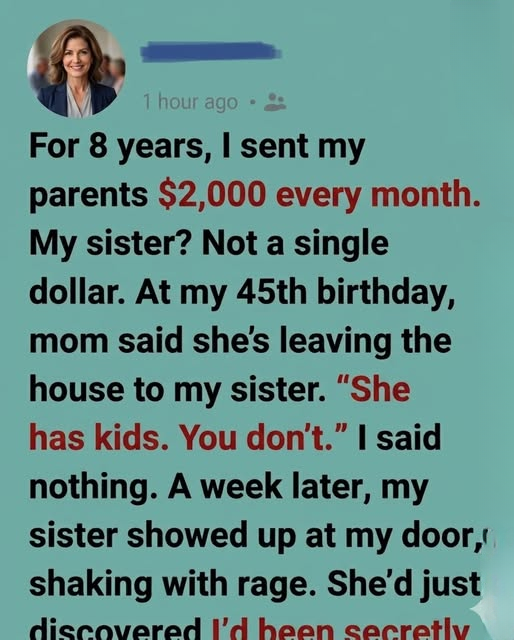
She stood in the doorway, arms crossed, waiting for an explanation she clearly believed I owed her. The tension in the room felt thick enough to touch. Outside, the evening light was fading, but inside everything felt sharper, louder, heavier.
I leaned against the frame and tried to steady my breathing.
There are truths that become harder to tell the longer you keep them hidden. What starts as silence turns into habit. Then habit becomes part of your identity. After enough years, speaking the truth feels less like confession and more like tearing open a wall you built with your own hands.
“I’ve been paying it,” I said at last.
My voice came out quieter than I expected.
“Paying what?” she asked.
“The house. The mortgage. The overdue bills. The balances they couldn’t catch up on. Every month.”
She stared at me, waiting for the rest.
“For eight years.”
The words landed between us like something dropped from a height.
Her expression changed instantly. The anger she entered with disappeared, replaced by disbelief so complete it almost looked like confusion.
Then she laughed.
Not because it was funny.
Because it sounded impossible.
“No,” Claire said, shaking her head. “That’s not true. It can’t be true.”
“It is.”
“Mom would have told me.”
“She didn’t.”
“Dad would have said something.”
“He didn’t.”
“You really expect me to believe they hid something like that from me?”
I stepped back and gave her room, though there wasn’t enough space in the house for what this conversation had become.
“They didn’t want you to worry,” I said. “And maybe they didn’t want to explain why I was the one handling it.”
She frowned.
“What is that supposed to mean?”
“It means they were drowning,” I replied. “And I was the only one who noticed how deep the water was.”
How It Started
People imagine life-changing decisions as dramatic moments.
A phone call in the middle of the night. A signature on an important document. A speech. A final argument. A suitcase packed by the front door.
But sometimes life changes quietly.
Sometimes it begins with noticing unopened envelopes on the kitchen counter.
That’s how it started for me.
I had come over for dinner one Sunday. Mom was pretending everything was normal. Dad was quieter than usual. They smiled too quickly and changed subjects too often.
When I went to throw something away, I saw the stack of letters.
Past due.
Final notice.
Urgent response required.
I didn’t say anything then. I just tucked the details into the back of my mind and drove home with a feeling I couldn’t shake.
A week later, I came back and found Dad in the garage staring at nothing.
He admitted they were behind.
More behind than I realized.
The mortgage had slipped. Credit cards were maxed. Utilities were late. They had been juggling payments, moving money around, hoping the next month would be easier.
It wasn’t.
“How bad is it?” I asked.
He didn’t answer directly.
That told me enough.
The First Payment
I told myself I would help once.
Just enough to catch them up.
Just enough to give them breathing room.
I transferred the money that night.
It was more than I could comfortably afford, but I had savings and no children yet. I thought sacrifice was temporary. I thought problems had edges.
The next month there was another shortage.
Then another.
Then car repairs.
Then medical bills.
Then insurance increases.
Then interest piling onto old balances.
Somewhere along the way, helping once became helping always.
No ceremony marked the change.
No one sat down and said, “This is your responsibility now.”
It simply became true.
What No One Saw
Claire lived two towns away by then. She visited on birthdays and holidays. She brought desserts, flowers, cheerful stories, and left believing our parents were doing fine.
Why wouldn’t she?
The lights stayed on.
The house was clean.
Dinner was warm.
Dad still made jokes.
Mom still insisted everyone take leftovers home.
That is the thing about struggle inside families: it is often hidden beneath routine.
People assume stability because they see appearances.
They don’t see who stayed up comparing bills.
They don’t see who skipped vacations.
They don’t see who postponed their own plans to keep everyone else comfortable.
They don’t see the quiet cost of being dependable.
My Own Life on Hold
There were years I almost bought a place of my own.
Years I nearly started a business.
Years I could have traveled more, invested more, saved more.
Each time I came close, something happened.
A tax bill.
A furnace replacement.
A hospital deductible.
A missed payment that would damage their credit.
I kept telling myself next year.
Next year I would focus on me.
Next year they would recover.
Next year I would stop being the bridge holding everything up.
But bridges don’t choose when people stop crossing them.
They just keep carrying weight.
Back to the Doorway
Claire was still standing there, searching my face for signs of exaggeration.
“Why didn’t you tell me?” she asked.
Because there are some questions with too many honest answers.
Because I didn’t want to embarrass them.
Because I didn’t want resentment.
Because I thought you would judge them.
Because I thought you would judge me.
Because I got used to carrying it alone.
Because once silence protects everyone, breaking it feels selfish.
Instead I said the simplest truth.
“Because they needed help.”
She looked away.
“That can’t be the only reason.”
“It’s enough of one.”
What She Didn’t Know About Sacrifice
People often think sacrifice feels noble.
Sometimes it does.
Most of the time it feels ordinary.
It looks like saying no to things no one knows you wanted.
It looks like checking your account before buying something small.
It looks like pretending you are fine when you are tired.
It looks like being reliable for so long that others mistake it for ease.
No applause comes with it.
No certificate arrives in the mail.
Usually, no one even notices.
And maybe that’s why her anger stung more than I expected. She had come to accuse me of being distant lately, of skipping family dinners, of acting cold.
She thought I had withdrawn out of selfishness.
She didn’t know I was exhausted.
The Truth About Resentment
I wish I could say I helped with a perfectly pure heart every month.
That would be a cleaner story.
But real love is rarely clean.
There were times I felt proud to protect them.
There were times I felt trapped.
Times I sent money gladly.
Times I stared at the screen before clicking transfer.
Times I envied friends whose parents still helped them instead of the other way around.
Times I hated myself for feeling that envy.
Love and resentment can live in the same room.
Duty and fatigue can share the same name.
You can be grateful for your family and burdened by them at once.
That complexity is hard to admit, especially to yourself.
Claire Sat Down
The fight had drained out of her.
She lowered herself onto the step outside my door and rested her elbows on her knees.
“I really didn’t know,” she said.
Her voice was quiet now.
Not defensive.
Not sharp.
Just stunned.
“I know.”
“Why didn’t they ask me?”
I considered the question carefully.
Maybe because she had children and a tighter budget.
Maybe because they still saw her as the younger one.
Maybe because I never gave them a reason to ask anyone else.
Maybe because families fall into roles and then confuse those roles for destiny.
“I don’t know,” I said.
But I knew enough.
Family Roles We Never Choose
Every family develops invisible assignments.
One person becomes the peacemaker.
One becomes the achiever.
One becomes the funny one.
One becomes the difficult one.
One becomes the dependable one.
These roles form slowly, often without discussion. Then everyone begins living around them as if they were facts of nature.
I became the dependable one.
The person who answered calls.
The person who fixed paperwork.
The person who stayed calm.
The person who would somehow handle it.
At first, being needed feels meaningful.
Eventually, it can feel like being taken for granted.
What Changed Everything
People might think the decision that changed everything was the first payment.
It wasn’t.
The real turning point happened in that doorway when I finally said the truth out loud.
Secrets shape relationships even when no one knows them.
They create distance.
They turn kindness into quiet bitterness.
They make misunderstandings grow in the dark.
By speaking, I changed the story Claire believed about me.
But I also changed the story I believed about myself.
I was not obligated to disappear inside the role I had been given.
I was allowed to be seen.
The Conversation After
We talked for hours.
Really talked.
Not the shallow family version full of updates and weather and jokes.
The real version.
She asked how much I had paid over the years.
I told her enough.
She asked why I never asked for help.
I told her I didn’t know how.
She cried once, briefly and angrily, wiping her face before the tears could become a scene.
I admitted I was tired.
That may have been the hardest sentence of the night.
She said she was sorry.
Not in a dramatic way.
In a sincere, quiet way that matters more.
What Happens Next
People always want endings tied neatly with ribbon.
The family gathers.
Everyone apologizes.
Money problems vanish.
Old wounds heal by breakfast.
Life is rarely that cooperative.
Our parents were embarrassed when they learned I had told her.
Claire was hurt they had hidden it.
I was relieved and uneasy at the same time.
There were awkward weeks.
Hard conversations.
New boundaries.
Shared responsibilities.
Practical plans.
Nothing magical.
Just honest work.
Sometimes that is better than a miracle.
Lessons I Learned Too Late
If I could speak to the version of myself from eight years ago, I would say this:
Helping is generous.
Helping in silence can become dangerous.
Love does not require self-erasure.
Resentment grows where honesty is absent.
Being strong is not the same as being alone.
Family support should be shared, not assumed.
And people cannot appreciate burdens they do not know exist.
I would also tell that younger version to ask for help sooner.
Final Thoughts
The hardest part was never the money.
It wasn’t the transfers, the skipped opportunities, or the years spent carrying what others didn’t see.
The hardest part was being misunderstood while doing it.
But one decision changed everything: I stopped protecting the silence more than I protected myself.
Sometimes the things holding a family together are invisible.
And sometimes healing begins the moment those invisible things are finally named.