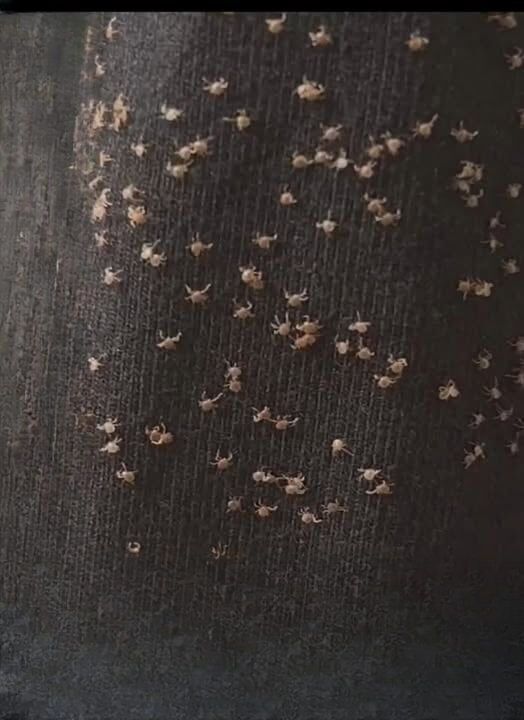
At first, it feels like nothing more than a minor annoyance. You return from a walk through grass or woodland edges, and there they are—tiny specks, burrs, or fuzzy fragments stubbornly attached to your socks, trousers, or your dog’s fur. Most people instinctively brush them off without a second thought. But those small hitchhikers are not random debris. They are part of one of nature’s most efficient travel systems, designed to move life across landscapes using anything that passes by.
What you’re seeing are seeds built for transportation. And in many cases, their design is so precise that it rivals human engineering.
These seeds are part of a broader ecological strategy called dispersal, and more specifically, a form known as epizoochory—where seeds travel by attaching to the outside of animals. Humans, pets, livestock, and wildlife all become accidental carriers. Every step you take through tall grass or along a trail becomes an opportunity for plants to extend their reach far beyond where they originally grew.
The logic behind this is rooted in survival. Plants cannot walk, crawl, or relocate when conditions become harsh. If all their seeds fell directly beneath them, the new plants would face immediate competition for sunlight, water, and nutrients. Over time, that would weaken the population. So evolution solved the problem in a surprisingly elegant way: make the seeds mobile.
Some of the most recognizable hitchhikers are burr-producing plants like burdock. Their seed heads are covered in tiny hooks that latch onto fabric, fur, or even hair with surprising strength. If you’ve ever tried to remove one, you’ll know how stubborn they can be. Those hooks are not accidental—they are finely tuned structures shaped over thousands of generations.
In fact, their design inspired one of the most widely used inventions in modern life: Velcro. Engineers studying burdock burrs realized that nature had already solved the problem of temporary adhesion. Tiny hooks that catch and release easily when needed became the blueprint for a fastening system used everywhere from shoes to spacecraft.
Other plants use different strategies. Some rely on fine hairs that weave into fabric fibers. Others produce sticky coatings that cling to almost any surface. Some seeds are sharp enough to lodge into soft materials like socks or animal paws, ensuring they travel long distances before falling away.
These adaptations are not just clever—they are highly strategic. Each plant species has evolved to exploit a specific type of movement. Fields, forests, roadsides, and even urban parks become corridors for dispersal. Wherever animals or humans move regularly, seeds follow.
Interestingly, this means that human activity has become part of natural seed distribution networks. Hiking trails, dog walking routes, and even farm paths now act as invisible highways for plant migration. Without realizing it, we help shape which plants spread, where they grow, and how ecosystems evolve over time.
This can have both positive and negative effects. On one hand, seed dispersal increases biodiversity by helping plants colonize new areas. On the other, it can also spread invasive species, especially when seeds travel far outside their native environments. In this way, a simple walk in nature becomes part of a much larger ecological chain reaction.
Pets play a particularly important role in this process. Dogs, with their thick fur and constant movement through varied environments, are excellent seed carriers. After a walk, their coats can hold dozens or even hundreds of seeds, many of which fall off later in entirely different locations. This turns pets into unintentional ecological transporters, linking habitats that might otherwise remain separate.
From a human perspective, these seeds often feel like a nuisance. They stick to clothing, scratch skin, or embed themselves in socks. But from a biological standpoint, they are remarkably successful survival tools. A single seed that travels even a few hundred meters away from its parent plant dramatically increases its chances of growing in a new, less competitive environment.
This strategy also helps plants recover after disturbances. In areas affected by construction, fire, or heavy foot traffic, fast-spreading hitchhiking plants are often the first to arrive. They stabilize soil, reduce erosion, and create conditions that allow other species to follow. In this sense, clinging seeds are not just travelers—they are ecological pioneers.
There is also something quietly impressive about the timing of it all. These seeds do not move on their own schedule. They move when we move. Every walk, run, or outdoor activity becomes a trigger for dispersal. Without intention or awareness, we become part of their life cycle.
Even clothing plays a role. Certain fabrics attract more seeds than others. Rough textures like wool or fleece provide ideal surfaces for hooks and fibers to latch onto. Smooth materials, on the other hand, tend to resist attachment. This is why some outdoor clothing manufacturers design fabrics specifically to reduce seed clinging, especially for hikers and workers in natural environments.
Removing seeds after a walk is more than just a matter of comfort. It also helps prevent unwanted spread into gardens or sensitive ecosystems. A quick check of socks, cuffs, and pet fur can significantly reduce accidental dispersal into areas where those plants might not naturally belong.
Yet despite these practical concerns, there is something worth appreciating in this interaction. It is one of the simplest examples of how deeply interconnected life on Earth really is. Plants depend on movement. Animals and humans provide it. Without realizing it, we become part of a system that has existed long before us and will continue long after.
Every clinging seed carries a small story of survival. It represents a plant’s attempt to reach further, grow stronger, and outlast competition. It is nature’s way of turning motion into opportunity.
So the next time you notice tiny seeds stuck to your clothing or your dog’s fur, it might be worth pausing for a moment before brushing them away. What seems like dirt or debris is actually a finely tuned piece of biological engineering—one that has quietly shaped ecosystems for millions of years.
A simple walk outside, then, is never entirely simple. It is part of a larger exchange between movement and growth, between species that travel and species that cannot. And in that exchange, even the smallest seed plays a surprisingly important role.
The Quiet Aftermath of a Walk Through Nature
If you look closer at these clinging seeds, you start to notice that they don’t just represent movement—they represent timing. Each species has evolved to release its seeds at exactly the moment when passing animals or humans are most likely to carry them. Some are more active in late summer and autumn, when fur is thicker and clothing layers increase. Others peak in spring, when fresh growth and outdoor activity begin again.
This timing isn’t accidental. It’s a refined biological rhythm shaped by environmental pressure. Plants that released seeds too early or too late simply failed to spread as effectively. Over countless generations, natural selection favored those that synchronized their life cycle with the movement patterns of animals.
There is also a subtle intelligence in how these seeds detach. If they clung permanently, they would never reach new soil. If they fell off too easily, they would not travel far enough. So most hitchhiking seeds exist in a narrow balance—strong enough to endure a long walk, but loose enough to drop eventually when conditions change.
That “eventually” is where the real success happens. A seed may travel across a field, down a road, or into a completely different habitat before finally falling off in a quiet patch of soil. There, it waits. Rain, sunlight, and temperature determine whether it will awaken and grow. The journey only ends when the next phase of life begins.
From an ecological perspective, this process is incredibly efficient. Instead of relying on wind, water, or animal digestion alone, these plants outsource movement entirely to contact. It requires no energy from the plant once the seed is formed—only design.
Even the structure of human environments now unintentionally supports this system. Parks, hiking trails, rural paths, and even roadside verges create continuous zones where movement and vegetation overlap. Every time people or animals pass through, they become part of a silent exchange, carrying genetic material across distances without noticing.
And while we often think of nature as something separate from daily life, these seeds show the opposite. Nature is constantly interacting with us, even in the smallest ways. A step through grass is not just a step—it is a moment of transfer, connection, and redistribution.
What makes this even more fascinating is that some plants have evolved specialized strategies depending on their “preferred carriers.” Seeds designed for mammals tend to be sturdier and more heavily hooked, while those relying on birds or smaller animals may be lighter and easier to detach. This variation suggests a kind of biological targeting system, where plants indirectly “select” the type of traveler that will best spread their offspring.
Over time, this has shaped entire landscapes. Areas with heavy foot traffic often develop distinct plant communities dominated by hitchhiking species. Meanwhile, untouched regions may rely more on wind or water dispersal. The result is a patchwork of ecosystems shaped not only by climate and soil, but by movement itself.
Even in urban environments, this process continues quietly. Seeds attach to shoes, bicycle tires, dog fur, and clothing, moving between parks, gardens, and vacant lots. In a sense, cities have become modern ecosystems where human motion replaces animal migration routes.
There is something almost poetic about this. Without planning or awareness, we participate in the spread of life. Every walk, every outing, every trip outdoors becomes part of a system that has been operating for millions of years.
And while we usually notice these seeds only when they become inconvenient, they are actually reminders of something much larger: that movement is life’s oldest strategy for survival.