For a few long seconds, everything else faded away.
The trees, the trail behind us, even the distant sounds of birds overhead—all of it disappeared as my son and I stood frozen, staring at something just off the path. We had been hiking for most of the morning, following one of our usual weekend routes through a dense stretch of forest near home. It was meant to be quiet, predictable—nothing out of the ordinary.
That changed instantly when my son grabbed my arm.
“Dad…” he said quietly.
There was something in his voice that made me stop without question. I followed his gaze down to the ground—and felt a sharp jolt of unease.
Something was sticking out of the soil.
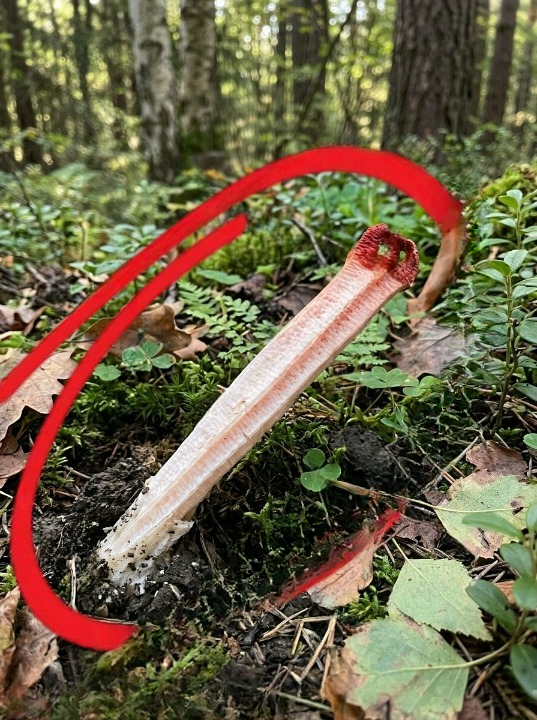
At first glance, it looked disturbingly like a human hand.
The shape was wrong, but close enough to trigger something instinctive. Long, red “fingers” stretched upward, twisted and uneven, as if they had pushed their way out of the earth. The surface looked slick in the morning light, and the color was unsettlingly vivid.
My son moved closer to me, pressing against my side. I could feel his tension without him saying a word.
“It’s okay,” I said, though I wasn’t convinced myself.
Then came the smell.
It was faint, but unmistakable—something sour, like damp soil mixed with decay. That only made the situation feel more alarming. My mind immediately began filling in possibilities I didn’t want to consider.
For a moment, I didn’t move.
Every instinct told me to turn around and leave. But curiosity held me there.
I carefully pulled out my phone and crouched down, keeping a bit of distance. The object didn’t move. No sign of life. No sound. Just that strange, unsettling shape.
I took a photo.
Then another.
“What is it?” my son asked softly.
“I’m not sure yet,” I replied.
On a hunch, I opened a plant identification app and scanned the image. I wasn’t expecting much—but after a brief pause, a result appeared:
Clathrus archeri
Common name: Devil’s fingers.
I stared at the screen, then back at the ground.
“It’s… a fungus,” I said, almost laughing from relief.
My son blinked. “Wait—seriously?”
“Yeah,” I said, exhaling. “It just looks terrifying.”
I read a bit more. The fungus starts underground in a small, pale “egg.” When it matures, it bursts open and sends out those red, finger-like structures. The smell, the color, the shape—it’s all intentional. It mimics decaying matter to attract insects, which then help spread its spores.
In other words, it’s designed to look exactly like something we’re wired to avoid.
My son crouched down beside me, now more curious than afraid. “So it’s not dangerous?”
“No,” I said. “Just really good at being creepy.”
He let out a small laugh, the tension finally breaking.
We stayed there for another moment, watching as small insects moved across the strange structure. It was doing exactly what it was meant to do—playing its role in a system far older and more complex than we usually think about.
Eventually, I stood up and gently guided him back toward the trail.
As we walked, he kept glancing back.
“So it tricks bugs?” he asked.
“Yeah.”
“That’s kind of smart.”
I smiled. “Nature usually is.”
The rest of the hike felt different.
Not dangerous—but deeper somehow. Like the forest had quietly revealed something unexpected. Every patch of ground seemed to hold possibilities we hadn’t noticed before.
My son stayed closer to me, but not out of fear anymore. More out of awareness. Like he was seeing the world with new eyes.
And I couldn’t stop thinking about how quickly our minds jump to conclusions. How easily we turn the unknown into something frightening. A strange shape becomes a threat. A shadow becomes something alive.
All because we don’t understand it yet.
By the time we reached the end of the trail, the fear had faded completely, replaced by something else—respect.
Before we left, my son asked one last question.
“Do you think there are more things like that out there?”
I looked back at the forest, quiet and full of hidden life.
“I think there’s a lot we don’t see,” I said. “And even more we don’t understand.”
He nodded, thoughtful.
And as we drove home, one thing felt clear:
The forest hadn’t changed.
But the way we saw it had.