At first glance, the puzzle seems incredibly simple.
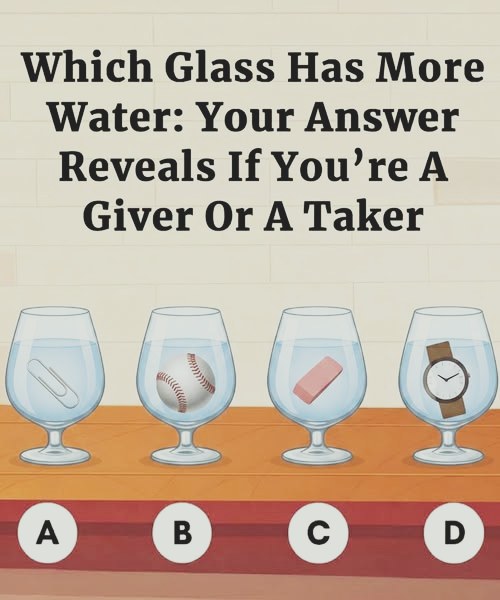
Four glasses labeled A, B, C, and D appear to be filled to exactly the same water level. Inside each glass sits a different object:
- Glass A contains a paperclip
- Glass B contains a baseball
- Glass C contains an eraser
- Glass D contains a wristwatch
The question sounds straightforward:
Which glass actually contains the most water?
Most people immediately assume the answer is “all of them” because the visible water level looks identical. But this puzzle is designed to test something deeper than eyesight—it tests whether you notice the hidden factor changing the entire situation.
The Key Concept: Displacement
The puzzle works because of a simple scientific principle called Displacement.
When an object is placed into water, it takes up space inside the container. That means the larger the object, the less room remains available for water itself.
So even if all four glasses appear equally full from the outside, they do not actually contain the same amount of water.
The objects inside each glass completely change the answer.
Breaking Down Each Glass
Glass B — Baseball
The baseball takes up a large amount of space inside the glass.
Because it displaces so much water, Glass B actually contains far less water than the others, even though the surface level appears the same.
Glass D — Wristwatch
The wristwatch is also relatively bulky and occupies a noticeable amount of volume.
That means it pushes out more water than smaller objects would.
Glass C — Eraser
The eraser falls somewhere in the middle.
It displaces some water, but not nearly as much as the baseball or wristwatch.
Glass A — Paperclip
This is the important one.
The paperclip is extremely small and takes up very little space inside the glass. Because it displaces the least amount of water, Glass A is able to contain the greatest actual volume of water.
The Correct Answer
✅ Glass A contains the most water.
Since all glasses appear filled to the same height, the one with the smallest object inside must logically hold the largest amount of water.
Sometimes the smallest detail changes everything.
Why So Many People Get It Wrong
This puzzle confuses people because the human brain naturally relies on visual shortcuts.
When we see identical water levels, the brain quickly assumes:
“Same height = same amount.”
That shortcut helps us process information quickly in everyday life, but puzzles like this are designed to expose those automatic assumptions.
Instead of relying on appearance alone, the puzzle forces you to think analytically and consider what is happening beneath the surface.
The Psychology Behind It
This type of thinking relates to a cognitive tendency often connected to visual assumption and pattern recognition.
Human brains constantly simplify complex information to save time and energy. Usually that works well—but sometimes hidden variables completely change the answer.
The puzzle demonstrates how easily appearances can mislead us when important details are overlooked.
What About the “Personality Test” Part?
Like many viral puzzles online, personality meanings are often attached to the answers.
For example:
- Choosing Glass A is sometimes linked to analytical thinking and attention to detail
- Choosing Glass B may be associated with instinctive or fast decision-making
- Glass C is often described as balanced thinking
- Glass D is sometimes tied to intuition or creativity
However, these interpretations are mainly for entertainment. They are not scientifically proven personality assessments.
The Bigger Lesson
What makes this puzzle interesting is that it reflects something much larger than water and objects in glasses.
It reminds us that:
- Appearances are not always complete
- First impressions can be misleading
- Small hidden details can completely change reality
In many situations, the most important information is not what we immediately notice—it’s what lies underneath the surface.
Final Thought
The glass puzzle may look simple, but it reveals an important truth about perception and critical thinking.
Sometimes what seems obvious at first glance is only part of the story.
And in this case, the smallest object—the paperclip in Glass A—quietly holds the biggest answer.