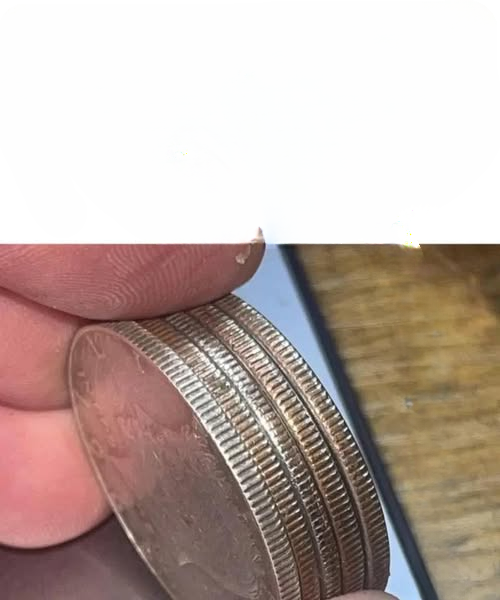
Most people handle coins every day without paying much attention to the tiny details built into them. Coins get tossed into pockets, dropped into jars, fed into parking meters, or forgotten between couch cushions. But if you stop and examine certain coins closely—especially quarters and dimes—you’ll notice something unusual around the edges:
tiny ridges.
At first glance, they seem purely decorative. Many people assume they’re just part of the coin’s design or manufacturing process.
But those ridges actually have a fascinating purpose rooted in history, crime prevention, and the protection of entire economies.
Why Coins Once Had Real Intrinsic Value
Today, most coins are worth far more as currency than as metal.
But centuries ago, coins were different.
Many were made from:
- gold,
- silver,
- or other precious metals.
That meant the metal itself carried genuine value.
A gold or silver coin wasn’t simply symbolic money—it was literally worth the value of the material it contained.
And wherever valuable materials exist, people eventually look for ways to exploit them.
The Problem of Coin Clipping
One of the oldest forms of financial fraud was something called:
Coin Clipping
Criminals discovered they could shave tiny slivers of metal from the edges of coins.
Because coins circulated constantly:
- small missing amounts often went unnoticed,
- and the coin could still be spent normally.
Over time, fraudsters collected enough shaved gold or silver to melt down and profit from.
The process looked harmless on individual coins:
- just a thin scrape,
- a slightly smoother edge,
- a barely noticeable reduction in size.
But across thousands of coins, the losses became enormous.
Why This Was a Serious Economic Problem
Coin clipping didn’t just hurt individual people.
It damaged trust in the entire money system.
As clipped coins spread:
- merchants became suspicious,
- coin weights became inconsistent,
- and economies faced instability.
People began questioning whether coins truly contained the amount of precious metal they were supposed to have.
That uncertainty threatened commerce itself.
The Brilliant Solution: Ridged Edges
To stop clipping, governments introduced a simple but highly effective idea:
Reeded Edges
Those tiny ridges around coins are officially called:
reeding.
The ridges made tampering immediately visible.
If someone shaved metal from the edge:
- the ridges would disappear,
- the pattern would look damaged,
- and the fraud became obvious.
Instead of smooth edges that could be quietly trimmed, coins now had built-in evidence protection.
It was essentially an early anti-counterfeiting technology.
A Small Design With Huge Impact
The invention worked surprisingly well.
Ridged edges:
- discouraged clipping,
- restored confidence in coinage,
- and protected precious metal supplies.
Even though the ridges are tiny, they represented a major advancement in financial security during a time when coins powered entire economies.
Why Some Coins Have Ridges and Others Don’t
If you look carefully at modern American coins, you’ll notice:
- quarters and dimes have ridges,
- but pennies and nickels have smooth edges.
Why?
Because historically:
- quarters and dimes contained silver,
- while pennies and nickels were made from less valuable metals.
The ridges were mainly necessary on coins with higher precious-metal value.
Even though modern coins are no longer made primarily from silver or gold, the tradition continues today.
The History Goes Back Centuries
Reeded coin edges became more common during the 16th and 17th centuries as governments searched for ways to combat widespread coin tampering.
Advances in minting technology allowed coins to be produced with more consistent:
- shapes,
- sizes,
- and edge patterns.
This made fraud easier to detect.
Some early coins even included:
- lettering,
- patterns,
- or inscriptions around the edge
for additional security.
The Technology Behind the Ridges
Modern coin ridges are created during the minting process using specialized machinery.
A collar die surrounds the coin blank as it is stamped.
This collar presses the edge pattern into the coin while the front and back designs are struck simultaneously.
The process is precise and highly standardized.
Ridges Still Serve a Purpose Today
Even though modern coins no longer contain large amounts of precious metal, ridges remain useful.
They help:
- distinguish coins by touch,
- assist visually impaired individuals,
- prevent counterfeiting,
- and preserve historical tradition.
For example:
- a quarter’s ridged edge feels very different from a nickel’s smooth edge.
Coin Design Is Full of Hidden Details
The ridges are just one example of how much thought goes into coin production.
Coins also include:
- specific textures,
- precise weights,
- exact diameters,
- and carefully engineered alloys.
These details help maintain consistency and security in national currency systems.
The Psychological Power of Small Details
What makes the ridges fascinating is how invisible they become in everyday life.
Millions of people touch coins daily without ever wondering why those grooves exist.
Yet behind that tiny feature lies:
- economic history,
- criminal ingenuity,
- government innovation,
- and centuries of financial evolution.
It’s a reminder that ordinary objects often carry hidden stories.
A Design Feature That Survived the Modern World
Today, digital payments dominate much of commerce.
People increasingly use:
- phones,
- credit cards,
- online transfers,
- and mobile apps.
Yet coin ridges remain almost unchanged from centuries ago.
They are one of the few design elements that survived from the era when money was literally made from precious metals.
Final Thoughts
Those tiny ridges on coins may seem insignificant, but they were originally created to solve a massive problem that once threatened trust in entire economies.
By making coin tampering immediately visible, reeded edges helped protect:
- trade,
- currency systems,
- and the value of money itself.
What looks like a small decorative detail is actually a centuries-old security feature—one born from the constant battle between innovation and fraud.
So the next time you hold a quarter or dime in your hand, take a closer look.
You’re not just looking at spare change.
You’re holding a tiny piece of economic history.