Most humans understand personal space.
Dogs, however, operate by very different social rules.
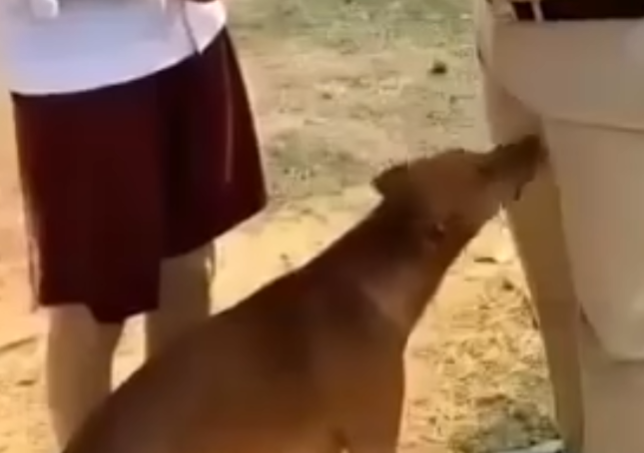
Many dog owners have experienced an awkward moment when a dog suddenly walks up and begins sniffing someone’s crotch. While embarrassing for people, experts say the behavior is usually completely natural for dogs and is closely tied to their extraordinary sense of smell.
To dogs, sniffing is not rude behavior—it is one of the primary ways they gather information about the world around them.
A Dog’s Sense of Smell Is Extremely Powerful
The nose of a Dog is vastly more advanced than a human nose.
Humans possess roughly six million scent receptors.
Dogs can have up to 300 million.
In addition, a much larger portion of a dog’s brain is devoted to processing smells, allowing them to detect scents at levels humans cannot even imagine.
This incredible ability explains why dogs are often trained for tasks such as:
- Search and rescue
- Detecting narcotics
- Finding missing persons
- Detecting medical conditions
- Identifying explosives
For dogs, smell functions almost like an additional language.
The Role of the Jacobson’s Organ
Dogs also possess a specialized sensory structure called the Jacobson’s organ.
Located above the roof of the mouth, this organ helps detect pheromones—chemical signals released naturally by humans and animals.
These pheromones can provide dogs with information about:
- Mood
- Stress levels
- Health changes
- Age
- Reproductive status
In other words, dogs gather social and biological information through scent in ways humans largely cannot perceive.
Why Dogs Target the Crotch Area
The reason dogs often sniff people’s crotches is surprisingly simple.
Humans have concentrated sweat glands called apocrine glands located primarily in areas such as:
- Armpits
- Groin regions
These glands release stronger scent signals and pheromones.
Since dogs cannot easily reach most people’s armpits, the groin area becomes the most accessible source of scent information.
To the dog, this behavior is not inappropriate—it is simply an efficient way to identify and understand someone.
Similar to How Dogs Greet Each Other
Dogs commonly sniff each other’s rear ends as a normal social greeting.
This behavior functions almost like a canine introduction or handshake.
When dogs sniff humans, they are often engaging in the same instinctive information-gathering process.
They may be trying to determine:
- Who you are
- Whether you are familiar
- Your emotional state
- Changes in your body chemistry
Some breeds with especially strong scent abilities, such as Bloodhound, Beagle, and Basset Hound, may show this behavior more intensely.
Dogs Can Detect Biological Changes
Experts note that dogs may become especially curious during times when human body chemistry changes noticeably.
This can include:
- Pregnancy
- Menstruation
- Illness
- Hormonal fluctuations
- Physical exertion
While humans may not notice these subtle chemical changes, dogs can detect them very easily.
This same scent-detection ability has helped some trained dogs identify medical conditions such as:
- Low blood sugar
- Certain cancers
- Seizure activity
How to Redirect the Behavior Politely
Although natural, the behavior can still make people uncomfortable.
Animal behavior experts generally recommend redirection rather than punishment.
One commonly used training method is called “touch” or “target” training.
The process works like this:
- Present a closed fist to the dog
- Reward the dog when it touches the hand with its nose
- Add a verbal cue such as “Touch”
- Practice consistently using positive reinforcement
Over time, owners can redirect a dog’s attention away from guests and toward the trained greeting behavior instead.
Why Punishment Usually Doesn’t Help
Because sniffing is instinctive communication for dogs, harsh punishment can create confusion or anxiety rather than stopping the behavior effectively.
Positive reinforcement tends to work better because it teaches dogs what owners want them to do instead.
Consistency and patience are usually far more effective than scolding.
Understanding the Behavior Helps Reduce Embarrassment
Many dog owners feel embarrassed when this behavior happens publicly, but experts emphasize that dogs are not attempting to be disrespectful or inappropriate.
They are simply interacting with the world using the sensory system evolution gave them.
To humans, the behavior feels socially awkward.
To dogs, it is basic communication.
Final Thoughts
The sniffing habits of Dog reveal just how differently animals experience the world compared to humans.
What may seem strange or embarrassing to people is often completely normal canine behavior driven by instinct, biology, and an incredibly advanced sense of smell.
With patience, training, and understanding, owners can gently redirect these habits while still respecting the natural ways dogs explore and communicate.
Because for dogs, scent is more than curiosity—
It is how they understand the world and the people around them.