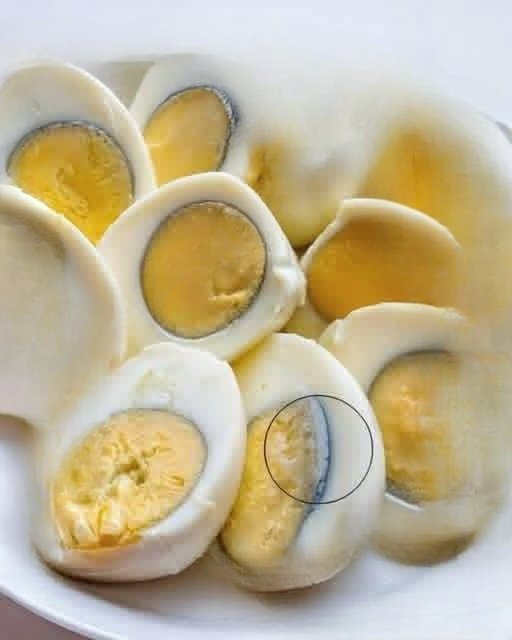
There are few kitchen disappointments more frustrating than peeling what looks like a perfectly cooked hard boiled egg, slicing it open, and discovering that strange greenish-gray ring wrapped around the yolk. For many people, that moment immediately raises concern. Has the egg spoiled? Was it bad before cooking? Is it still safe to eat?
Surprisingly, the answer has nothing to do with freshness or contamination.
That mysterious ring is actually the result of a completely harmless chemical reaction — and once you understand what causes it, you can prevent it almost every single time.
The Science Behind the Green Ring
Inside every egg are two important elements that normally stay separate:
- The egg white contains sulfur
- The yolk contains iron
When eggs are exposed to excessive heat for too long, the sulfur and iron begin reacting together. This creates a compound called iron sulfide, which forms the dull green or gray layer around the yolk.
In other words, the ring is not rot, mold, or spoilage.
It is simply chemistry.
The egg is still safe to eat, although the texture and flavor may suffer slightly. Overcooked eggs tend to develop:
- Dry, chalky yolks
- Rubbery whites
- A stronger sulfur smell
The discoloration is basically your egg telling you it spent too much time under intense heat.
Why Most People Accidentally Overcook Eggs
One of the biggest myths in home cooking is the belief that hard boiled eggs need to boil aggressively for 15–20 minutes.
That method almost guarantees overcooking.
Many people leave eggs bubbling violently on the stove because they are worried about undercooked centers. Unfortunately, constant boiling pushes the sulfur and iron reaction into overdrive.
The secret to perfect eggs is not stronger heat.
It is controlled heat.
Professional cooks understand that eggs continue cooking even after the burner is turned off. This is known as carryover cooking, and using it correctly completely changes the final result.
The Foolproof Method for Perfect Hard Boiled Eggs
If you want smooth whites and rich golden yolks without any green ring, follow this simple method carefully.
Step 1: Start With Cold Water
Place your eggs in a single layer inside a pot.
Cover them with cool water until the water sits about 1–2 inches above the eggs.
Starting with cold water helps the eggs heat gradually, which reduces:
- Cracked shells
- Uneven cooking
- Sudden protein tightening
Step 2: Bring to a Gentle Boil
Place the pot over medium heat.
You do not need a violent rolling boil. A steady gentle boil is enough.
Once the water begins boiling consistently:
- Turn OFF the heat completely
- Cover the pot with a lid
This is the step most people skip.
The trapped residual heat is enough to finish cooking the eggs perfectly without overexposing them to extreme temperatures.
Step 3: Let the Eggs Sit
For firm but creamy yolks:
- Let eggs sit covered for 10–12 minutes
For slightly softer centers:
- 9 minutes works well
For extra firm yolks:
- 12 minutes is usually enough
Timing matters more than people realize. Even a few extra minutes can push the yolks into overcooked territory.
Step 4: Immediately Transfer to Ice Water
This is the real game changer.
As soon as the timer ends, move the eggs directly into an ice bath.
Do not let them sit in hot water.
Do not leave them on the counter.
Do not “let them cool naturally.”
Eggs continue cooking internally long after leaving the stove. Without rapid cooling, the trapped heat keeps triggering the sulfur-iron reaction.
The ice bath instantly stops the cooking process.
Leave the eggs in the ice water for at least 5–10 minutes.
This preserves:
- Bright yellow yolks
- Tender whites
- Better texture
- Cleaner flavor
The Unexpected Bonus: Easier Peeling
The ice bath does something else incredibly useful.
It makes peeling dramatically easier.
Rapid cooling causes the egg inside the shell to contract slightly, creating separation between the shell membrane and the egg white.
That tiny gap helps the shell slide off much more cleanly.
If your eggs constantly tear apart during peeling, improper cooling is often the reason.
Does Egg Freshness Matter?
Yes — but not in the way most people think.
Fresh eggs are actually harder to peel when hard boiled.
As eggs age slightly in the refrigerator, their internal pH changes. This weakens the bond between the shell membrane and the white.
That is why eggs that are several days old usually peel better than ultra-fresh eggs.
For the best hard boiled eggs:
- Use eggs about 5–10 days old
- Avoid extremely fresh farm eggs if easy peeling matters
Common Mistakes That Cause Green Yolks
Here are the biggest reasons hard boiled eggs develop discoloration:
1. Boiling Too Long
The number one cause.
2. Using High Heat the Entire Time
Violent boiling overcooks the outer layers before the center stabilizes.
3. Skipping the Ice Bath
Residual heat continues cooking the eggs internally.
4. Leaving Eggs in Hot Water After Cooking
Even with the burner off, hot water can keep cooking eggs too long.
5. Guessing Instead of Timing
Perfect eggs require precision.
A kitchen timer matters more than most people realize.
Why Restaurant Eggs Look Better
Ever notice how restaurant eggs often have:
- Bright golden centers
- Smooth texture
- Easy-to-peel shells
- No green ring
That is not luck.
Professional kitchens rely on:
- Precise timing
- Controlled heat
- Immediate cooling
- Consistent technique
Once you start treating egg cooking as a timing process rather than simply “boiling,” your results improve dramatically.
Can You Still Eat Eggs With a Green Ring?
Absolutely.
The green ring may look unpleasant, but it is completely safe.
The only real downside is texture and appearance.
The eggs may taste:
- Slightly sulfuric
- Drier
- More chalky
But they are not spoiled.
So if you accidentally overcook a batch, there is no need to throw them away.
How to Store Hard Boiled Eggs Properly
After cooling:
- Store eggs in the refrigerator
- Keep them in their shells if possible
- Use within one week
Shell-on eggs stay fresher longer because the shell protects against moisture loss and odor absorption.
If peeled, keep them in an airtight container.
Why This Tiny Kitchen Trick Matters
Hard boiled eggs seem simple, but small technique changes create huge differences.
The difference between:
- Rubbery whites and tender whites
- Chalky yolks and creamy yolks
- Green centers and golden centers
often comes down to only a few minutes and one bowl of ice water.
Once you understand the science, the process becomes incredibly easy.
And suddenly, perfect eggs stop feeling random.
The Final Secret to Perfect Eggs Every Time
If there is one takeaway that changes everything, it is this:
Stop aggressively boiling eggs from start to finish.
Instead:
- Start cold
- Bring to a gentle boil
- Turn off the heat
- Let carryover cooking finish the job
- Shock immediately in ice water
That simple method transforms ordinary hard boiled eggs into smooth, golden, perfectly cooked eggs every single time.
No green ring.
No rubbery whites.
No disappointment when you slice them open.
Just clean, rich, beautiful yolks that look as good as they taste.