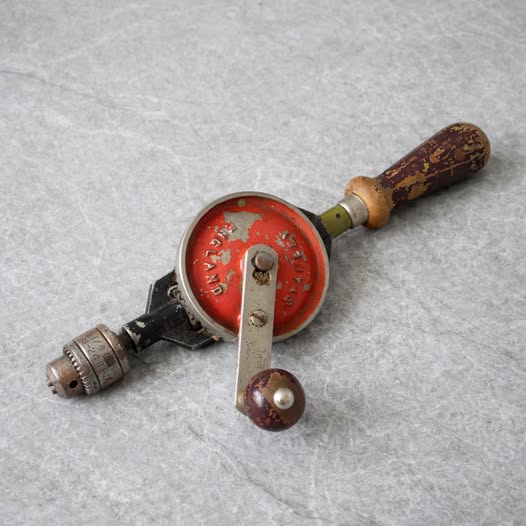
Before cordless power tools, rechargeable batteries, and electric workshops became common, many households relied on something much simpler — and surprisingly effective.
At first glance, it may look like a strange kitchen utensil or antique mechanical gadget.
But older generations often recognize it instantly.
It’s a classic Hand drill, commonly known as an “eggbeater drill” because of its distinctive gear-and-crank design.
For decades, this simple tool was a staple in garages, workshops, and homes around the world.
What This Vintage Tool Actually Is
A mechanical hand drill is a manually powered drilling tool that uses gears and a rotating crank handle to spin a drill bit.
Unlike modern electric drills, it requires no:
- Electricity
- Batteries
- Charging
- Motors
Everything operates entirely through hand power.
The user turns a side crank, which rotates internal gears that spin the drill bit at surprisingly high speed.
The design became famous because the side crank resembles the old-fashioned hand mixers once used in kitchens — giving rise to the nickname “eggbeater drill.”
Why It Was So Popular Before Electric Drills
Before affordable electric drills became common in homes, mechanical hand drills offered an efficient and practical way to perform small drilling jobs.
People used them for:
- Woodworking
- Furniture repairs
- Household maintenance
- Craft projects
- Small metalwork
- Leatherwork
They were especially useful for creating:
- Pilot holes
- Small precision holes
- Controlled drilling in delicate materials
Unlike heavy modern drills, these tools provided excellent control and finesse.
How the Tool Works
The mechanism is surprisingly clever for such a simple-looking device.
The drill includes:
- A main handle for stability
- A side crank for power
- Gears that multiply rotation speed
- A chuck that holds the drill bit
When the user turns the crank:
- The gears rotate rapidly
- The chuck spins the drill bit
- Gentle forward pressure creates the hole
The gear system increases rotational speed while maintaining smooth manual control.
Why Older Craftsmen Loved Them
Many experienced woodworkers and mechanics appreciated hand drills because they allowed more precision than powerful electric tools.
With delicate materials, slower controlled drilling helps prevent:
- Splitting wood
- Damaging surfaces
- Over-drilling
- Losing alignment
Even today, some hobbyists still prefer manual drills for detailed work because they provide better tactile feedback and control.
A Tool From the Industrial Age
The eggbeater-style drill became widely popular during the late 1800s and early 1900s as manufacturing and home craftsmanship expanded.
Companies such as Stanley and many other manufacturers produced millions of versions throughout the 20th century.
Similar models were also manufactured worldwide, including:
- Europe
- The Soviet Union
- North America
- Asia
Because the design was so practical and durable, it remained common for decades even after electric tools became available.
Why Vintage Collectors Still Love Them
Today, these drills are highly popular among:
- Tool collectors
- Antique enthusiasts
- Woodworkers
- Workshop decorators
- Restoration hobbyists
People admire them for:
- Mechanical craftsmanship
- Exposed gears
- Durable metal construction
- Vintage workshop appearance
- Historical value
Many older drills still work perfectly after basic cleaning and lubrication.
That durability is one reason vintage hand tools continue fascinating collectors today.
The Difference Between a Hand Drill and a Brace
Older workshops often contained two different manual drilling tools:
Hand Drill (Eggbeater Style)
Best for:
- Small drill bits
- Speed
- Precision
- Light materials
Brace and Bit
Best for:
- Large holes
- Heavy torque
- Deep drilling in wood
Skilled craftsmen often used both depending on the task.
Why Modern People Often Don’t Recognize It
Younger generations raised around cordless drills and electric tools sometimes struggle identifying these older mechanical devices.
Without context, the drill can resemble:
- A kitchen mixer
- A scientific instrument
- A crank toy
- A sewing tool
But for many older adults, seeing one instantly triggers memories of:
- Family workshops
- Garages
- Home repairs
- Grandparents’ toolboxes
- Simpler pre-digital craftsmanship
Why Hand Tools Still Matter Today
Despite modern technology, many woodworkers and craftsmen still appreciate manual tools because they encourage:
- Precision
- Patience
- Skill development
- Quiet operation
- Mechanical understanding
Unlike power tools, hand tools create a stronger physical connection between the user and the material being worked on.
Many hobbyists describe manual tools as more relaxing and satisfying to use.
Caring for Vintage Hand Drills
Collectors and users often maintain these tools by:
- Cleaning rust carefully
- Oiling gears and moving parts
- Sharpening bits properly
- Protecting wooden handles
- Preserving original paint or patina
With proper care, many century-old drills remain fully functional.
Final Thoughts
The classic Hand drill may look outdated compared to modern cordless power tools, but its design remains remarkably effective even today.
For generations before the 1980s, tools like this were everyday essentials found in countless garages and workshops.
They represent an era when craftsmanship relied more heavily on patience, mechanical skill, and durable hand-built tools rather than electronics and batteries.
And perhaps that is why so many people still feel nostalgic when they see one.
Because it is not just an old tool.
It is a reminder of a time when simple mechanics and human effort were enough to build, repair, and create almost anything.