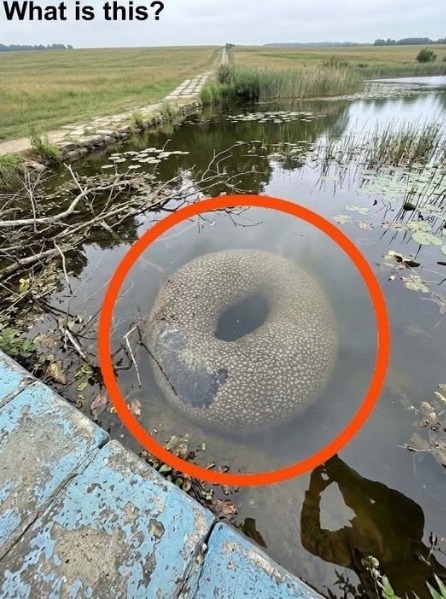
At first glance, it looks like something from a science fiction movie.
A giant jelly mass floating underwater. A strange brain-shaped blob attached to a branch. Some people even mistake it for alien eggs, fish parasites, or a mysterious mutation.
But the truth is far more fascinating.
This bizarre freshwater organism is known as a bryozoan colony, most commonly the species Pectinatella magnifica. Despite its strange appearance, it is completely natural, harmless to humans, and one of the most unusual living systems found in freshwater environments.
Not One Creature — But Thousands Working Together
The most surprising fact about bryozoans is that the giant gelatinous mass is not a single organism.
It is actually a colony made up of thousands of microscopic animals called zooids.
Each zooid is a tiny living creature with:
- Its own mouth
- Digestive system
- Feeding organs
Yet all the zooids remain physically connected and cooperate together inside the same jelly-like structure. In many ways, the colony behaves almost like one giant living organism.
Why Bryozoans Form Colonies
Living alone in freshwater environments can be dangerous for tiny aquatic animals. By forming massive colonies, bryozoans gain several advantages:
- Protection from predators
- Better feeding efficiency
- Greater environmental stability
- Improved reproduction
The soft gelatin surrounding the colony acts like protective armor while still allowing water to circulate freely through the structure.
The “Brain-Like” Appearance Explained
One reason bryozoans attract so much attention online is their strange shape.
As the colony grows, new zooids form around the outer edges while older sections remain near the center. This natural growth pattern creates folds, ridges, and curved lines that resemble:
- A human brain
- Coral formations
- Alien organisms
The patterns are not random. They develop naturally as the colony expands and maximizes feeding space.
How They Feed
Bryozoans survive by filtering microscopic particles from the water.
Each zooid uses tiny tentacles called a lophophore to capture:
- Algae
- Bacteria
- Organic particles
- Microscopic food sources
Because thousands of zooids feed continuously, large colonies can filter impressive amounts of water every day.
This also helps improve water clarity and contributes to freshwater ecosystem balance.
Why They Grow So Large
Under ideal conditions, bryozoan colonies can become enormous — sometimes reaching the size of a basketball or larger.
Warm temperatures, calm water, and abundant nutrients allow colonies to grow rapidly during summer months.
They are commonly found in:
- Lakes
- Ponds
- Slow-moving rivers
- Streams
Most colonies attach themselves to submerged:
- Branches
- Rocks
- Docks
- Tree roots
Stable surfaces help protect the colony from strong currents that could damage the soft structure.
Are Bryozoans Dangerous?
Despite their unsettling appearance, bryozoans are harmless.
They:
- Do not bite
- Do not sting
- Are not poisonous
- Do not attack animals or humans
In fact, scientists often consider them a positive sign.
Bryozoans are sensitive to severe pollution, so their presence usually indicates relatively healthy freshwater conditions.
Their Incredible Survival Strategy
One of the most remarkable features of Pectinatella magnifica is its ability to survive harsh conditions using tiny structures called statoblasts.
Statoblasts function almost like biological seeds.
Before winter or environmental stress arrives, the colony produces these survival capsules. Even if the main colony dies, the statoblasts remain alive and later create entirely new colonies when conditions improve.
This explains why bryozoans often reappear in the same lakes year after year.
Ancient Survivors
Bryozoans are not new organisms.
Scientists believe their ancestors existed hundreds of millions of years ago, making them one of Earth’s oldest colonial animal groups.
Their long survival demonstrates how effective cooperative colony living can be in aquatic ecosystems.
Tiny Ecosystems Inside the Colony
Bryozoan colonies also support other forms of freshwater life.
Small organisms often use the gelatin structure for:
- Shelter
- Protection
- Feeding opportunities
This turns the colony into a miniature ecosystem supporting biodiversity beneath the water’s surface.
Why They Go Viral Online
Whenever photos of bryozoans appear online, confusion quickly follows.
People often assume they are:
- Alien organisms
- Dangerous parasites
- Mutated eggs
- Unknown sea creatures
Their unusual appearance naturally sparks curiosity and fear among people unfamiliar with freshwater biology.
But the reality is much more interesting.
These giant jelly masses are actually highly organized communities of microscopic animals working together in one of nature’s strangest survival systems.
Final Thoughts
What looks like a mysterious underwater “brain” is actually a remarkable example of biological cooperation.
Bryozoans may appear strange, but they play an important role in freshwater ecosystems by filtering water, supporting biodiversity, and adapting through highly specialized survival strategies.
Their bizarre appearance is exactly what makes them so fascinating.
And once you understand what they really are, these strange jelly-like colonies become less frightening — and far more extraordinary.