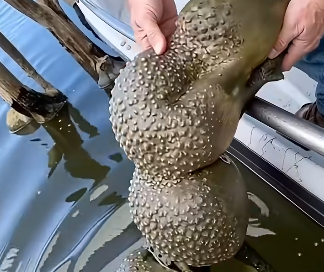
In March 2024, visitors at Oklahoma’s McGee Creek Reservoir noticed something beneath the water that looked more like science fiction than nature.
Attached to submerged branches were large translucent blobs with a soft jelly-like appearance. Their unusual shape immediately sparked curiosity and concern among boaters and anglers who spotted them drifting quietly below the surface.
Some people feared they might be invasive organisms, giant egg sacs, or even dangerous aquatic creatures. Photos quickly spread online as speculation grew.
But the truth turned out to be far less alarming — and far more fascinating.
The Mystery Organism Explained
According to the Oklahoma Department of Wildlife Conservation, the strange formations were actually colonies of bryozoans, tiny freshwater animals that have existed on Earth for hundreds of millions of years.
Although the blobs appear to be single organisms, they are actually massive colonies made up of thousands of microscopic creatures called zooids.
Each zooid is an individual animal with its own digestive system and feeding structures. Together, they function as one coordinated living colony.
Why They Look So Strange
The soft gelatinous appearance comes from a protective outer layer surrounding the colony.
Inside this jelly-like structure, the zooids live safely while filtering microscopic particles from the water. Using specialized feeding organs called lophophores — tiny rings of tentacles — they continuously collect algae, bacteria, and organic matter for food.
This process not only helps the colony survive but also improves water quality by naturally filtering suspended material from the lake.
When underwater, bryozoan colonies feel slippery and soft. Once removed from the water, however, they quickly dry out and become brittle.
Their appearance can vary from nearly transparent to light brown depending on age, sunlight exposure, and environmental conditions.
Completely Harmless to Humans
Despite their unsettling appearance, bryozoans are entirely harmless.
They do not:
- Bite
- Sting
- Produce toxins
- Attack fish or humans
Scientists actually consider their presence a positive environmental sign because bryozoans thrive in relatively healthy freshwater ecosystems.
In McGee Creek Reservoir, calm water, submerged branches, and stable nutrient levels created ideal conditions for colony growth.
Ancient Creatures With Incredible Survival Skills
One of the most remarkable things about bryozoans is their age.
Fossil records suggest their ancestors date back roughly 470 million years to the Ordovician period, making them one of the oldest colonial animal groups still alive today.
They have survived massive environmental changes over hundreds of millions of years through an impressive reproductive strategy involving structures called statoblasts.
Statoblasts act like biological survival capsules:
- They survive freezing temperatures
- Resist drought conditions
- Remain dormant until environments improve
Once conditions become favorable again, entirely new bryozoan colonies can emerge.
This explains why they often reappear in the same lakes year after year.
Tiny Ecosystems Hidden Underwater
Bryozoan colonies do more than simply exist in freshwater environments.
They also:
- Provide shelter for microscopic organisms
- Support aquatic biodiversity
- Help maintain water clarity
- Contribute to freshwater food chains
Small fish and aquatic invertebrates sometimes feed on them, while other tiny organisms live inside or around the gelatinous structures.
In many ways, a single bryozoan colony functions like a miniature underwater ecosystem.
Why People Often Misunderstand Them
Because most people rarely encounter bryozoans, their appearance naturally creates confusion.
Large jelly-like masses attached to branches can easily resemble:
- Alien organisms
- Fish eggs
- Brain tissue
- Parasites
- Invasive species
But scientists emphasize that these colonies are simply a normal — and important — part of many freshwater habitats.
Their strange appearance is less a sign of danger and more a reminder of how much hidden life exists beneath the surface of lakes and rivers.
A Reminder About Nature’s Complexity
The discovery at McGee Creek Reservoir ultimately became an unexpected lesson about freshwater ecosystems.
What initially appeared mysterious and alarming turned out to be an ancient life form quietly performing a valuable ecological role.
Bryozoans have been filtering water and supporting aquatic environments for millions of years, long before humans ever noticed them.
And while their gelatinous blobs may still look strange at first glance, they are actually one of nature’s most fascinating examples of cooperation, survival, and environmental balance.
Sometimes the things that seem most unusual are simply parts of the natural world we have not learned to recognize yet.