Few creatures in the animal kingdom provoke as much fascination—and discomfort—as the remarkable Surinam Toad. Known scientifically as Pipa pipa, this unusual amphibian has evolved one of the most extraordinary reproductive strategies found in nature.
Native to the quiet wetlands and slow-moving waters of South America, the Surinam toad challenges many of our expectations about how animals reproduce and care for their young. With its flattened body, almost leaf-like appearance, and silent movements through muddy ponds, it often goes unnoticed by casual observers.
But hidden beneath its calm exterior is a life cycle so unusual that it has fascinated scientists and nature enthusiasts for decades.
From eggs embedded in living skin to fully formed young emerging from their mother’s back, the story of the Surinam toad is one of evolution’s most astonishing—and unsettling—adaptations.
A Master of Camouflage in Murky Waters
The Surinam toad is perfectly adapted to life in still, murky water.
Its body is extremely flat, helping it blend into the muddy bottoms of ponds, marshes, and flooded forests. Its triangular head and tiny eyes make it look almost like a fallen leaf rather than an animal.
Unlike many frogs and toads, the Surinam toad rarely makes loud calls. Instead, it spends most of its life quietly resting along the bottom of shallow waterways.
This camouflage protects it from predators while also allowing it to ambush small aquatic prey.
Yet despite its quiet lifestyle, its reproductive behavior is anything but ordinary.
The Unusual Mating Ritual
During the breeding season, the male Surinam toad begins a slow and deliberate courtship process.
Unlike the loud croaking displays used by many amphibians, this species relies on subtle physical cues.
The male approaches the female and gently clasps her in a mating position known as amplexus, a behavior common among frogs and toads.
Together, the pair begins a remarkable underwater “dance.”
They rotate slowly through the water in a series of graceful flips. During each rotation, the female releases eggs while the male fertilizes them.
But what happens next is what makes this species truly extraordinary.
Instead of allowing the eggs to float away or attach to plants like most amphibians do, the male carefully presses each fertilized egg onto the female’s back.
Eggs Embedded Into Living Skin
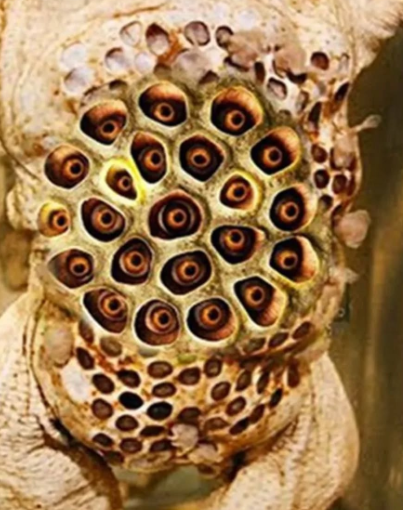
As the eggs settle onto the female’s back, her skin begins to change.
Within hours, the skin swells and softens, forming small pockets around each egg. Over time, the skin grows over them completely, sealing the eggs safely inside.
The female’s back gradually transforms into a patchwork of tiny incubation chambers.
Each chamber holds a developing embryo.
For many observers, this transformation can appear unsettling. The back of the female becomes dotted with dozens of small cells, each containing a growing offspring.
Yet biologically, it is an incredibly effective survival strategy.
By protecting the eggs inside her own skin, the mother shields them from predators, environmental dangers, and infections that could easily destroy exposed eggs.
Development Hidden Beneath the Skin
Inside these protective pockets, something remarkable happens.
Unlike most amphibians, whose eggs hatch into free-swimming tadpoles, Surinam toad embryos complete their entire development within the mother’s skin.
Over several weeks, the embryos transform.
First they develop the basic structure of tadpoles.
Then they begin the complex process known as Metamorphosis, during which their bodies gradually shift from aquatic larvae into fully formed young toads.
Limbs grow.
Tails shrink and disappear.
Internal organs reorganize to support life outside the embryonic stage.
All of this happens hidden beneath the surface of the mother’s back.
A Protected Nursery
The incubation pockets serve as miniature nurseries.
Within each one, the developing toad receives protection from the outside world.
This reproductive method offers several advantages:
• Protection from predators that would normally eat exposed eggs
• Reduced risk of fungal or bacterial infection
• Greater survival rates for offspring
• Less competition with other aquatic larvae
For species living in environments filled with predators and environmental instability, such protection can mean the difference between success and extinction.
The Surinam toad’s strategy represents one of nature’s most inventive solutions to this problem.
The Dramatic Birth of the Young
Eventually, the young toads complete their development.
At this point, they are no longer tadpoles.
They are fully formed miniature versions of adult Surinam toads.
And their exit into the world is dramatic.
One by one—or sometimes in rapid succession—the young push through the skin covering their chambers and emerge from their mother’s back.
To observers, the moment can appear chaotic and even shocking.
Tiny toads burst outward from the small openings, quickly swimming away to begin independent life.
Despite the dramatic appearance, the process is natural and temporary.
The mother’s skin heals quickly after the young emerge.
Within days, her back returns to its normal smooth appearance.
The Cost of Motherhood
Carrying dozens of developing offspring inside her skin requires a great deal of energy.
The female must endure weeks of physical strain as the embryos grow.
Yet this sacrifice greatly increases the survival rate of her young.
In evolutionary terms, the strategy is highly effective.
By investing heavily in protecting each clutch of offspring, the Surinam toad ensures that a large percentage survive to adulthood.
This is one reason the species has persisted for millions of years in its natural habitat.
A Rare Reproductive Strategy
Parental care among amphibians takes many forms.
Some species carry eggs on their backs.
Others hold eggs in their mouths or specialized pouches.
But the Surinam toad’s approach—embedding eggs directly into living skin—is among the rarest and most complex known in the animal kingdom.
Biologists continue to study this species to better understand how such unusual reproductive strategies evolve.
The Surinam toad provides valuable insights into amphibian development, parental investment, and evolutionary adaptation.
Habitat and Lifestyle
In the wild, Surinam toads inhabit quiet freshwater environments across northern South America.
They are commonly found in:
• shallow ponds
• marshes
• slow-moving rivers
• flooded forest areas
Their flattened bodies and muted coloration allow them to blend almost perfectly with muddy substrates.
This camouflage helps them avoid predators such as birds, fish, and snakes.
Most of their activity occurs underwater, where they feed on small invertebrates, insects, and other aquatic organisms.
Why the Surinam Toad Fascinates Scientists
The Surinam toad is more than just a biological curiosity.
It offers important lessons about the flexibility of evolution.
Over millions of years, species adapt to environmental challenges in surprising ways.
What might appear strange—or even disturbing—to human observers is often a highly effective survival strategy.
The Surinam toad’s reproductive system demonstrates how evolution can produce solutions that are both efficient and unexpected.
For scientists studying amphibian biology, it remains one of the most intriguing examples of parental care in nature.
Nature’s Creativity
One of the most remarkable aspects of the natural world is its diversity.
Across the planet, countless species have developed unique ways to survive and reproduce.
Some strategies appear familiar.
Others, like that of the Surinam toad, challenge our expectations entirely.
Yet every one of them reflects a fundamental principle of life on Earth: adaptation.
Species that successfully adapt to their environments continue to thrive.
Those that cannot eventually disappear.
Conclusion
The life cycle of the Surinam Toad stands among the most unusual and fascinating reproductive strategies in the animal kingdom.
From the delicate underwater mating dance to the embedding of eggs within the mother’s skin, from hidden metamorphosis to the dramatic emergence of fully formed young, every stage reflects an extraordinary evolutionary innovation.
Though it may seem unsettling to some observers, the process is a powerful example of nature’s ingenuity.
In the quiet waters of South America, this strange amphibian continues its ancient cycle—reminding us that the natural world is filled with wonders far stranger, and far more remarkable, than we often imagine.