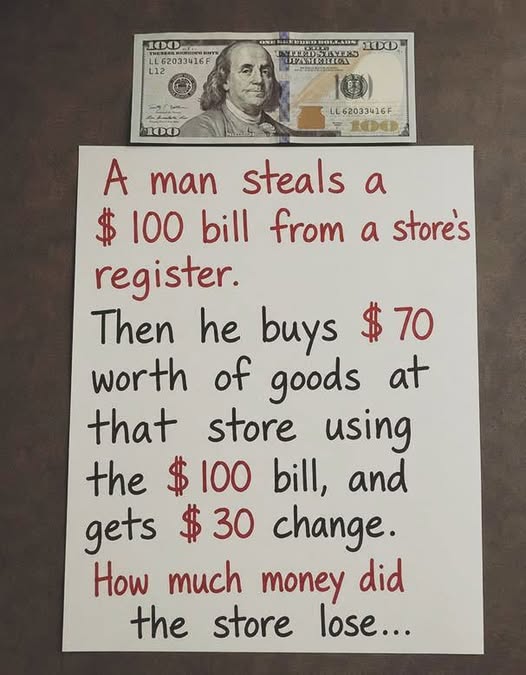
A deceptively simple math riddle has been making the rounds online, sparking heated debates across social media, forums, and comment sections. At first glance, the problem appears straightforward, but many people arrive at completely different answers.
So, what’s causing all the confusion?
The Riddle
A thief steals a $100 bill from a store’s cash register.
Later, the thief returns to the same store and buys $70 worth of merchandise using that stolen $100 bill.
The cashier, unaware that the bill was stolen, accepts it and gives the customer $30 in change.
Question: How much did the store lose?
Why People Disagree
Many people immediately begin adding together multiple losses:
- The original $100 theft
- The $70 worth of merchandise
- The $30 in change
This often leads to answers such as:
- $200
- $170
- $130
The problem is that these calculations usually count the same money more than once.
The riddle is designed to make people focus on each event separately rather than looking at the store’s final position.
Breaking It Down
Step 1: The Theft
The thief steals $100.
At this moment, the store is down $100 in cash.
Loss: $100
Step 2: The Purchase
The thief returns and uses that same stolen $100 bill to buy $70 worth of goods.
The cashier places the $100 back into the register.
This means the original stolen money has now returned to the store.
The store then gives:
- $70 worth of merchandise
- $30 in change
Total value leaving the store:
$70 + $30 = $100
The Key Insight
The stolen $100 bill is no longer missing because it came back into the register during the purchase.
The only things the thief ultimately leaves with are:
- $70 in merchandise
- $30 in cash
Together, that equals:
$100 total value
The Correct Answer
The store’s net loss is $100.
The thief walks away with:
- $70 worth of goods
- $30 cash
Total gain to the thief:
$100
Total loss to the store:
$100
Why This Riddle Is So Effective
The puzzle isn’t really testing math skills. It’s testing whether you can separate a story from the actual numbers.
The mention of theft, payment, and change encourages people to track every step individually and accidentally count the same money multiple times.
Once you focus only on the final outcome, the answer becomes clear:
The store lost $100 in total value.
That’s why this simple riddle continues to divide opinions online—it reveals how easily our brains can overcomplicate a problem that is actually quite simple.