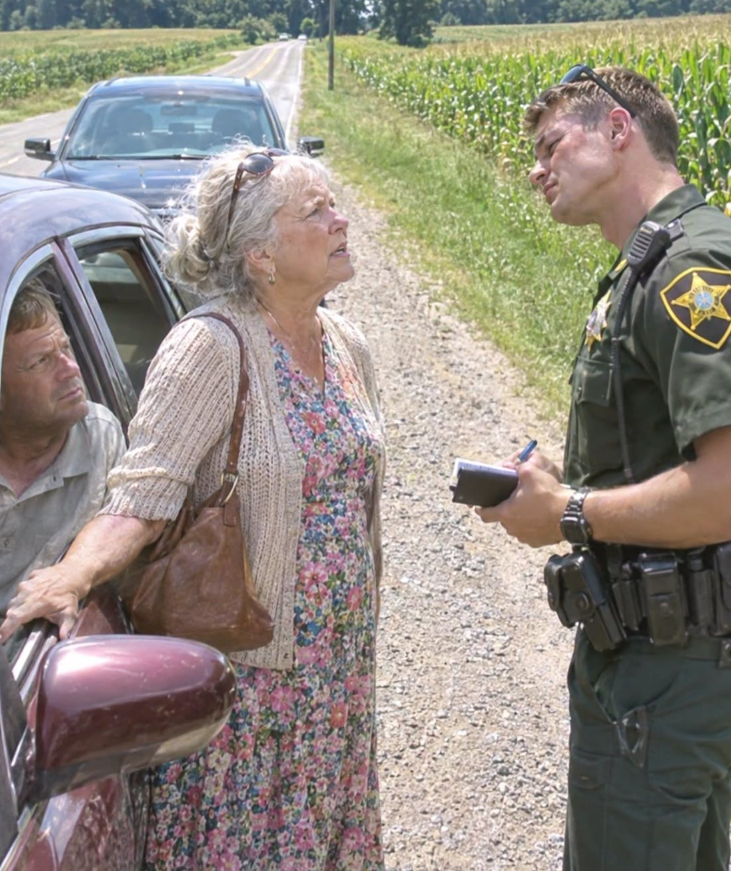
A deputy pulled my 71-year-old mother over on County Road 6, stood her on the shoulder in the August sun for forty minutes, and laughed that her license looked homemade.
So she asked him, very politely, to press the button on his radio and say her name.
It was ninety-one degrees.
No shade for a mile.
Corn on both sides, tall as a hallway.
I was in the passenger seat with a pan of lemon bars on my lap.
Mom drives forty-eight in a fifty-five.
Always has.
He walked up with his sunglasses on.
“License and insurance.”
No hello.
She handed him the yellow paper the courthouse gives you.
Her new card hadn’t come in the mail yet.
He held it up to the sun with two fingers.
“Did you print this at the library, hon?”
Then he laughed.
A small laugh, through his nose.
“Step out of the vehicle, ma’am.”
She stepped out.
Flowered dress. Handbag on her arm.
“Stand at the back where I can see you.”
I said she was seventy-one.
He bent down to my window.
“Sir, you stay in that seat.”
“Sit still, Jeffrey,” my mother said.
So I sat.
He went back to his truck.
Engine running. Windows up.
Ten minutes.
Twenty.
I watched her in the side mirror.
She never leaned on the car.
The trunk was too hot to touch.
At thirty minutes, she asked if she could wait inside.
“You can sit when I tell you,” he said.
The powdered sugar on the bars had melted clear.
Here is what I’m ashamed of.
My mother worked nights in the courthouse basement for thirty-four years.
I used to tell people she just answered phones.
I said it like an apology.
So I sat there thinking she was nobody to this kid.
An old woman with a paper license.
At forty minutes, he came back with his ticket book.
He said he was calling a tow truck too.
That’s when she spoke.
“Deputy, may I ask one thing first?”
“You can ask.”
“Would you press the button on your radio and say my name?”
“Only my name. Shirley Hagen.”
He grinned at me through the back window.
“You think you’re somebody?”
“No,” she said. “I don’t think that at all.”
I wanted to crawl under the dashboard.
He did it for the joke.
Thumb on the shoulder mic.
“Got a lady on a homemade license wants her name said on the air.”
“Says it’s Shirley Hagen.”
He laughed again.
Then the radio went quiet.
Not busy quiet.
The other kind.
A blackbird sat on the fence wire.
The corn moved.
Then a woman’s voice came back, careful and slow.
“Fourteen, say that name again.”
He rolled his eyes and reached for the button.
My mother leaned in toward his shoulder first.
Would you have stayed in that seat because she told you to, or gotten out of the car?
Part 2
My mother leaned toward the deputy’s shoulder before he could press the button again.
“That’s enough, son. Just listen.”
He frowned.
“Ma’am, step back.”
But the voice on the radio came again.
“Fourteen, this is Dispatch. Confirm the full name.”
He lifted the microphone.
“Shirley Hagen. That’s what she said.”
There was a pause.
Then the dispatcher spoke.
“Deputy, remove your sunglasses and look at the identification document again. You’re speaking to Shirley Ann Hagen?”
He glanced at my mother.
“That’s what the paper says.”
“Then you need to put your ticket book away immediately.”
His smile disappeared.
“Why?”
The dispatcher didn’t answer right away.
Instead, another voice came over the radio.
An older man’s voice.
“Fourteen, this is Sheriff Coleman. Do not move that woman another inch. Do you understand?”
The deputy straightened.
“Yes, sir.”
“Do you know who you’re standing in front of?”
He looked at my mother again.
She simply adjusted the strap of her handbag.
“No, sir.”
“Then perhaps you should ask the courthouse what happened to the woman who spent thirty-four years protecting that building and everyone working inside it.”
My stomach tightened.
The deputy swallowed.
The sheriff continued.
“Shirley Hagen was the senior court records administrator. She handled sealed judicial documents, evidence transfers, and emergency court orders. She trained half the clerks in this county. Three sheriffs served during her career. Every one of them knew her.”
The deputy’s face had gone pale.
My mother finally spoke.
“I retired six years ago, Sheriff. I believe the young man has simply forgotten his manners.”
There was a short silence.
Then Sheriff Coleman said something I’ll never forget.
“Shirley, I’m sorry. I’m sending someone to your location.”
The deputy lowered his radio.
“Ma’am, I didn’t know—”
My mother interrupted him.
“That’s precisely the problem.”
He stared at her.
She continued.
“You didn’t know who I was, so you decided I wasn’t worth treating with respect.”
I looked down at the lemon bars.
The powdered sugar had completely disappeared.
For thirty-four years, my mother had worked behind the scenes, making sure other people’s lives weren’t destroyed by missing documents, careless signatures, or people who thought their authority made them untouchable.
And I had spent most of my adult life describing her job as answering phones.
I suddenly felt ashamed.
A black SUV pulled onto the shoulder behind us.
The sheriff stepped out.
He was an older man with silver hair, and he walked straight toward my mother.
“Shirley.”
She smiled.
“Hello, Robert.”
He shook her hand, then looked at the deputy.
“Give me your badge and your report.”
The deputy hesitated.
“Sir, I was just checking a document.”
“No. You were humiliating an elderly woman because you thought she couldn’t do anything about it.”
Then the sheriff turned toward me.
“Are you Jeffrey?”
I nodded.
He glanced at the pan on my lap.
“Are those lemon bars?”
I almost laughed.
“Yes, sir.”
My mother sighed.
“They were supposed to be for the retirement luncheon.”
The sheriff looked at her.
“Whose retirement luncheon?”
She reached into her handbag and pulled out a folded invitation.
“Mine. The courthouse is celebrating the opening of the new records archive today.”
The sheriff smiled.
“Then I suppose we’d better get you there.”
But before we left, my mother asked him one question.
“Robert, did you ever find out what happened to the original evidence files from the old courthouse investigation?”
The sheriff’s expression changed.
He looked at her for a long moment.
“Why are you asking about those now?”
She glanced at the deputy, then back at him.
“Because I think someone should remind this young man that a uniform doesn’t make a person important.”
She paused.
“And a piece of paper doesn’t make a person legitimate. Sometimes, the truth is in the records.”
The sheriff slowly nodded.
“Then I think we need to talk.”
I had no idea what she meant.
Not yet.
But I was about to learn that my mother had kept something far more important than old courthouse paperwork.
Part 3 (The Ending)
We followed the sheriff to the courthouse.
The deputy stayed behind with another officer while an internal investigation was opened.
I carried the lemon bars.
My mother walked beside me, holding her handbag with both hands.
She didn’t look angry.
She didn’t look frightened.