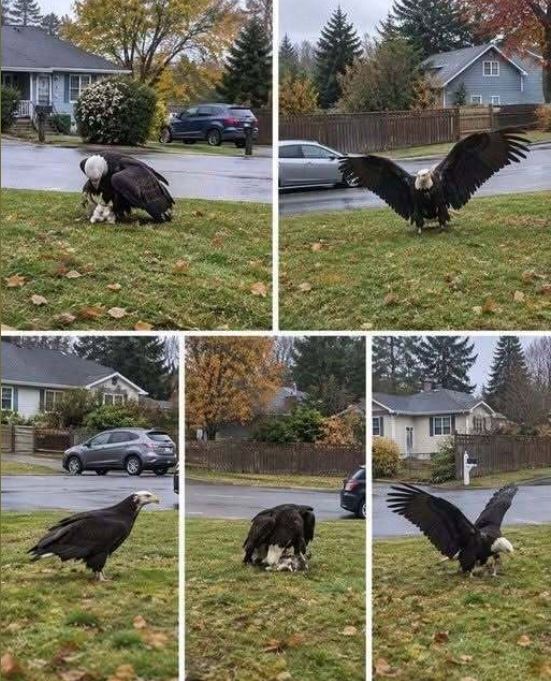
An unusual eagle sighting has attracted attention from nature enthusiasts and wildlife lovers, raising an interesting question: Could this really be one of the largest birds of prey ever seen?
With its broad wings, powerful appearance, and impressive presence, an eagle can easily become the center of attention. Even experienced birdwatchers can be surprised when encountering an especially large individual in its natural environment.
Photographs of these magnificent birds often generate excitement because they reveal details that people might not notice during an ordinary wildlife encounter.
However, before assuming that a particular eagle is unusually large or belongs to a rare species, it is important to understand how bird identification and photography work.
Could the bird genuinely be exceptional, or might camera perspective be making it appear larger than it really is?
Exploring the characteristics of eagles, their natural habitats, and the science of wildlife photography helps explain why these sightings are so fascinating.
1. Why Eagles Are Among the Most Impressive Birds in Nature
Eagles are powerful birds of prey belonging to the family Accipitridae. They are found across many parts of the world and occupy a wide range of environments, including forests, mountains, wetlands, grasslands, and coastal regions.
Their physical characteristics make them particularly well adapted to hunting.
One of their most remarkable features is their eyesight. Eagles can detect movement from considerable distances, helping them locate potential prey while flying or observing their surroundings from elevated positions.
Their strong feet are equipped with sharp, curved talons designed to grasp and hold prey. Their hooked beaks help them tear food into manageable pieces.
Many eagle species also have broad wings that allow them to glide efficiently.
Rather than constantly flapping their wings, these birds can use rising columns of warm air, known as thermals, to gain altitude and travel over long distances.
These abilities make eagles extraordinary examples of adaptation in the natural world.
2. Could the Eagle Really Be Larger Than Normal?
One of the first questions people ask after seeing an impressive wildlife photograph is whether the animal is genuinely as large as it appears.
Eagles vary considerably in size depending on their species.
Some are relatively small compared with the world’s largest birds of prey, while others possess enormous wingspans and powerful bodies.
Individual differences also occur within the same species. Age, sex, and natural genetic variation can influence an eagle’s physical dimensions.
In many eagle species, females are noticeably larger than males. This is a natural biological difference known as reverse sexual size dimorphism.
Consequently, an eagle that looks unusually large might simply be a healthy adult female belonging to a naturally large species.
Without reliable measurements or a suitable comparison, however, it is difficult to determine the bird’s actual dimensions from a photograph alone.
3. How Photography Can Make an Eagle Look Enormous
Photography plays an important role in how people perceive wildlife.
A bird photographed from a particular angle may appear dramatically larger than its surroundings, even when its physical dimensions are completely normal.
Several factors can influence the final appearance.
Camera distance: An eagle positioned close to the camera may appear much larger than objects located farther away.
Photographic perspective: The angle of the photograph can emphasize certain features, particularly the bird’s head, wings, and body.
Lens selection: Telephoto lenses allow photographers to capture distant wildlife, but the resulting image can create a different visual impression of distance and scale.
Digital cropping: Removing surrounding details from a photograph can make the animal dominate the entire image.
Position and posture: An eagle spreading its wings may appear significantly larger than one sitting with its feathers folded.
These factors do not necessarily mean a photograph has been manipulated. They simply demonstrate that visual appearance and actual measurements are not always the same.
4. Different Eagle Species Have Different Physical Characteristics
Another important consideration is the identity of the bird.
There are numerous eagle species around the world, each with distinctive physical features and habitat preferences.
For example, the bald eagle is widely recognized for its white head and dark brown body. The golden eagle is known for its powerful build and golden-brown feathers around the head and neck.
The harpy eagle, native to tropical forests of Central and South America, has exceptionally strong legs and prominent feathered crests.
The Philippine eagle is another remarkable species, recognized for its impressive appearance and conservation importance.
These examples demonstrate how dramatically eagle species can differ.
Identifying a bird correctly requires examining several characteristics rather than judging its size alone.
Important identification features include:
- Overall feather coloration and patterns.
- Shape and size of the beak.
- Appearance of the head and neck.
- Wing proportions and feather structure.
- Tail shape and coloration.
- Geographic location and surrounding habitat.
Age also matters because immature eagles can have different feather patterns from fully mature adults.
5. Could the Bird Be Another Large Species?
Not every impressive bird of prey is necessarily an eagle.
Several other large birds can resemble eagles, particularly when viewed from a distance or photographed in difficult lighting conditions.
Large hawks, vultures, and some other raptors have powerful bodies, broad wings, and hooked beaks.
These similarities can make identification challenging for inexperienced observers.
Vultures, for example, are often recognized by their broad wings and soaring flight. Some species spend long periods gliding above open landscapes while searching for food.
Large hawks may also resemble smaller eagles because of their body proportions and hunting behavior.
A clear photograph showing the bird’s head, wings, tail, and body markings can help wildlife specialists determine its identity.
The geographical location is equally valuable because different species occupy different regions.
6. Why the Location of the Sighting Matters
Geography is one of the most useful clues in wildlife identification.
Different eagle species have different natural distributions, and their preferred environments can vary considerably.
Some are commonly associated with coastal regions and lakes, while others inhabit mountainous areas, forests, or open grasslands.
For instance, bald eagles are strongly associated with North America, particularly areas offering access to suitable nesting locations and food sources.
Golden eagles occupy extensive regions of the Northern Hemisphere and are frequently associated with mountainous and open landscapes.
Harpy eagles inhabit tropical forests, where their powerful bodies and hunting abilities help them navigate dense vegetation.
Knowing where an unusual bird was photographed can therefore help narrow down the possibilities.
Combining geographical information with visible physical characteristics is much more reliable than making an identification based on appearance alone.
7. The Importance of Eagles in Natural Ecosystems
Eagles are important predators that contribute to the ecological balance of their environments.
Depending on the species, their diets may include fish, birds, reptiles, and mammals.
By hunting different animals, they participate in food-web relationships that influence prey populations and ecosystem dynamics.
Some eagles specialize in catching fish, while others hunt terrestrial animals.
Their feeding habits also demonstrate how different species adapt to the resources available in their habitats.
Healthy ecosystems provide the food, nesting locations, and environmental conditions these birds require.
When natural habitats are destroyed or degraded, eagle populations can experience additional pressure.
This is why protecting forests, wetlands, rivers, and other natural environments is essential for maintaining healthy populations of birds of prey.
8. Conservation Challenges Facing Eagles
Despite their impressive hunting abilities, eagles are not immune to environmental threats.
Habitat destruction is a major concern for many bird species. Deforestation, agricultural expansion, urban development, and infrastructure projects can reduce suitable nesting and feeding areas.
Pollution can also affect birds of prey.
Some contaminants accumulate through food chains, potentially exposing predators to harmful substances through the animals they consume.
Another concern is accidental poisoning, which can occur when birds consume contaminated prey or improperly disposed materials.
Collisions with vehicles, power infrastructure, and other human-made structures can also cause injuries and fatalities.
The level of risk varies between species and geographical regions.
Conservation organizations and wildlife researchers work to address these problems through habitat protection, population monitoring, public education, and environmental regulations.
Protecting eagle populations also benefits many other animals that depend on the same ecosystems.
9. How to Observe Eagles Without Disturbing Them
Seeing an eagle in the wild can be an unforgettable experience.
However, responsible wildlife observation should always take priority over obtaining a close-up photograph.
Eagles need space to hunt, rest, and care for their young.
Approaching too closely can cause unnecessary stress, especially during nesting season.
Anyone fortunate enough to encounter one should follow a few basic guidelines:
- Maintain a respectful distance from the bird.
- Avoid approaching nests or nesting areas.
- Never attempt to feed or handle a wild eagle.
- Use binoculars or a camera with an appropriate zoom lens.
- Avoid making loud noises or sudden movements.
- Follow local wildlife protection regulations.
Photographers should also avoid disturbing vegetation or entering restricted nesting areas.
A photograph is never worth putting an animal’s safety at risk.
10. Could This Be a Rare or Record-Breaking Eagle?
An unusually impressive sighting can naturally lead to speculation about whether the bird represents a rare species or an exceptional individual.
However, claims about record-breaking size require reliable evidence.
Wildlife specialists would need to establish the species and examine trustworthy measurements before drawing conclusions.
Photographs can provide useful information, but they do not always reveal the true dimensions of an animal.
A confirmed record would generally require documented measurements and appropriate verification rather than online speculation.
This is particularly important when unusual wildlife photographs begin circulating on social media.
An interesting image can encourage people to learn more about nature without necessarily proving that a rare event has occurred.
Scientific identification and careful documentation help separate genuine discoveries from misunderstandings.
11. Technology Is Changing the Way We Discover Wildlife
Modern technology has made wildlife observation more accessible than ever.
High-quality cameras, powerful telephoto lenses, and improved digital photography allow people to capture birds that would otherwise be difficult to observe closely.
Wildlife researchers also use camera traps, GPS tracking, and other monitoring techniques to study animal movements and behavior.
Bird identification applications can provide useful suggestions based on photographs, sounds, and geographical information.
However, these tools should be treated as helpful resources rather than infallible authorities.
Image quality, lighting, age-related plumage differences, and similar-looking species can all affect identification results.
Combining technology with expert knowledge remains one of the most reliable ways to understand unusual wildlife encounters.
Final Thoughts: Sometimes Nature Is More Extraordinary Than We Expect
An impressive eagle sighting reminds us of the incredible diversity and beauty of the natural world.
Whether the bird is an exceptionally large individual, a representative of a remarkable eagle species, or simply an animal photographed from an unusual perspective, there is plenty to appreciate.
Eagles demonstrate the extraordinary adaptations that allow birds of prey to survive in different environments.
Their eyesight, powerful talons, broad wings, and hunting abilities make them fascinating subjects for wildlife enthusiasts and researchers alike.
More importantly, their presence reminds us why protecting natural habitats and respecting wildlife matters.
The next time you encounter a photograph of an enormous eagle, take a moment to look beyond its impressive appearance.
Consider its species, habitat, physical characteristics, and the photographic perspective.
Sometimes the most interesting part of a wildlife discovery is not simply what we see, but everything we can learn by looking a little closer.