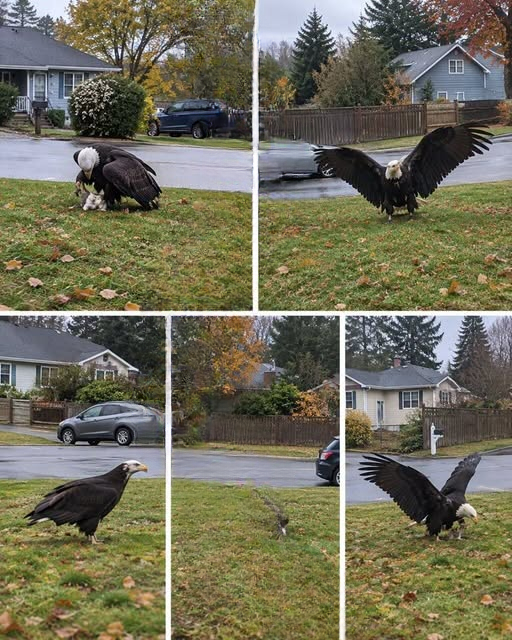
Wildlife enthusiasts and nature lovers are taking a closer look at an extraordinary eagle photograph that has sparked curiosity and conversations online. The bird appears remarkably large, with an impressive wingspan and powerful body that make it difficult to ignore.
At first glance, some viewers might wonder whether the eagle is unusually large or belongs to a rare species. However, photographs can sometimes create surprising visual effects, making animals appear much bigger or smaller than they really are.
So, what makes this particular sighting so interesting? And could the bird really be as enormous as it appears?
Why Eagles Are So Fascinating
Eagles have long been admired for their strength, impressive flying abilities, and remarkable eyesight. As powerful birds of prey, they occupy an important position in many natural ecosystems.
Their broad wings allow them to glide effortlessly through the air, often taking advantage of rising warm air currents to stay airborne without constantly flapping.
Watching an eagle soaring above mountains, forests, or open landscapes can be an unforgettable experience. Their impressive appearance and hunting abilities make them some of the most recognizable birds in the world.
Is This Eagle Really That Big?
One of the biggest questions surrounding unusual wildlife photographs is whether the animal’s apparent size is accurate.
A photograph doesn’t always provide a reliable sense of distance or scale. Depending on where the bird is positioned in relation to the camera, it may appear significantly larger than nearby objects.
For example, an eagle flying close to the photographer while buildings or trees remain farther away can create the illusion of an enormous bird.
Camera lenses, zoom settings, and digital cropping can also influence how large an animal appears.
Without a recognizable object for comparison, determining an eagle’s actual dimensions from a single photograph can be difficult.
How Photography Changes Our Perception
Perspective plays an important role in wildlife photography.
An eagle photographed from directly underneath may appear particularly impressive because its wings dominate the image. Meanwhile, a photograph taken from the side may emphasize its body and tail.
Even the bird’s position can change its appearance.
When an eagle spreads its wings completely, its silhouette can look dramatically different from when its wings are folded.
These photographic effects don’t make the image any less remarkable. They simply remind us that appearances don’t always tell the entire story.
Identifying the Eagle Species
Before determining whether a bird is unusually large, identifying its species is an important first step.
Different eagle species have different physical characteristics, including:
-
Wing shape and overall wingspan.
-
Feather patterns and body coloration.
-
Head markings and beak shape.
-
Tail length and appearance.
-
Natural habitat and geographic distribution.
Age can also influence identification. Young eagles sometimes have different feather patterns from fully grown adults.
Lighting, distance, and image quality may make these characteristics harder to recognize.
For this reason, identifying a bird accurately often requires examining several details rather than relying on its apparent size alone.
Eagles Come in Many Shapes and Sizes
Not every eagle has the same physical dimensions.
Some species are relatively smaller, while others are among the largest birds of prey found in the wild.
Their size can vary depending on species, sex, age, and individual characteristics.
This diversity helps explain why certain eagle sightings attract so much attention.
Someone accustomed to seeing smaller birds may be genuinely surprised when encountering one of the larger species.
However, calling an eagle the biggest ever photographed requires reliable measurements and expert verification.
An impressive photograph alone cannot establish a world record.
Could It Be Another Bird of Prey?
There is another possibility worth considering.
Not every large bird photographed from a distance is necessarily an eagle.
Several other birds of prey, including hawks, vultures, and kites, can have impressive wingspans and silhouettes that resemble those of eagles.
When image quality is limited, distinguishing between these birds can become challenging.
Examining the head, wings, tail, coloring, and surrounding environment can help narrow down the possibilities.
The location where the photograph was taken is particularly useful because different species inhabit different regions.
Why Location Matters
Geographic location provides valuable information when identifying wildlife.
An eagle photographed near a coastline may be a different species from one spotted in a mountainous or forested region.
The surrounding habitat can also offer important clues.
Rivers, lakes, wetlands, open grasslands, and mountain ranges support different wildlife populations.
Knowing where the photograph was taken can therefore help bird experts determine which species is most likely.
How to Observe Eagles Responsibly
Seeing an eagle in the wild is an exciting experience, but observing wildlife responsibly should always come first.
If you encounter one, maintain a safe distance and avoid disturbing its natural behavior.
Never approach an eagle’s nest or attempt to attract the bird for a photograph.
Wild birds need space to hunt, rest, and care for their young.
Taking photographs from a respectful distance allows people to appreciate wildlife without interfering with its natural environment.
Could This Be an Unusual or Rare Sighting?
It is certainly possible that an unusual photograph captures a particularly impressive individual or a less commonly observed species.
However, confirming whether a sighting is rare requires more information.
Wildlife specialists may examine photographs, geographic location, physical characteristics, and measurements before reaching a conclusion.
Comparing these details with established information about known species provides a much more dependable answer than guessing from appearance alone.
Until those details are available, it is best to appreciate the photograph without making unsupported claims.
Final Thoughts
An impressive eagle sighting reminds us how extraordinary the natural world can be.
Whether this particular bird was exceptionally large or simply photographed from an angle that made it appear enormous, there is plenty of reason to admire it.
Eagles are remarkable animals with powerful wings, incredible eyesight, and impressive flying abilities.
Sometimes, a single photograph can inspire us to ask questions, explore unfamiliar species, and develop a greater appreciation for wildlife.
And perhaps that is the most interesting part of this sighting: it encourages us to look closer, learn more, and remember that nature can surprise us in ways we never expected.