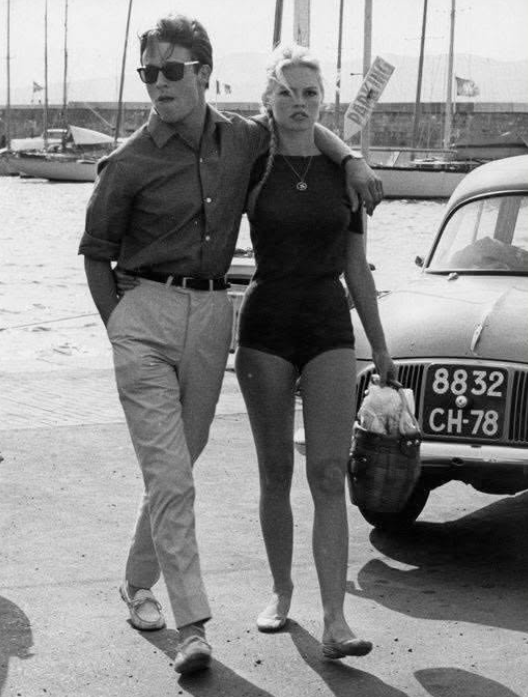
In the summer of 1958, Brigitte Bardot was becoming one of the most recognizable figures in international cinema. Her distinctive style, expressive screen presence, and unconventional public image helped make her a symbol of changing attitudes toward fashion, femininity, and personal freedom.
The French Riviera became closely associated with her public image. Among its most recognizable destinations was Saint-Tropez, a Mediterranean town increasingly attracting artists, actors, and fashionable visitors. Its beaches, harbor, and relaxed atmosphere provided the backdrop for photographs that helped define an era of French glamour.
During this period, Bardot’s relationship with actor Jacques Charrier attracted considerable public attention. Their romance, marriage, and family life became part of the story surrounding a woman whose fame extended far beyond the movie screen.
Yet behind the photographs was a more complicated reality. Bardot was navigating an expanding career, intense media attention, and personal responsibilities while the public continued to view her as a symbol of beauty and independence.
Brigitte Bardot’s Rise to International Fame
Born in Paris on September 28, 1934, Bardot studied ballet before entering the world of modeling and acting. Her early work in fashion publications helped bring her to public attention, and she gradually developed a recognizable image that differed from the more formal presentation associated with many established screen actresses.
Her blonde hair, expressive features, and relaxed style became defining elements of her appearance. On screen, she often conveyed a sense of spontaneity that appealed to audiences during a period of significant cultural change.
One of the most important milestones in her career came with the 1956 film And God Created Woman, directed by Roger Vadim. Bardot played Juliette Hardy, a young woman whose desires and independent behavior challenged the expectations of the conservative community around her.
The film attracted controversy, but it also helped establish Bardot as an international star. Her performance became associated with a changing portrayal of women in cinema, in which characters could be complex, independent, and unwilling to conform to traditional social expectations.
Her influence soon extended beyond acting. Fashion magazines discussed her appearance, young women adopted elements of her style, and photographs of her circulated widely.
By the late 1950s, Bardot was more than a successful actress. She had become a cultural figure whose image reflected broader conversations about youth, sexuality, fashion, and independence.
Saint-Tropez and the Glamour of the French Riviera
Saint-Tropez had long been a coastal community associated with fishing and maritime life. During the postwar years, however, it began attracting growing numbers of artists, writers, filmmakers, and wealthy travelers.
Its appeal came partly from its combination of natural beauty and informality. The harbor, narrow streets, Mediterranean beaches, and bright summer light offered an alternative to the more formal atmosphere of major cities.
Bardot became one of the figures most closely associated with this transformation. Her casual clothing and relaxed appearance helped establish an image of glamour that seemed less rigid than traditional celebrity elegance.
In photographs, she might appear in simple summer outfits rather than elaborate formal clothing. Her style suggested that sophistication could be effortless, combining comfort with a distinctive sense of individuality.
The connection between Bardot and Saint-Tropez grew stronger as images of her circulated internationally. The town increasingly became associated with the lifestyle represented by her public persona: youthful, fashionable, and connected to the Mediterranean coast.
These photographs also helped shape the way people imagined the French Riviera, even if they had never visited it themselves.
Jacques Charrier Enters the Story
Jacques Charrier was building his own acting career when his relationship with Bardot became a subject of public interest. Born in Metz, France, on November 6, 1936, he trained in theater and pursued professional opportunities in French cinema.
Although Charrier was an actor in his own right, his relationship with Bardot brought him additional public attention. She was already an internationally recognized star, and the difference in their levels of fame became part of how the couple was portrayed.
Being in a relationship with someone famous can bring unusual pressures. Ordinary outings may attract photographers, private decisions can become subjects of speculation, and personal disagreements may receive attention from people who know little about the relationship itself.
Charrier’s connection to Bardot placed their romance within this environment. Their appearances together became interesting to fans, entertainment journalists, and photographers who wanted to capture moments from the actress’s personal life.
However, the public image of a couple is never a complete representation of the relationship. Photographs can show how two people appeared at a particular moment, but they cannot explain the conversations, expectations, or challenges that shaped their lives away from the camera.
A Romance Under Public Scrutiny
Bardot was accustomed to attention by the time her relationship with Charrier became widely discussed. Her appearance and personal life were frequently examined in magazines and newspapers, making it difficult to maintain a clear boundary between public recognition and private experience.
For admirers, the couple represented romance and the glamour of postwar French society. For photographers, their appearances offered opportunities to capture two actors against the attractive surroundings of the Riviera.
But the image of a happy couple does not necessarily reveal the full circumstances of a relationship.
A photograph may preserve a smile or an affectionate gesture, yet it cannot establish whether the people pictured were experiencing an easy period in their lives. Like other couples, Bardot and Charrier had their own ambitions, responsibilities, and personal circumstances.
Their relationship developed while Bardot’s professional life was expanding rapidly. The demands of fame and the public’s interest in her private affairs formed part of the environment in which they attempted to build a life together.
Marriage and Family Life
Bardot and Charrier married in June 1959. Their marriage attracted considerable attention because of her international reputation and the continuing fascination with her personal life.
The following January, Bardot gave birth to their son, Nicolas-Jacques Charrier. Motherhood brought new responsibilities during a period when her career and public image remained under intense scrutiny.
Bardot later spoke openly about the difficulties she experienced during this stage of her life and her complicated feelings about motherhood. Her reflections challenged idealized assumptions about what every woman should feel when becoming a parent.
Parenthood can involve a wide range of emotions and experiences, and those experiences differ from one individual to another. Bardot’s account should be understood as part of her personal history rather than as a universal description of motherhood.
The birth of their son also meant that the couple’s decisions affected a growing family, adding another dimension to their relationship.
Their private circumstances were often discussed in public, illustrating how celebrity attention can make personal milestones difficult to experience away from outside expectations.
Why Their Marriage Eventually Ended
Bardot and Charrier eventually separated, and their divorce was finalized in 1962. Their marriage had lasted only a few years, becoming one chapter in the personal histories of two actors whose lives subsequently developed in different directions.
It is difficult to explain the end of a marriage through a single cause. Relationships are shaped by a combination of individual needs, changing circumstances, communication, and expectations.
Bardot’s career involved considerable public attention, while Charrier had his own professional ambitions. The responsibilities of marriage and parenthood added further complexity.
Although their relationship attracted public interest, outsiders could not know every private circumstance that contributed to their separation. It would therefore be misleading to reduce the marriage to a simple story about fame, romance, or personal differences.
Their experience illustrates a broader reality: two people can share meaningful experiences and sincerely attempt to build a future together without remaining compatible as spouses.
The end of a marriage does not erase the significance of the relationship or establish that every part of it was unhappy.
Bardot’s Influence on Fashion and Popular Culture
Bardot’s influence reached well beyond her romantic relationships. She helped popularize a style that combined femininity with a relaxed approach to clothing and personal presentation.
Her hairstyles became widely imitated, and the Bardot neckline—designed to expose the shoulders—became associated with her name. Simple summer dresses, striped tops, fitted trousers, and casual footwear also contributed to her recognizable look.
Her style was particularly effective against the backdrop of the French Riviera. The combination of Mediterranean light, informal clothing, and natural movement helped create an image of elegance that did not depend on elaborate formality.
This influence extended beyond France, as magazines and photographs circulated her appearance internationally.
Bardot’s cultural significance also reflected a wider shift in attitudes toward women. Her public image suggested that femininity could include independence and individuality, even as she faced criticism from people who considered her persona inconsistent with traditional expectations.
At the same time, her image was shaped by the entertainment industry, photographers, filmmakers, and media organizations that selected which aspects of her life to present to the public.
Understanding her influence therefore requires looking at both her distinctive presence and the wider culture that helped transform her into an international symbol.
The Difference Between a Photograph and a Life
Historical photographs of Bardot and Charrier remain compelling because they preserve the appearance and atmosphere of a particular period. Their clothing, expressions, and surroundings offer glimpses into the fashion and celebrity culture of the late 1950s.
However, photographs cannot provide a complete account of the people they depict.
A relaxed pose does not establish that someone was free from personal worries, just as a smile cannot explain everything a person was feeling. Images preserve selected moments, while relationships unfold through countless experiences that cameras never record.
This distinction is especially important when viewing celebrity photographs from earlier decades. Attractive settings and fashionable clothing can encourage a romanticized understanding of the past, leaving the impression that life was simpler than it actually was.
Bardot’s story shows why it is worth looking beyond the visual appeal of an image. Her public life included professional achievements, changing personal circumstances, family responsibilities, and the challenges of living under constant scrutiny.
Her relationship with Charrier was an important part of that history, but it cannot be fully understood through photographs alone.
A Legacy That Extended Beyond Romance
Bardot’s later life included a significant commitment to animal protection. After leaving acting in the early 1970s, she devoted much of her public work to animal welfare and established the Brigitte Bardot Foundation in 1986.
This became another major part of her public identity, distinct from the film roles and fashion influence that had initially made her famous.
Her later public statements and political positions also attracted controversy and criticism. A balanced understanding of her legacy must recognize both her cultural influence and the contentious aspects of her public life.
Bardot’s story cannot be reduced to a single photograph, relationship, or stage of her career. She was an actress whose work helped reshape the image of women in popular cinema, a fashion figure whose style endured, and an animal-welfare advocate whose later activities became central to her public identity.
Looking Back at Brigitte Bardot and Jacques Charrier
The story of Bardot and Charrier remains connected to the glamour of the French Riviera and the transformation of celebrity culture during the late 1950s.
Their relationship unfolded while Bardot was becoming an international icon. Their marriage, the birth of their son, and their eventual separation revealed personal circumstances that were more complicated than the romantic images circulated in magazines.
Saint-Tropez provided a striking backdrop, while Bardot’s distinctive style helped define an era of French fashion and cinema. Yet the lasting interest in their story comes from more than its visual appeal.
Their photographs remind us that public images preserve only fragments of human lives. Behind the glamour were two individuals navigating their own careers, family responsibilities, and changing circumstances.
Bardot’s legacy ultimately extends far beyond her romance with Charrier. Her influence on cinema, fashion, and animal protection forms a much larger story—one that continues to attract interest decades after the photographs of her younger years were taken.