For decades, scientists have been fascinated by the extraordinary journeys animals make across the natural world. Birds, in particular, can travel incredible distances, crossing mountains, forests, deserts, and oceans in search of food, suitable habitats, and places to breed.
But imagine tracking an eagle for years, expecting to discover a familiar migration pattern, only to find that its movements appear to defy everything researchers thought they understood.
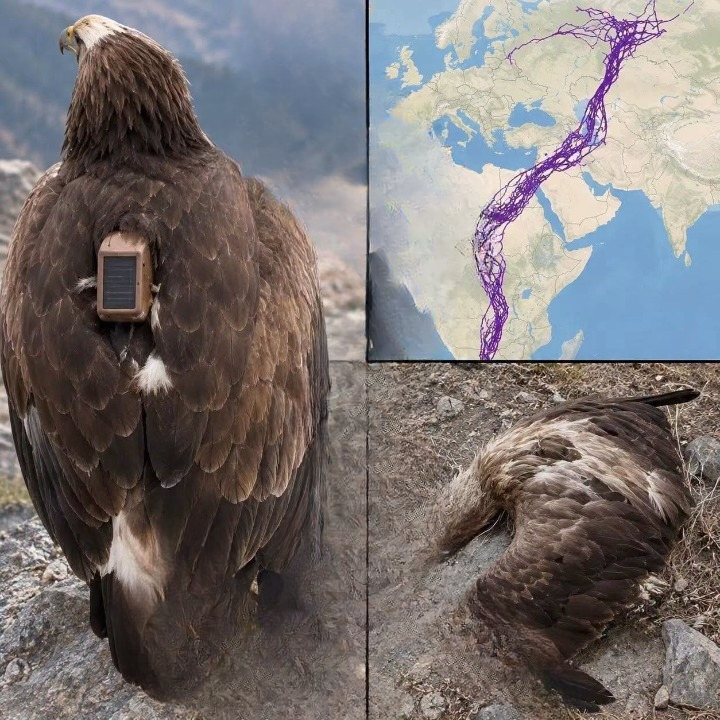
That is the intriguing story behind a GPS-tracked eagle whose unusual movements reportedly attracted scientific attention. Instead of following one predictable route, the bird appeared to travel through different landscapes, revisit certain locations, and change direction as environmental conditions shifted.
Its journey raises an interesting question: What if what appears to be random movement in nature is actually a sophisticated response to a constantly changing environment?
A Tracking Project That Raised Unexpected Questions
GPS tracking has transformed the way scientists study wildlife.
In the past, researchers often depended on direct observations, field surveys, and occasional sightings to understand where animals traveled. These methods provided valuable information, but they could not always reveal what happened between observations.
Modern tracking technology allows researchers to collect much more detailed information about an animal’s movements.
Small tracking devices can record geographical positions at regular intervals, helping scientists investigate migration routes, feeding locations, breeding areas, and seasonal movements.
When an eagle is fitted with an appropriate tracking device, researchers may be able to follow its movements across enormous distances.
However, tracking data does not always produce simple answers.
An animal may travel in unexpected directions, remain in one location for extended periods, or repeatedly return to places that initially appear unimportant.
Such patterns can encourage researchers to investigate the environmental conditions influencing the animal’s decisions.
Why the Eagle’s Movements Appeared So Unusual
Many bird species follow recognizable seasonal movement patterns.
Their journeys are often influenced by food availability, breeding requirements, weather conditions, temperature, and daylight.
Some birds travel thousands of kilometers between seasonal habitats, while others move shorter distances depending on local environmental conditions.
Eagles can also display considerable variation in their movements.
Depending on the species, age, breeding status, and habitat, some individuals remain within relatively established territories, while others travel much farther.
A tracking map showing repeated journeys across different landscapes might initially look confusing.
However, unusual movements do not necessarily indicate unpredictable behavior.
An eagle might change direction because food has become less available in one area. It may move toward locations with favorable weather or follow opportunities created by seasonal changes.
What looks like a detour on a map could represent an important survival decision.
The Hidden Influence of Weather and Wind
One of the most important environmental factors influencing large birds is the weather.
Eagles are powerful fliers, but flying long distances still requires energy.
Air currents, wind direction, temperature, and atmospheric conditions can influence how efficiently a bird travels.
Some large birds use rising columns of warm air, known as thermals, to gain altitude without constantly flapping their wings.
These rising air currents can help them conserve energy while traveling over land.
Wind conditions can also influence flight routes.
A bird may take a longer geographical route if the surrounding conditions make that journey more favorable.
This is one reason why researchers studying wildlife movements often compare tracking information with weather records.
A flight path that initially seems unusual may become easier to understand when wind patterns and seasonal conditions are considered.
Food Availability Can Change Everything
Finding enough food is another major factor affecting wildlife movements.
Eagles are predators and scavengers, depending on the species and available food sources.
Their diets can include fish, birds, mammals, and other prey.
However, prey populations do not remain constant throughout the year.
Seasonal changes, droughts, habitat disturbances, and shifts in animal populations can influence where food is available.
An eagle that repeatedly visits different areas may be responding to these changing opportunities.
For example, a location that provides abundant prey during one season may become less productive later.
Moving to another area can therefore be a practical survival strategy.
Tracking technology allows scientists to investigate these possibilities by comparing animal movements with information about habitat conditions and prey availability.
Why Some Birds Do Not Follow Fixed Migration Routes
It is easy to imagine migration as a journey along a predetermined road.
In reality, wildlife movement is often more complicated.
Some species follow relatively consistent migration corridors, while others demonstrate considerable flexibility.
Young birds may also move differently from experienced adults.
Their movements can change as they mature, establish territories, find suitable habitats, or respond to environmental conditions.
Even individuals belonging to the same species may have very different movement patterns.
This variation is important because it reminds researchers that one animal’s behavior should not automatically be treated as representative of every member of its species.
Long-term tracking can help reveal these differences and provide a more complete understanding of wildlife behavior.
What GPS Technology Has Taught Scientists About Wildlife
GPS tracking has become an important tool in modern conservation research.
By monitoring animals over extended periods, researchers can identify places that are particularly important for survival.
These locations may include:
- Important feeding grounds.
- Seasonal resting areas.
- Breeding territories.
- Migration corridors.
- Areas used during unfavorable weather.
- Habitats that provide shelter and protection.
This information can help conservation organizations identify areas that deserve additional protection.
It can also reveal how animals respond when their surroundings change.
For example, if a bird repeatedly changes its movements after habitat disturbance, researchers may investigate whether development, environmental degradation, or changes in food availability are influencing its behavior.
The information can contribute to conservation planning and help protect important wildlife habitats.
The Connection Between Climate Change and Animal Movements
Environmental conditions are changing in many parts of the world.
Rising temperatures, altered rainfall patterns, droughts, wildfires, and changing seasonal conditions can affect wildlife habitats.
For animals that depend on specific environmental conditions, these changes may create additional challenges.
Food sources may become less predictable, traditional habitats may become unsuitable, and migration timing may change.
Some species may respond by moving to new locations or adjusting their seasonal behavior.
Others may have fewer opportunities to adapt, particularly when suitable habitats are separated by roads, buildings, agriculture, or other human developments.
Studying how individual animals respond to environmental changes can help scientists understand which habitats are especially important.
It also highlights the importance of maintaining connected natural landscapes.
Why Long-Term Wildlife Research Matters
One of the greatest advantages of long-term tracking projects is that they allow scientists to observe changes that might otherwise go unnoticed.
A few weeks of observations can reveal where an animal travels during a particular period.
Several years of information may show seasonal habits, repeated movements, and changes associated with different environmental conditions.
Longer studies can provide additional insights, although researchers must also account for the limitations of tracking equipment and the fact that animal behavior can vary naturally.
GPS devices do not explain every movement automatically.
Scientists must interpret the collected information alongside observations, ecological research, weather records, and other available evidence.
A tracking map is therefore a starting point for investigation rather than a complete explanation of an animal’s behavior.
It is also important to remember that a specific claim about one eagle being tracked continuously for 20 years requires verification through the original research or tracking records. Without those details, the precise story should be treated cautiously rather than presented as an established scientific discovery.
What We Can Learn From the Eagle’s Journey
The broader lesson behind unusual wildlife movements is that nature rarely follows a perfectly simple pattern.
Animals constantly respond to the conditions around them.
Their decisions are influenced by food, shelter, weather, competition, breeding needs, and changes in their surroundings.
A movement that appears unnecessary to a human observer may have an important biological explanation.
This is why scientists continue to invest in wildlife tracking and long-term ecological research.
Every recorded journey can provide another piece of information about how animals survive in an increasingly changing world.
The more researchers understand these patterns, the better equipped they may be to protect vulnerable species and preserve the habitats they depend on.
Final Thoughts: Nature’s Greatest Secrets Are Sometimes Hidden in Plain Sight
The idea of an eagle traveling across vast landscapes while researchers follow its movements for years captures the imagination.
It reminds us how much there is still to discover about the natural world.
What may initially appear to be wandering can sometimes reflect responses to changing weather, food availability, and environmental conditions.
GPS technology has given scientists an extraordinary opportunity to observe these behaviors in ways that were once impossible.
More importantly, it has demonstrated the value of looking beyond the obvious when studying wildlife.
The eagle’s story offers a powerful reminder that survival is not always about following the same route every year. Sometimes, it depends on responding to new challenges and finding opportunities in an unpredictable environment.
And perhaps that is one of nature’s most fascinating lessons: the world is constantly changing, and the animals that inhabit it must continually respond.