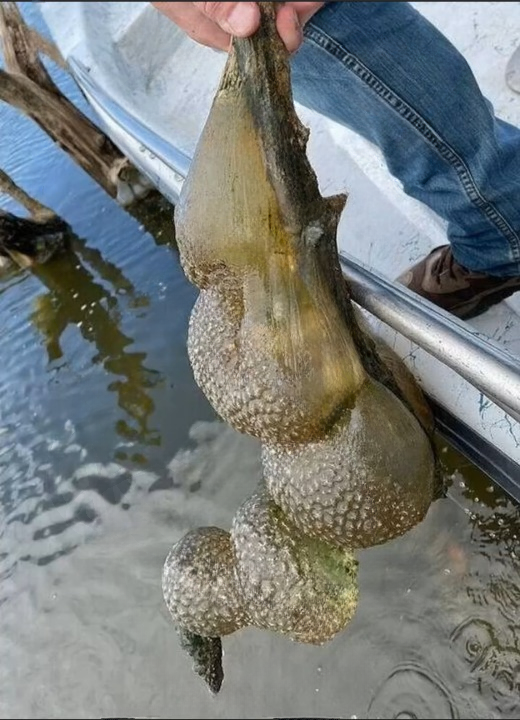
A strange discovery beneath the surface of a lake can easily capture people’s attention. Clear, gelatinous masses hanging from submerged tree branches may look unusual, especially to someone who has spent years fishing the same waters without noticing them before.
That is the kind of sight described in a story from McGee Creek Reservoir in Atoka County, Oklahoma. The unusual formations, sometimes referred to as “lake jellies,” resemble large transparent blobs suspended underwater. Although their appearance may seem mysterious, they are associated with a group of small aquatic organisms known as freshwater bryozoans.
These organisms are far less frightening than their unusual appearance might suggest. In fact, they are an interesting part of freshwater ecosystems and offer a glimpse into a largely unseen underwater world.
What Are Freshwater Bryozoans?
Bryozoans are small aquatic invertebrates that live together in colonies. They can be found in freshwater and marine environments, depending on the species.
Some freshwater bryozoans form soft, gelatinous colonies that attach themselves to underwater surfaces. These may include submerged branches, rocks, logs, and other stable objects.
A large colony is not a single animal. It consists of many tiny individual organisms called zooids. Each zooid is small, but thousands of them can live together within a shared structure.
The gelatinous material surrounding the colony provides support and helps hold the individual organisms together. Because it contains a large amount of water, the colony can appear almost transparent when viewed underwater.
Depending on the species and environmental conditions, these formations can become surprisingly large. Their unusual shape and texture are among the reasons they attract attention from anglers, swimmers, and people exploring freshwater habitats.
How Do These Tiny Organisms Live?
Although a bryozoan colony may look like a motionless underwater blob, its individual members are active feeders.
Each zooid has a specialized feeding structure called a lophophore. This structure consists of a crown of tentacles surrounding the mouth.
The tentacles are covered with tiny hair-like structures known as cilia. Their movement helps create water currents that bring microscopic food particles toward the feeding area.
Bryozoans generally feed on suspended material, including microscopic algae and other small particles found in the water.
Because many zooids feed together, an entire colony can collect food from the surrounding environment. This feeding activity makes bryozoans part of the natural process through which aquatic ecosystems use and recycle suspended organic material.
Their feeding behavior is sometimes compared with that of other filter-feeding organisms. However, describing them as a complete lake-cleaning system would be an exaggeration. They contribute to natural ecological processes, but they do not independently determine whether a lake has good water quality.
Why Do Bryozoans Form Gelatinous Colonies?
Living together provides several advantages for these organisms.
The shared gelatinous structure allows individual zooids to remain connected while occupying a larger surface area. This arrangement also gives the colony a way to attach itself to objects beneath the water.
Submerged wood can provide a suitable place for colonies to develop because it offers a stable surface and access to moving water containing food particles.
The appearance of a colony can change over time. Some formations look rounded and compact, while others develop irregular lobes or hanging shapes.
Water movement, the age of the colony, and the particular species can influence its appearance.
This explains why two colonies in the same lake may not look exactly alike.
How Do Bryozoans Survive Changing Seasons?
One of the most interesting features of many freshwater bryozoans is their ability to survive unfavorable environmental conditions.
Some species produce specialized structures called statoblasts. These are durable reproductive or survival bodies that help the organisms persist when conditions become unsuitable for active growth.
Statoblasts can remain dormant during periods of cold weather or other environmental stress. When conditions become favorable again, they may develop into new colonies.
This survival strategy helps explain how freshwater bryozoans can appear in a particular area during one season and become much less noticeable during another.
The process also helps populations persist even when the adult colonies do not survive throughout the entire year.
Statoblasts can be transported through waterways and may also spread through natural processes involving aquatic animals and water movement. This allows the organisms to reach suitable habitats beyond the locations where earlier colonies developed.
As temperatures and other environmental conditions change, new colonies may begin growing on available underwater surfaces.
Why Might People Suddenly Notice Them in a Familiar Lake?
A lake that has been visited for many years can still contain organisms that most visitors have never seen.
Bryozoan colonies may become more noticeable when they grow large enough to be visible from the surface or from a boat. Their transparent appearance can also make them difficult to spot under certain lighting conditions.
Several factors can influence when people notice them:
- Seasonal growth: Favorable conditions can support the development of visible colonies.
- Available surfaces: Submerged branches, logs, and rocks provide places for attachment.
- Water movement: Currents help bring food particles toward feeding organisms.
- Visibility: Sunlight and clear water can make transparent formations easier to see.
- Colony size: Larger formations are naturally more noticeable than newly developing ones.
For anglers, these colonies may be particularly surprising because they can appear attached to underwater branches and other structures commonly encountered while fishing.
However, their presence does not necessarily mean that they have recently arrived or that the lake has experienced an unusual environmental event.
Are Freshwater Bryozoans Dangerous?
The unusual appearance of gelatinous colonies can lead to understandable questions about safety.
Freshwater bryozoans are not jellyfish, and their colonies should not be confused with the familiar stinging marine animals found in oceans. They are a different group of organisms with a different biological structure.
Their presence alone is not generally considered a reason for alarm.
Nevertheless, people should avoid handling unfamiliar aquatic growth unnecessarily. Other organisms, algae, and substances in freshwater environments can look similar, and appearance alone is not always enough to identify what has been found.
Anyone who discovers an unusual mass in a lake should avoid disturbing it and can take a photograph for identification. Local wildlife or environmental authorities may be able to provide more information when there is uncertainty.
It is also important to remember that the presence of bryozoans does not prove that water is safe to drink or swim in. Water quality depends on many different environmental factors and should be assessed through appropriate testing.
What Role Do Bryozoans Play in Freshwater Ecosystems?
Bryozoans are part of the biodiversity found in lakes, ponds, and other aquatic habitats.
By feeding on suspended microscopic particles, they participate in the movement of nutrients and organic material through freshwater food webs.
Their colonies can also provide small-scale habitat structures for other organisms. Tiny aquatic animals may use the surfaces and surrounding spaces as places to move, feed, or shelter.
Like other aquatic invertebrates, bryozoans are part of a much larger ecological network. Their populations interact with microorganisms, plants, other invertebrates, and environmental conditions.
Although they are rarely noticed by casual visitors, these small organisms contribute to the complexity of freshwater habitats.
An Ancient Group of Aquatic Organisms
Bryozoans also have a long evolutionary history. Fossils show that members of this animal group existed hundreds of millions of years ago.
Ancient bryozoans were important components of marine environments, where their colonies contributed to the diversity of underwater communities.
Modern species continue to inhabit aquatic environments around the world. Their survival across long periods of geological history demonstrates how successful colonial living and specialized feeding structures can be.
Freshwater bryozoans may look unfamiliar to someone seeing them for the first time, but they belong to a well-established group of organisms with a fascinating biological history.
What to Remember When You See a Jelly-Like Mass Underwater
A large transparent formation attached to a submerged tree branch can certainly look unusual. However, it may be a colony of freshwater bryozoans rather than a dangerous organism or an unusual form of pollution.
These colonies are made up of thousands of tiny zooids living together inside a shared gelatinous structure. Their specialized tentacles help them collect microscopic food particles, while statoblasts allow certain species to survive unfavorable conditions and develop new colonies later.
Their presence is one reminder of how much life exists beneath the surface of familiar lakes and reservoirs.
The next time an unusual transparent mass appears beneath the water, it may be worth taking a closer look from a safe distance. What initially seems mysterious could turn out to be an ordinary, yet remarkable, example of freshwater biology.