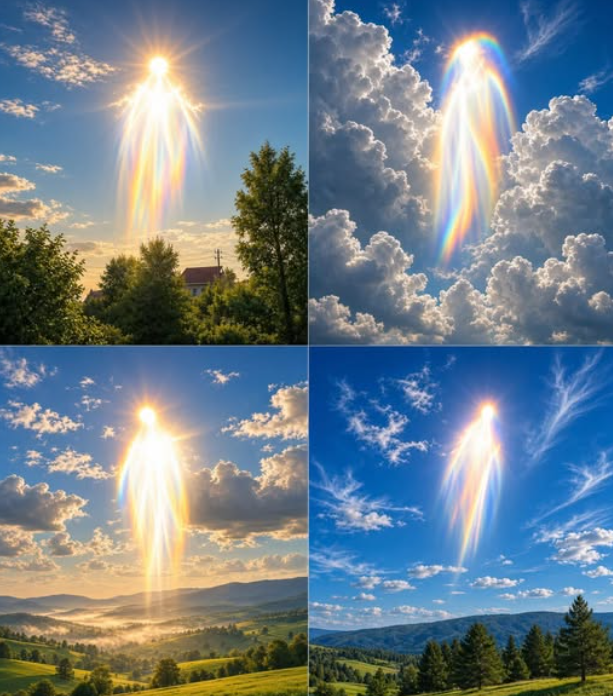
A series of unusual photographs attributed to the Greek island of Ikaria has attracted attention online, leaving viewers debating what they might show. The images appear to capture a bright, elongated formation in the sky, surrounded by clouds and intense sunlight. Beneath the glowing center are colorful bands of yellow, orange, blue, and violet that seem to stretch downward.
What makes the pictures especially intriguing is their apparent resemblance to a human figure. Some viewers believe the shape looks like an angel or another heavenly presence, while others have suggested that it could be an unusual atmospheric effect or an image created with artificial intelligence.
Despite the many interpretations, one important question remains unanswered: Is there reliable evidence that the photographs show a real event above Ikaria?
The Unusual Images That Started the Discussion
The photographs reportedly circulated online after being associated with Ikaria, an island in the eastern Aegean Sea in Greece.
The bright formation appears against a blue sky, with a luminous upper section and flowing colors below it. Together, these elements create the impression of a figure suspended in the air.
For some viewers, the image immediately brings to mind familiar religious artwork. Angels and other heavenly beings have traditionally been represented with radiant light, glowing outlines, and human-like shapes. The resemblance has encouraged people to discuss whether the pictures could have a spiritual meaning.
Others have approached the images from a scientific or technological perspective. They have questioned whether the colors might be caused by an optical effect, whether a camera or editing software changed the appearance, or whether an AI image generator produced the scene.
A report published by the Greek news outlet Europost on July 27, 2024, discussed photographs described as showing an unusual light formation over Ikaria. The images prompted speculation about their possible origin, but the report did not establish their authenticity.
This distinction is important. A photograph circulating online does not automatically prove that the event described in its caption actually happened. Without the original files, a verified photographer, and reliable information about the time and location, the pictures remain difficult to assess.
Could a Natural Atmospheric Phenomenon Explain the Colors?
One possible explanation involves atmospheric optics, the study of how light behaves as it passes through the atmosphere.
Sunlight interacts with water droplets, ice crystals, clouds, and other particles in ways that can produce surprising visual effects. Depending on the conditions, light may be reflected, refracted, scattered, or separated into different colors.
Rainbows are the most familiar example. They form when sunlight interacts with water droplets in the atmosphere, producing a visible spectrum of colors. However, rainbows are not the only atmospheric effects capable of creating colorful displays.
Several other natural phenomena can produce unusual patterns in the sky.
Sun Pillars
A sun pillar is a vertical column of light that can appear to extend above or below the Sun. It is generally associated with sunlight reflecting from ice crystals suspended in the atmosphere.
Depending on the viewing conditions, the effect can resemble a bright beam or glowing column against the surrounding sky.
Although this phenomenon may sound similar to the appearance of the Ikaria images, there is not enough information to identify it as the cause of the photographs.
Cloud Iridescence
Cloud iridescence occurs when sunlight interacts with small water droplets or ice crystals in clouds. The effect can produce pastel or rainbow-like colors, sometimes appearing in irregular patches.
The colors may look especially vivid when they contrast with a blue sky or darker cloud formations.
Other Optical Effects
Light passing through gaps in clouds can also create dramatic beams and patterns. These effects are sometimes called crepuscular rays.
Camera settings can influence how these scenes appear in photographs. Exposure, lens characteristics, reflections, digital processing, and image compression may change the intensity and appearance of bright areas.
These possibilities show that nature can produce unusual displays. However, none of them can be confirmed as the explanation for the Ikaria photographs without additional evidence.
Why Some People Believe the Formation Resembles an Angel
The apparent human-like shape is one of the main reasons the photographs have attracted so much attention.
The bright upper section may look like a head, while the elongated colorful bands below it can resemble a body, clothing, or wings. Against the clouds and blue sky, the formation may appear similar to traditional illustrations of angels.
Across different cultures and historical periods, artists have used light to represent holiness, protection, revelation, and divine presence. Religious paintings often show heavenly figures surrounded by glowing halos or emerging from luminous clouds.
When people encounter an image that resembles these familiar representations, their interpretation may be influenced by personal beliefs and cultural experiences.
For someone with a religious background, the photographs might suggest a spiritual symbol. Someone interested in science may instead focus on the possible interaction between sunlight and atmospheric particles. Others may simply wonder whether the image has been digitally created.
These different reactions are understandable, but an emotional or spiritual interpretation is not the same as scientific verification.
The Role of Pareidolia
There is also a psychological explanation for why people sometimes recognize familiar figures in unusual images.
The phenomenon is known as pareidolia. It describes the human tendency to recognize familiar patterns, such as faces, animals, or human figures, in ambiguous visual material.
People experience pareidolia when looking at clouds, shadows, rocks, and other irregular shapes. The brain naturally searches for recognizable patterns, even when the visual material does not objectively contain the figure being perceived.
In the Ikaria photographs, the bright upper section and narrow vertical colors may encourage some viewers to see a human-like silhouette.
Pareidolia does not prove that an image is fake. It also does not explain how the image was created. It simply helps explain why different people may interpret the same unusual shape in different ways.
Could Artificial Intelligence Have Created the Photographs?
Another possibility raised in online discussions is that the pictures may have been generated or altered using artificial intelligence.
Modern AI image-generation tools can produce highly detailed scenes from written descriptions. They can create realistic-looking skies, dramatic clouds, bright light sources, and unusual figures without requiring a corresponding real-world event.
For example, a description of a glowing human-shaped figure appearing among clouds above a Mediterranean island could produce an image with several features similar to those seen in the circulating photographs.
The technology has developed considerably, making it increasingly difficult to identify synthetic images simply by looking at them.
Some AI-generated pictures contain visual inconsistencies, such as unusual reflections, distorted objects, irregular textures, or lighting that does not behave naturally. However, these clues are not always present, and genuine photographs can also contain visual irregularities.
Likewise, conventional editing software can change colors, contrast, sharpness, and brightness. An ordinary photograph may look dramatically different after extensive editing.
For this reason, the appearance of the Ikaria images alone cannot establish whether artificial intelligence was involved.
How Experts Could Investigate the Images
Determining whether the photographs are genuine would require more than simply examining their visual appearance.
Investigators would first need to identify the earliest available version of the images and establish who originally published them.
Original files could provide useful information about the camera, capture time, and technical settings. This information is sometimes stored in image metadata, although metadata can be removed or modified and should not be treated as conclusive proof.
Reverse-image searches could also help reveal whether the pictures appeared online before the alleged sighting. Comparing different versions might show whether they were edited, copied, or derived from an earlier image.
Specialized forensic analysis could provide additional clues about digital processing or synthetic image creation. However, no single detection method can reliably identify every AI-generated or manipulated image.
It would also be important to establish whether the photographs were taken independently. Several similar images circulating online do not necessarily represent several independent witnesses. They may all originate from one original picture or from a common digital source.
What Evidence Would Help Establish the Truth?
A reliable investigation into the alleged Ikaria sighting would begin with several basic questions.
- When were the photographs actually taken?
- Who captured the original images?
- Where was the photographer standing?
- Are the original photographs or video recordings available?
- Can recognizable landmarks confirm the location?
- Were other independent witnesses present?
- Do weather records support a possible atmospheric explanation?
If the images documented a genuine optical phenomenon, information about the weather, cloud conditions, and the Sun’s position could help researchers evaluate possible causes.
Independent photographs or videos taken from different locations would also be valuable. If several people recorded the same formation at the same time, investigators could compare the material to determine whether it was consistent with a physical event.
If digital manipulation or AI generation were suspected, researchers could examine the original files and compare them with earlier versions.
Until this information becomes available, it would be premature to identify a specific explanation.
How to Evaluate Extraordinary Images on Social Media
The story also highlights a broader challenge facing internet users. Photographs can spread rapidly across social media, often reaching thousands or millions of people before their origins are properly investigated.
A dramatic caption may describe an image as a miracle, an unexplained event, or proof of something extraordinary. As the picture gets reposted, the original source can become difficult to find, and speculation may gradually be repeated as fact.
There are several practical ways to approach such content more carefully.
First, look for the earliest available version of the photograph rather than relying only on screenshots or reposts.
Second, check whether reputable news organizations or independent investigators have verified the event.
Third, look for original footage, named witnesses, and specific details that can be confirmed.
Finally, remember that an unusual appearance does not automatically prove either a supernatural event or digital deception. Nature can produce surprising optical effects, while modern technology can create images that look remarkably realistic.
The most reliable conclusions come from evidence rather than assumptions.
What Is Actually Known About the Ikaria Light?
The Greek island of Ikaria is a real place, and unusual atmospheric optical effects are genuine scientific phenomena. However, these facts do not establish that the specific luminous formation shown in the circulating photographs appeared above the island as described.
The images have prompted several interpretations, including a possible angelic figure, a natural atmospheric phenomenon, and an AI-generated or digitally altered creation.
At present, the available information does not conclusively establish the photographs’ authenticity, original source, or precise explanation.
It is possible for people to find the pictures meaningful from a religious, cultural, or artistic perspective without claiming that a supernatural event has been scientifically proven.
The distinction between personal interpretation and verifiable evidence allows the discussion to remain respectful while avoiding unsupported conclusions.
An Intriguing Image That Still Needs Verification
The mysterious rainbow-colored formation attributed to Ikaria continues to attract curiosity because it appears to sit between the familiar and the unexplained.
Some viewers see something spiritual, others see a possible natural optical effect, and some suspect digital creation. Each interpretation raises interesting questions, but none should be presented as the confirmed answer without reliable supporting evidence.
Ultimately, the most important part of the story is not whether the image looks like an angel or an unusual beam of light. It is whether the original photographs can be authenticated and their origin established.
Until that happens, the alleged rainbow-colored light above Ikaria should be treated as an intriguing but unverified online story, rather than proof of a supernatural appearance or a confirmed scientific discovery.