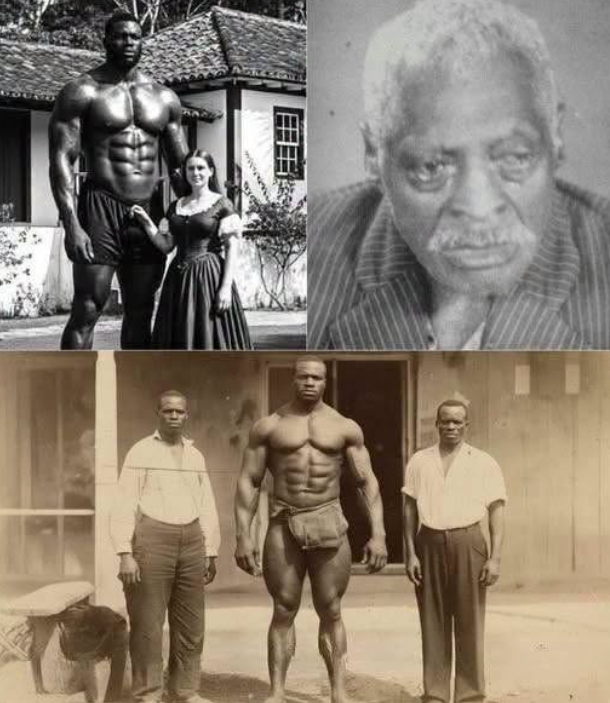
In nineteenth-century Brazil, a man named Roque José Florêncio became known by the nickname Pata Seca, commonly translated as “Dry Leg.” According to accounts passed down through generations, he was exceptionally tall, reaching approximately 7 feet 2 inches (2.18 meters). But his physical appearance was only one part of a much more complicated story.
His name became associated with allegations of exploitation during slavery, claims that he fathered more than 200 children, and reports that he lived to an extraordinary age. Although some details remain uncertain, his story offers an opportunity to examine the cruelty of slavery and the importance of preserving the histories of people whose lives were rarely documented.
The Man Behind the Nickname
Roque José Florêncio is commonly believed to have been born around 1827 or 1828 in the Brazilian province of São Paulo, possibly in the Sorocaba region.
Descriptions preserved through local and family traditions portray him as an unusually tall Black man with broad shoulders and relatively slender lower legs. His physical proportions reportedly inspired the nickname Pata Seca.
However, the surviving historical information about his early life is limited. Much of what is known comes from oral accounts, family recollections, and later research rather than a complete collection of contemporary records.
This uncertainty is important. Stories about his height, family, and experiences have circulated for generations, but not every detail can be independently confirmed.
Behind the nickname was a person who lived during a period when slavery shaped nearly every aspect of Brazilian society.
Growing Up Under Slavery in Brazil
During the nineteenth century, Brazil remained deeply dependent on enslaved labor. Millions of Africans and their descendants were forced to work in agriculture, mining, domestic service, and other industries.
In southeastern Brazil, coffee production became increasingly important. Large plantations depended on extensive workforces, and the wealth generated by the industry helped shape the region’s economy.
For enslaved people, however, this prosperity came at an enormous human cost.
They had little control over their working conditions, movement, or family lives. People could be sold or transferred between properties, sometimes separating parents from children and spouses from one another.
Historical records often reflect this imbalance. Wealthy landowners left behind financial documents, property records, and correspondence, while enslaved people frequently appeared only through brief descriptions or incomplete information.
As a result, reconstructing the personal lives of people such as Roque can be difficult.
Their experiences were real, but many details were never recorded in the documents historians commonly use.
Why Pata Seca Became Associated With Exploitation
One of the most disturbing elements of Roque’s traditional biography concerns the way slaveholders allegedly viewed his physical characteristics.
According to regional accounts, certain landowners believed that his unusual height and appearance made him particularly valuable as a potential father of children who could later be forced into labor.
These beliefs were not scientifically supported. A person’s height or leg proportions cannot determine how many children they will have or whether those children will be boys or girls.
Nevertheless, the story illustrates how slavery could turn even the most personal aspects of human life into matters of economic interest.
Enslavers treated people as property and sought to control their labor, movement, and family relationships. Enslaved women were also subjected to reproductive exploitation, often under circumstances in which they had little freedom to make decisions about their own bodies.
The traditional account of Pata Seca therefore raises questions about more than one man’s experience. It also draws attention to the women whose stories are rarely included in popular versions of his biography.
Their experiences deserve recognition rather than being reduced to numbers associated with a famous figure.
His Reported Life at Fazenda Santa Eudóxia
According to accounts preserved in the Santa Eudóxia region, Roque was reportedly purchased in Sorocaba around 1849 by Francisco da Cunha Bueno, a landowner associated with Fazenda Santa Eudóxia.
Some later versions of the story suggest that Roque was selected because of his unusual physical characteristics and the belief that he could father many children.
The exact circumstances of the purchase and the decisions surrounding his treatment are not fully established. Dramatic descriptions of negotiations or conversations should therefore be treated cautiously.
Other regional accounts suggest that Roque performed duties involving animals, transportation, and errands rather than spending all his time working in coffee fields.
Even if his daily responsibilities differed from those of other enslaved workers, that would not mean he enjoyed genuine freedom. Different treatment did not remove the power an enslaver held over a person’s life.
A person could receive better food or perform different work while remaining unable to decide where to live or whether to leave.
This distinction is essential when examining his story. Any apparent privilege existed within a system that denied basic human rights.
The Claims About His Children
Perhaps the most widely repeated claim about Pata Seca is that he fathered more than 200 children. Some retellings give even higher estimates.
These figures have helped make his biography popular, but they have not been established through a complete, independently verified genealogical record.
Family recollections and regional traditions preserve stories about his large number of descendants. Interviews with members of his family, including recollections attributed to his grandson Nelson Florêncio, have contributed to efforts to understand his history.
Oral history is valuable, particularly when researching communities whose experiences were neglected by official records. Family memories can preserve names, relationships, and events that might otherwise have disappeared.
At the same time, stories can change as they pass between generations. Different family branches may remember events differently, and popular accounts sometimes confuse children with later descendants.
For that reason, the number of children attributed to Roque should be presented as a traditional claim rather than a confirmed total.
More importantly, the women involved should not disappear from the story. If relationships and pregnancies were shaped by an enslaver’s demands, the women experienced their own forms of coercion and hardship.
They were individuals with families, feelings, and lives of their own. Their experiences deserve the same attention as Roque’s.
Brazil’s Long Journey Toward Abolition
Roque’s reported lifetime coincided with major changes in Brazilian history.
In 1850, Brazil passed the Eusébio de Queirós Law, which targeted the transatlantic slave trade. However, the law did not immediately free people who were already enslaved.
In 1871, the Free Womb Law declared that children born to enslaved mothers after its enactment would be legally free, although its provisions still allowed considerable control over their lives and labor.
Further legal changes followed, but slavery remained in place.
Resistance by enslaved people, escapes from plantations, abolitionist campaigning, and political pressure all contributed to the movement toward emancipation.
Finally, on May 13, 1888, Princess Isabel signed the Lei Áurea, or Golden Law, abolishing slavery throughout Brazil.
If Roque’s commonly reported birth year is approximately correct, he would have been around 60 years old when abolition became law.
For someone who had spent most of his adult life under slavery, emancipation represented a major turning point. Yet freedom did not immediately eliminate poverty, discrimination, or the economic inequalities created by generations of forced labor.
Formerly enslaved people often had to build independent lives without access to land, savings, education, or reliable financial support.
Life After Emancipation
Regional accounts suggest that Roque remained connected to the Santa Eudóxia area after abolition.
Some versions of his biography claim that he received land from his former owner. The property is sometimes associated with the name Sítio Pata Seca, although details about its size and the circumstances of the reported transfer vary.
If accurate, access to land would have represented an important change in his life.
It could provide an opportunity to cultivate food, establish a household, and work for the benefit of his own family rather than an enslaver.
Other accounts suggest that he experienced financial difficulties and may have lost part of the property. Some describe him supporting himself through small-scale agriculture and other activities.
The available information does not provide a complete picture of his economic circumstances. Nevertheless, his reported life after emancipation offers a reminder that freedom was only the beginning of a new set of challenges.
His Family and the Stories That Survived
Roque is often reported to have married a woman named Palmira, with whom he had nine children. These details appear in popular accounts, although the complete documentary evidence remains limited.
Family relationships became an important part of how his name survived.
In communities where written records were incomplete, stories passed between grandparents, parents, and children could preserve connections to earlier generations.
Some accounts claim that a substantial number of people in the Santa Eudóxia area can trace their ancestry to Pata Seca. However, specific percentages sometimes repeated online should not be treated as verified demographic findings without comprehensive genealogical research.
Even so, the continued interest of his descendants demonstrates the importance of family memory.
His story is not simply about an unusual physical appearance or an extraordinary number of alleged children. It is also about the people who preserved his name and continued investigating the history of their community.
Did Pata Seca Really Live to 130?
Another remarkable claim concerns Roque’s age.
Many accounts state that he died on February 17, 1958, at approximately 130 years old. If his reported birth year of 1827 is correct, this would represent an exceptionally long lifespan.
However, his birth date has not been securely established through the kind of documentation needed to confirm such a longevity record.
Records from the early nineteenth century were often incomplete, particularly for people born into slavery. Later estimates of someone’s age could rely on family memories or information that was never independently verified.
Therefore, the claim that Roque lived for approximately 130 years should be understood as part of his traditional biography rather than a confirmed scientific record.
His life remains historically meaningful without relying on an extraordinary age claim.
Why His Story Still Matters
Pata Seca’s story has attracted renewed attention through local research, family investigations, and artistic projects.
Brazilian artist Nádia Taquary created a work titled Roque José Florêncio e Filhos do Apagamento, associated with the Pinacoteca de São Paulo and the Enciclopédia Negra project. The work reflects broader efforts to recognize Black historical figures whose experiences have been overlooked.
These projects encourage people to look beyond the familiar names of wealthy landowners and political leaders and consider the lives of those whose labor sustained the country.
They also raise an important question: how many personal histories were lost because enslaved people were not given the opportunity to preserve their own stories?
In Roque’s case, the surviving accounts provide only fragments. His precise birth date, the full circumstances of his enslavement, the number of children attributed to him, and his reported age remain uncertain.
But those gaps should not make his experience less worthy of attention.
Remembering Roque José Florêncio
Today, the most meaningful way to remember Pata Seca is to recognize the person behind the nickname.
His story is connected to a period when Brazilian law permitted human beings to be bought, sold, and controlled by others. Traditional accounts describe how his unusual physical characteristics allegedly attracted the attention of slaveholders who viewed reproduction as a potential source of economic gain.
The details of his biography require careful historical examination, but the broader context is clear: slavery denied people control over their labor, relationships, and futures.
Roque’s reported life also crossed the historic transition from slavery to freedom. His name survived through family traditions and community memories, allowing later generations to continue asking questions about his experiences.
His legacy should not be measured by his height, the number of children attributed to him, or the age he reportedly reached.
It should be understood through the human dignity that slavery attempted to deny him.
Before he became known as Pata Seca, Roque José Florêncio was a human being who deserved freedom, respect, and the right to make decisions about his own life.
That is the part of his story most worth remembering.