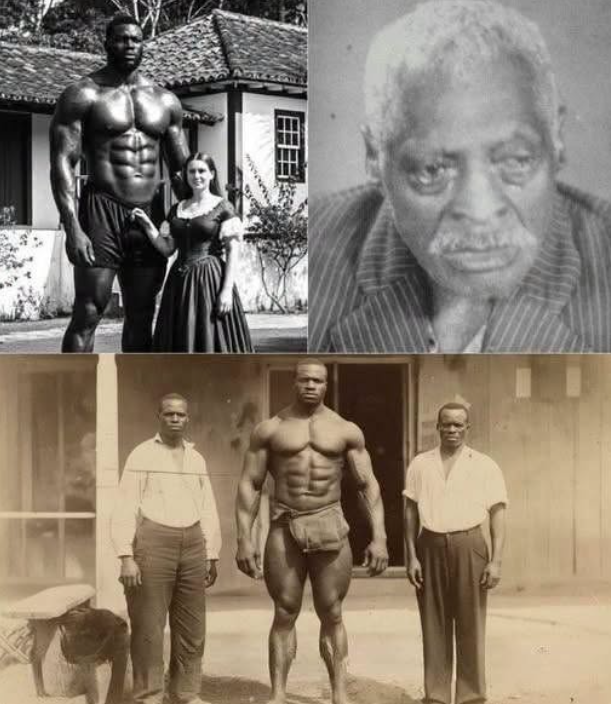
In nineteenth-century Brazil, a man named Roque José Florêncio became known by the nickname Pata Seca, commonly translated as “Dry Leg.” Stories about his unusual height and his life under slavery have endured for generations, turning him into a figure of local history and oral tradition.
His biography is also surrounded by uncertainty. Some accounts claim that he was selected by a landowner because of his physical characteristics and forced to father children who could be exploited as laborers. Other widely repeated stories suggest that he fathered more than 200 children and lived to an extraordinary age. However, not all these details have been established through surviving historical records.
What can be understood from the broader historical context is the injustice of a society that treated enslaved people as property and denied them control over their own lives, families, and futures.
The Man Behind the Name
Roque José Florêncio is commonly believed to have been born around 1827 or 1828 in the Brazilian province of São Paulo. His exact birth date and several details of his early life remain uncertain.
According to local accounts, he was exceptionally tall, with some estimates placing his height at approximately 7 feet 2 inches, or 2.18 meters. His unusual appearance reportedly contributed to the nickname Pata Seca.
Yet his physical characteristics are only one part of the story. Much of the attention surrounding him comes from accounts of how slaveholders allegedly viewed his body and potential offspring as economic assets.
These stories are disturbing because they describe a world in which enslaved people could be denied the most basic form of personal freedom: the right to make decisions about their own bodies and families.
Because much of Roque’s biography has been preserved through oral history and local recollections, individual claims should be treated carefully. The lack of complete documentation does not diminish the importance of remembering the historical conditions in which he lived, but it does mean that popular accounts cannot automatically be treated as verified fact.
Growing Up in a Society Built on Slavery
During the nineteenth century, Brazil remained deeply shaped by slavery. Millions of Africans and their descendants had been subjected to forced labor over several centuries, supporting agricultural production, mining, domestic work, and other parts of the economy.
In southeastern Brazil, coffee production became increasingly important. Large plantations depended on substantial labor forces, and the wealth generated by this industry helped influence the development of São Paulo.
Behind that prosperity was a system built on coercion. Enslaved people could be forced to work under harsh conditions, punished for resisting, sold to new owners, and separated from their relatives.
Children born into slavery faced the same denial of freedom. Their lives could be shaped by decisions made by people who claimed ownership over them, rather than by their own wishes or those of their families.
Historical records from this period often reflect the priorities of slaveholders and institutions. Wealthy landowners might leave behind financial documents, property records, and correspondence, while enslaved people could appear only briefly in surviving paperwork.
As a result, historians often face significant challenges when reconstructing the personal experiences of enslaved individuals. Family memories and oral traditions can preserve important information, but they may also contain gaps, variations, and details that are difficult to confirm independently.
Roque’s story reflects this wider problem: the people whose lives were most affected by slavery were often the people whose voices were least likely to be preserved in official records.
Claims About His Physical Characteristics
Pata Seca is frequently described in popular accounts as an unusually tall man with a distinctive build. Some versions of his story give his height as approximately 2.18 meters.
Without reliable measurements or contemporary documentation, however, that figure should be understood as an estimate repeated in accounts of his life rather than a conclusively established fact.
His nickname also became an important part of the way the story was told. Such labels can preserve a detail remembered by a community, but they can also reduce a person’s identity to a physical trait.
Roque was more than a nickname or an unusual appearance. He was a person who lived within a system that restricted his freedom and shaped the possibilities available to him.
Remembering that distinction helps prevent the story from becoming simply a tale about an extraordinary body.
The Allegations of Forced Reproduction
One of the most troubling claims associated with Pata Seca is that a landowner allegedly sought to exploit his physical characteristics by forcing him to father children. According to some accounts, the children were intended to become part of the enslaved workforce.
If accurately described, such conduct would represent a particularly severe form of exploitation. Enslaved people were already deprived of legal freedom, and the control exerted over their intimate and family lives could be another expression of that system.
However, the specific allegations about Roque’s circumstances are not fully established by the information available in the account. They should therefore be presented as claims preserved in local tradition, not as definitively proven details of his biography.
The broader historical reality is clear: slavery enabled people to be treated as property, and enslaved families were vulnerable to coercion, separation, and exploitation. That context explains why stories of forced reproduction resonate so strongly, even when individual details require further evidence.
It is also important not to treat the alleged number of Roque’s children as a confirmed statistic. Some stories claim that he fathered more than 200 children, but a figure of that scale would require reliable documentation before it could be accepted as fact.
How Oral History Preserves the Past
Oral history plays an important role in preserving the experiences of communities, particularly when official records are incomplete or biased.
Family recollections, local stories, and community traditions can carry information that would otherwise be lost. They can preserve names, relationships, experiences, and memories across generations.
At the same time, oral accounts can change as they are retold. Dates may become uncertain, estimates may be repeated as facts, and separate memories can sometimes merge into a single narrative.
The story of Pata Seca illustrates why historians often compare oral traditions with surviving documents and other forms of evidence.
Presentations connected with artist Nádia Taquary’s work on Roque, including material associated with the Pinacoteca de São Paulo, have acknowledged the importance of oral accounts in preserving his history. This recognition also highlights the limits of the surviving record.
Rather than dismissing local traditions or accepting every detail without question, a careful approach considers what the stories preserve, what remains uncertain, and what can be supported by independent evidence.
The Question of His Descendants
Pata Seca is sometimes described as the ancestor of a large number of descendants in the São Paulo region. Some accounts claim that his family became an important part of the local community.
These claims are difficult to evaluate without detailed genealogical records. The number of children attributed to him, the identities of those children, and the extent of any descendant network should not be presented as settled facts unless supported by reliable documentation.
Even so, the interest in his descendants reflects a broader historical reality. Family connections among formerly enslaved people have been important to the preservation of identity, community memory, and cultural continuity.
For descendants of enslaved people, reconstructing family histories can be challenging. Records may be incomplete, names may have changed, and families may have been separated by forced labor or sale.
That makes careful historical research especially important. A documented family history can help connect individual lives with the wider events that shaped a community, while also distinguishing confirmed relationships from stories passed down over time.
A Reported Long Life and Other Uncertain Details
Some versions of Pata Seca’s story claim that he lived for approximately 130 years. Such a lifespan would be exceptional, and it should not be accepted without strong supporting records.
Historical accounts of people born into slavery can contain uncertainty about dates of birth and death. Ages may have been estimated, and records may have been created long after the events they describe.
For that reason, claims about Roque’s age need to be considered alongside the quality of the available evidence. It is more accurate to acknowledge that some accounts attribute an extraordinary lifespan to him than to repeat the figure as a verified fact.
The same standard should apply to other remarkable details. A story’s longevity does not necessarily prove every part of it, but uncertainty about particular claims does not erase the historical injustice that gives the story its significance.
Remembering the Person, Not Just the Legend
Pata Seca’s story continues to draw attention because it brings together several difficult subjects: slavery, bodily exploitation, family history, community memory, and the challenge of recovering lives that were poorly documented.
It can be tempting to focus on the most astonishing details, such as his reported height, the number of children attributed to him, or claims about his lifespan. Those elements may make the story memorable, but they should not overshadow the larger human experience.
Roque José Florêncio lived in a society that denied enslaved people control over their labor and many of their personal choices. His life, as remembered through local accounts, offers a way to consider how slavery affected not only economic and political systems but also family relationships and individual dignity.
At the same time, respecting his memory means acknowledging what is not known. Historical uncertainty should not be filled with invented details simply to make a story more dramatic.
The most meaningful way to approach Pata Seca is to recognize both the suffering associated with the system in which he lived and the limitations of the surviving evidence. His story is part of a much larger history of people whose lives were shaped by slavery, whose experiences were often excluded from official narratives, and whose descendants and communities continue to preserve their memories.
The details of his biography may remain partly unresolved, but the broader lesson is clear: people should never be reduced to their physical characteristics, their labor, or the legends that grow around them. Their humanity must remain at the center of the story.