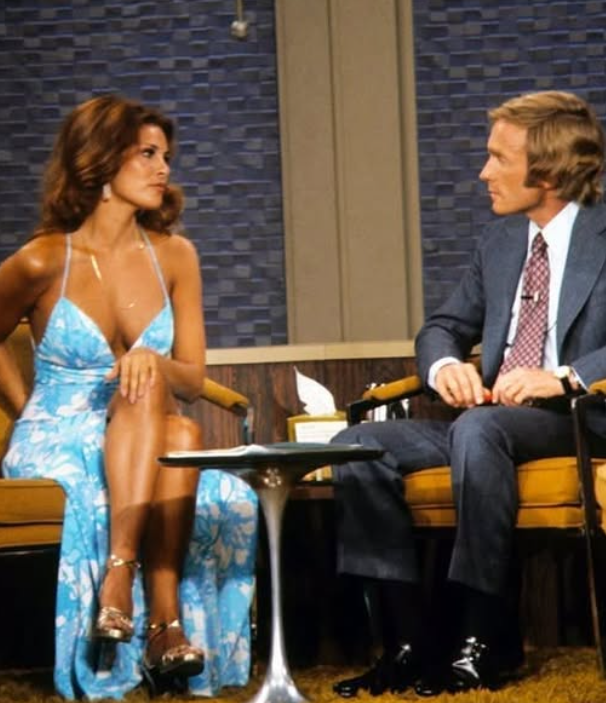
Raquel Welch became one of the most recognizable faces in Hollywood during the 1960s and 1970s. Although audiences often associated her with glamorous roles and striking screen appearances, her career also demonstrated determination, humor, and a serious commitment to her craft.
Her 1972 appearance on The Dick Cavett Show offers a glimpse into how she spoke about her work and the public image that surrounded her. Looking back at interviews from this period helps place Welch in a broader context—not simply as a celebrated actress, but as a performer navigating the expectations placed on women in the entertainment industry.
An Interview Beyond the Headlines
Dick Cavett became known for a conversational interviewing style that gave guests room to discuss their careers, experiences, and ideas. His program featured actors, filmmakers, writers, and other prominent figures, often moving beyond the standard promotional questions.
Welch’s appearance came during an important period in her career. By the early 1970s, she was widely recognized for her roles in films such as Fantastic Voyage and One Million Years B.C. Her public image was strongly connected to her appearance, sometimes overshadowing the preparation and effort involved in her acting work.
A television interview offered an opportunity to show a different side of that image. Rather than being defined entirely by publicity photographs or movie posters, Welch could speak about the practical realities of making films and the experiences that shaped her career.
The Physical Demands of Kansas City Bomber
One of the projects associated with Welch’s work during this period was Kansas City Bomber, a 1972 drama set in the world of professional roller derby.
Welch played K.C. Carr, an ambitious skater whose professional goals intersect with complicated personal relationships. The role required her to engage with a physically demanding sport that was unfamiliar to many movie audiences.
Preparing for the film involved learning roller-skating skills and adapting to the movements and challenges of the sport. Roller derby is a fast-paced activity involving balance, speed, close contact, and the ability to maneuver around other skaters. Performing convincingly in that environment required more than simply wearing the costume.
Accounts of Welch’s preparation describe the physical difficulties she encountered, including an injury to her wrist. The experience illustrates how roles that appear effortless on screen can require substantial training and carry real physical risks.
The production also demonstrates a broader aspect of Welch’s career: she took on a range of characters rather than remaining exclusively within the type of roles that first brought her widespread recognition.
The Reality Behind a Famous Image
Welch’s celebrity was closely tied to her appearance, particularly after the success of One Million Years B.C. Her image became familiar to audiences around the world, and publicity often emphasized her looks more than her acting decisions.
That attention could create a gap between the person viewers imagined and the woman they encountered in interviews.
In the supplied account of her conversation with Cavett, Welch described meeting people who expected her to be much larger in person because of her commanding screen presence. The anecdote was presented with humor, reflecting her awareness of how movies and publicity could shape expectations.
The story also points to an enduring feature of celebrity culture. Camera angles, costumes, lighting, editing, and carefully composed photographs can make performers seem different from how they appear in everyday life. A screen persona is a constructed image, not a complete representation of the person behind it.
For Welch, that distinction was particularly relevant because her public identity was so strongly associated with glamour.
Style and Personal Presentation
Welch’s fashion choices were another part of her public image. During the 1970s, she appeared at premieres, award ceremonies, parties, and television appearances in a variety of outfits, ranging from formal gowns to more understated clothing.
The source account describes her wearing a blue gown during the Cavett interview and suggests that she had worn it at an earlier high-profile event. Without independently verified documentation of the dress’s history, that detail is best treated as an account of the appearance rather than a confirmed statement about its previous use.
Regardless of the particular outfit, Welch’s public style reflected the expectations surrounding Hollywood stars at the time. Celebrities were frequently expected to look polished at public events, and their clothing could become a subject of discussion in its own right.
Yet personal style also involves practical choices. Rewearing an outfit, selecting comfortable clothing away from formal events, or choosing a distinctive look can all reflect individual preferences rather than a carefully planned public statement.
Welch’s career illustrates how the image of a glamorous star could coexist with the ordinary decisions and routines of everyday life.
Humor and Self-Awareness
Humor was another way Welch could respond to the assumptions people made about her. The source account attributes to her a humorous anecdote about a press conference in which people were surprised that she did not match their expectations of a larger-than-life movie star.
The story captures an important distinction between celebrity and personal identity. When an audience repeatedly sees a performer in dramatic roles or highly stylized photographs, it can begin to confuse that presentation with the individual’s everyday personality.
A sense of humor can help challenge those assumptions without requiring a serious confrontation. By joking about the difference between her screen image and her real-life appearance, Welch could acknowledge the expectations surrounding her while showing that she understood their limitations.
Although specific quotations should be checked against the original broadcast before being reproduced as exact wording, the anecdote reflects the broader theme of the interview account: Welch was aware of the public image associated with her name and could approach it with self-deprecating humor.
More Than a Hollywood Sex Symbol
The label of sex symbol followed Welch throughout much of her career. While it contributed to her visibility, it also risked narrowing the way audiences and commentators understood her work.
Welch had a career that included drama, comedy, television, and stage performances. She continued working across different formats and projects, demonstrating an interest in roles beyond the image that initially made her famous.
Her background also formed part of her identity. Born Jo Raquel Tejada in Chicago in 1940, she had a Bolivian father and an American mother. She later became known professionally as Raquel Welch, building a career that extended across several decades.
Her experience reflects a broader challenge faced by many actresses: being recognized for a particular look or role while also seeking opportunities to demonstrate a wider range of abilities.
Interviews are valuable in this respect because they preserve moments when performers can discuss their work in their own voices. They may not reveal everything about a person, but they can offer a more varied picture than publicity materials alone.
The Lasting Appeal of Vintage Interviews
Older television interviews continue to attract viewers because they preserve the language, manners, fashions, and entertainment culture of their time.
A conversation from 1972 can show how a celebrity presented herself before the modern social-media era, when public figures had fewer direct channels for communicating with audiences. Television appearances, magazine interviews, press conferences, and film promotions played a central role in shaping public perception.
Watching such material today also encourages viewers to consider how celebrity images are created. The star seen in a movie may appear confident, glamorous, or larger than life, while the person speaking in an interview may be more relaxed, humorous, or practical.
Neither image necessarily tells the whole story. Each represents a different setting in which a public figure interacted with an audience.
Welch’s appearance during this period remains interesting because it connects her celebrated screen image with the everyday work and personality behind it.
Raquel Welch’s Enduring Legacy
Raquel Welch died on February 15, 2023, at the age of 82. Her death was widely reported as resulting from cardiac arrest, with Alzheimer’s disease also reported as an underlying condition.
Her legacy includes much more than the photographs and performances that made her famous. She worked across film, television, and theater, remained a recognizable figure for decades, and helped define a particular era of Hollywood celebrity.
Looking back at her 1972 appearance on The Dick Cavett Show provides an opportunity to revisit that period and consider the person behind the image. The interview account highlights her humor, her experiences preparing for demanding roles, and the expectations that came with being one of the era’s best-known actresses.
Her career is a reminder that a public image, however memorable, can never fully describe an individual. Behind the glamour were years of work, professional decisions, challenges, and personal experiences that extended far beyond the camera.
That is part of what makes archival interviews worth revisiting: they allow audiences to see familiar stars in a different context and to appreciate the many dimensions of a career that might otherwise be remembered through only a handful of iconic images.