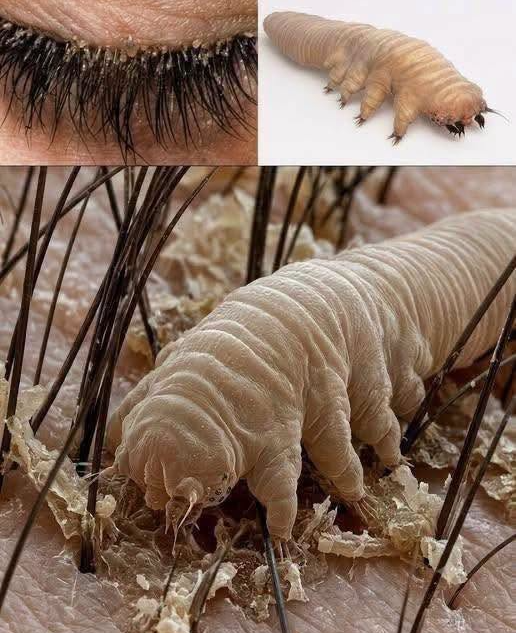
Many people are surprised to discover that microscopic organisms live on their skin. Among the most common are tiny mites known as Demodex. They are too small to be seen without magnification and are commonly found in areas containing hair follicles, including the eyelashes, eyebrows, and parts of the face.
Although the idea may sound unsettling at first, their presence is generally a normal part of the human skin environment. Most adults carry these mites without experiencing any noticeable symptoms.
Understanding what Demodex mites are, where they live, and when they may become associated with irritation can help put this natural phenomenon into perspective.
What Are Demodex Mites?
Demodex refers to a group of microscopic mites that live in association with human hair follicles and oil-producing glands.
Two main species are commonly found on people: Demodex folliculorum and Demodex brevis. They occupy slightly different areas of the skin. One is commonly associated with hair follicles, while the other is more often found deeper within oil glands.
These mites feed on materials such as skin oils and dead skin cells. Because they are microscopic, people generally have no idea they are present.
For most individuals, their existence does not cause discomfort or require treatment. They are simply part of the microscopic environment that naturally exists on human skin.
Where Do They Live?
Demodex mites are particularly associated with areas of the body that contain numerous hair follicles and oil glands.
Common locations include:
- Eyelashes and the surrounding eyelid area.
- Eyebrows.
- The forehead.
- The sides of the nose.
- Other areas of the face where oil-producing glands are present.
Their preferred environment helps explain why they are often discussed in connection with facial skin and eyelid health.
Despite their presence in these areas, most people do not experience itching, redness, or other noticeable problems.
Do Demodex Mites Cause Skin Problems?
In most cases, Demodex mites live on the skin without causing symptoms.
However, research has associated unusually high mite populations with certain skin and eyelid conditions. When their numbers increase significantly, some people may experience itching, redness, irritation, or inflammation.
One condition sometimes discussed in connection with Demodex is blepharitis, which refers to inflammation of the eyelids. Symptoms can include irritated eyelid edges, crusting around the eyelashes, redness, and discomfort.
Demodex mites have also been studied in relation to rosacea, a skin condition that can cause facial redness, visible blood vessels, and inflammatory bumps.
It is important to understand that an association does not mean the mites are responsible for every case of these conditions. Skin redness and itching can have many possible causes, so symptoms should not automatically be attributed to Demodex.
Their Presence Does Not Mean Poor Hygiene
One common misconception is that having Demodex mites means someone has poor personal hygiene.
That is not the case.
These organisms are commonly found on adults, including people who follow regular skincare routines. Their presence is not proof that someone is dirty, unhealthy, or neglecting personal care.
The fact that they live in hair follicles and oil glands also helps explain why ordinary washing does not necessarily eliminate them.
For most people, there is no reason to worry about their presence or attempt to remove every mite from the skin.
Simple Habits That Support Skin Health
Although Demodex mites are usually harmless, maintaining a gentle skincare routine can help support overall skin health.
Helpful habits include:
- Washing the face regularly with a gentle cleanser.
- Removing makeup before going to bed.
- Avoiding harsh scrubbing around the eyes.
- Cleaning makeup brushes and other frequently used skincare tools.
- Changing pillowcases and washing bedding regularly.
- Avoiding products that cause irritation.
These habits are useful for general skin care, but they should not be viewed as a guaranteed way to eliminate Demodex mites.
People experiencing persistent eyelid irritation or facial inflammation may benefit from professional advice rather than trying aggressive cleansing methods.
When Should You Seek Medical Advice?
Most people with Demodex mites never develop symptoms. However, persistent itching, redness, eyelid swelling, crusting around the eyelashes, or ongoing skin irritation may deserve medical attention.
An eye-care professional can assess symptoms affecting the eyelids, while a dermatologist can evaluate persistent facial redness or other skin concerns.
Sudden eye pain, changes in vision, or significant swelling should be assessed promptly.
A healthcare professional can determine whether Demodex may be contributing to a problem or whether another condition is responsible. Treatment, when necessary, depends on the symptoms and the diagnosis.
Understanding the Microscopic World of Human Skin
The human skin may look like a simple surface, but it is home to a complex environment that includes bacteria, fungi, and microscopic organisms.
Demodex mites are one example of life that exists beyond what the naked eye can detect.
Learning about them can initially be surprising, but their presence is not automatically a cause for concern. Most adults carry these tiny organisms without experiencing any discomfort.
The important distinction is between their ordinary presence and situations where unusually high populations may be associated with irritation or inflammation.
In most cases, Demodex mites are simply part of the natural microscopic world of human skin—not something people need to fear.