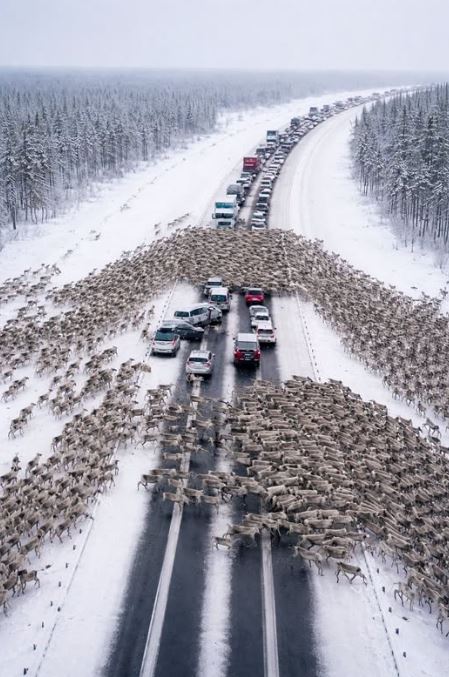
Imagine driving along a quiet highway when, without warning, thousands of reindeer suddenly emerge from the surrounding forest. Cars slow down, traffic comes to a complete standstill, and drivers watch in amazement as an enormous herd moves across the road.
At first, the unusual sight might seem like something from a Christmas story. Reindeer are strongly associated with winter landscapes and holiday traditions, making the appearance of such a large herd especially memorable.
But behind a scene like this could be a much more serious explanation. Seasonal migration, changing weather conditions, food shortages, or disturbances in their natural habitat can cause reindeer to move in large groups, sometimes crossing roads and other areas occupied by people.
The possibility that animals might be escaping dangerous conditions adds another dimension to an already remarkable sight.
An Unexpected Encounter on the Highway
For motorists, encountering a large group of wild animals is always surprising. However, seeing thousands of reindeer moving together would be an extraordinary experience.
A highway that was previously carrying normal traffic could suddenly become crowded with animals moving from one side to another.
Drivers would have little choice but to slow down and wait.
The sight of so many reindeer traveling together could create a remarkable display of movement. Their antlers, thick winter coats, and coordinated behavior would make the scene unforgettable.
Although such an encounter might initially attract excitement, it would also require patience and caution.
Wild animals do not understand traffic signals or road rules. When frightened, they may move unpredictably, creating dangerous situations for both themselves and motorists.
Why Do Reindeer Travel in Large Groups?
Reindeer are naturally adapted to environments where seasonal conditions can change dramatically.
They inhabit northern regions of Europe, Asia, and North America, where temperature, snowfall, and food availability influence their movements.
Many reindeer populations undertake seasonal migrations in search of suitable grazing areas.
Moving together offers several advantages. Large herds can travel across extensive landscapes while following established migration routes.
Their movement is influenced by several environmental factors, including:
- Seasonal changes in temperature.
- Availability of vegetation and food.
- Snow depth and changing weather.
- Access to suitable grazing grounds.
- Natural migration patterns.
During winter, finding food can become particularly challenging. Reindeer depend heavily on vegetation, including lichens, which may become difficult to reach when covered by deep snow or ice.
These environmental conditions can influence where herds travel and how they move through their habitats.
Could an Avalanche Cause Such a Movement?
One possible explanation for a sudden movement of animals from mountainous terrain is an avalanche.
Avalanches occur when large amounts of snow rapidly slide down a mountain slope. They can destroy vegetation, damage forests, block routes, and create dangerous conditions for wildlife.
Animals living in mountainous regions may react to changing environmental conditions by moving away from areas they perceive as dangerous.
However, it is important not to assume that every large herd movement is caused by an avalanche.
Reindeer migration is a natural behavior, and their movements can occur for many reasons.
Without verified photographs, location details, eyewitness documentation, or reports from wildlife authorities, the specific story of thousands of reindeer escaping an avalanche onto a highway should be treated as an unconfirmed account.
Nevertheless, it highlights the relationship between wildlife movement and changing environmental conditions.
When Wildlife and Roads Meet
Highways and transportation networks can create significant challenges for migrating animals.
Roads sometimes cross traditional wildlife movement routes, forcing animals to navigate areas with heavy traffic.
For reindeer, crossing a busy road can be especially dangerous when an entire herd moves together.
Drivers may have difficulty predicting the animals’ movements, particularly when visibility is poor or weather conditions are unfavorable.
Collisions can cause serious injuries to wildlife and motorists.
This is why wildlife crossings, road signs, speed restrictions, and seasonal traffic management can play important roles in protecting animals.
In regions where reindeer migration routes intersect with major roads, cooperation between transportation authorities and wildlife specialists can help reduce these risks.
How Drivers Should Respond to a Large Animal Herd
Encountering reindeer or other large wild animals on a road requires calm and responsible behavior.
The safest response is to slow down carefully and maintain a suitable distance.
Drivers should avoid honking unnecessarily, flashing headlights, or attempting to move through the herd.
Animals may become frightened by sudden noises or unexpected movements.
It is also important not to leave vehicles in dangerous positions or approach wild animals for photographs.
If a large herd blocks the road, motorists should follow instructions from traffic authorities and wait until the animals have moved safely away.
Patience can prevent accidents and reduce unnecessary stress for wildlife.
The Importance of Protecting Reindeer Habitats
Reindeer are an important part of northern ecosystems and have cultural, ecological, and economic significance in several regions.
Their habitats support many other forms of wildlife, while their grazing activities contribute to the natural dynamics of northern landscapes.
However, these environments face several challenges.
Climate change can influence snowfall patterns, vegetation, and the availability of winter food. Infrastructure development can also interrupt traditional migration routes.
In some areas, industrial activities and changes in land use create additional pressure on habitats.
Protecting migration corridors is therefore an important part of long-term reindeer conservation.
Scientists, wildlife organizations, local communities, and government authorities all have roles to play in maintaining suitable habitats.
Why Stories Like This Capture Our Imagination
There is something fascinating about seeing wildlife in large numbers.
A single reindeer is impressive, but thousands moving together across a landscape create an entirely different experience.
Such scenes remind people that nature operates according to patterns and needs that are often independent of human schedules.
A traffic jam might frustrate drivers under ordinary circumstances. But when wildlife is involved, the situation can encourage people to reconsider their priorities.
A few minutes or even several hours of waiting may seem insignificant compared with the importance of allowing animals to move safely through their natural environment.
These encounters also create opportunities to learn more about migration, animal behavior, and the environmental challenges facing wildlife.
Final Thoughts: A Powerful Reminder of Nature’s Strength
The image of thousands of reindeer crossing a highway is certainly extraordinary. Whether caused by seasonal migration, changing weather, or an environmental disturbance, a large wildlife movement reminds us how closely human transportation networks and natural habitats are connected.
Although the particular story involving an avalanche has not been independently established, the broader conservation message is important.
Wild animals need safe spaces to move, feed, and survive. When roads interrupt their natural routes, responsible planning and considerate driving become essential.
Sometimes, the most memorable moments in nature are unexpected. A sudden encounter with a migrating herd can turn an ordinary journey into a reminder of the remarkable wildlife sharing our planet.
And perhaps the most important lesson is simple: when nature needs the road, people should be willing to slow down and give wildlife the space it needs.