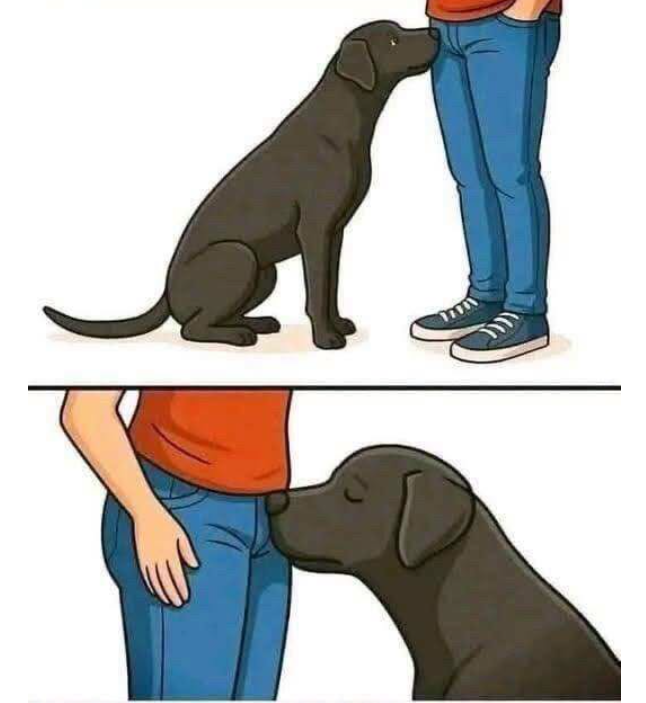
Dogs explore the world through their noses. While people rely heavily on sight and language to understand their surroundings, dogs use scent to gather information about other animals, people, and familiar environments. This is why a dog may sometimes sniff a person’s groin area, even when the behavior feels awkward or unexpected.
Although the habit can seem unusual, it is generally a normal part of canine communication and exploration. It does not automatically mean that a person has a medical condition or that something is wrong.
Understanding why dogs behave this way can help owners respond calmly, maintain appropriate boundaries, and recognize when a change in a dog’s behavior deserves further attention.
The Remarkable Power of a Dog’s Sense of Smell
A dog’s sense of smell is far more developed than that of a human. Dogs have an extensive olfactory system that helps them detect and distinguish odors that people may not notice.
Estimates often place the number of scent receptors in dogs at up to around 300 million, although the exact number varies by breed and individual. Humans have approximately five to six million olfactory receptors.
Dogs also have specialized brain structures for processing scent information. Their noses can detect subtle differences in odor, allowing them to investigate their surroundings in ways that are difficult for humans to imagine.
Scent helps dogs recognize familiar people, investigate new environments, locate food, and gather information about other animals. For them, sniffing is not simply an occasional habit; it is one of the primary ways they interact with the world.
Why Dogs Sniff the Groin Area
The groin area can produce noticeable individual scents because it contains sweat glands and is close to other sources of natural body odor. Dogs may find these odors particularly informative.
Human bodies produce many chemical compounds that contribute to personal scent. These odors can vary with everyday factors such as physical activity, hygiene products, clothing, and normal hormonal changes.
A dog may investigate these scents because they are distinctive, not because it understands them in the same way a human would. The behavior is usually driven by curiosity and the dog’s natural way of collecting information.
Dogs may also sniff other areas of the body, including hands, shoes, clothing, and hair. The particular location they investigate can depend on what is accessible and which odors attract their attention.
In most cases, this behavior is not a deliberate attempt to embarrass someone. It is simply a form of exploration.
Can Dogs Detect Changes in Human Scent?
Dogs can sometimes detect changes in human odor that are difficult for people to notice. Researchers have studied trained dogs’ ability to identify certain medical conditions by smelling samples, including changes associated with some diseases.
However, there is an important distinction between a trained detection dog and an ordinary household pet.
In research settings, dogs may undergo extensive training to recognize specific odor patterns under controlled conditions. A pet that sniffs a person’s groin area has not necessarily detected a disease, infection, or hormonal change.
It would therefore be misleading to treat this behavior as a reliable medical warning sign. A dog’s sniffing alone cannot diagnose a health condition, and people should not draw medical conclusions from it.
If a person notices symptoms such as unusual pain, persistent itching, an unexplained rash, or an unusual discharge, they should seek appropriate medical advice rather than relying on a pet’s behavior.
Hormones and Natural Body Odors
Human body odor can change for many ordinary reasons. Hormonal fluctuations, sweating, exercise, diet, and personal-care products may all influence the scents released by the body.
Dogs may notice some of these differences because their noses are sensitive to odors that humans cannot easily distinguish.
That does not mean a dog can reliably identify a person’s menstrual cycle, pregnancy, or another hormonal state simply by sniffing. Although dogs have been reported to react to changes in their owners’ behavior and scent, individual reactions vary, and sniffing is not a dependable test for any particular biological condition.
A dog’s interest in one person rather than another may reflect many factors, including unfamiliar scents, recent activities, clothing, or simple curiosity.
Why Dogs Sniff People They Have Just Met
Sniffing is also part of how dogs investigate unfamiliar people. A dog may approach a visitor and sniff their hands, clothing, shoes, or lower body before becoming comfortable around them.
This behavior can provide information about the person’s scent and recent surroundings. It is broadly comparable to the way humans use visual cues and conversation when meeting someone new, although the processes are not identical.
Some dogs are more curious or socially enthusiastic than others. Their behavior can also be influenced by previous experiences, training, age, and temperament.
A dog that approaches visitors calmly and briefly sniffs them may simply be following its natural instincts. However, owners should still manage the behavior when it makes someone uncomfortable.
How to Respond When Your Dog Does It
If your dog repeatedly sniffs your groin area or does so when guests arrive, there are practical ways to redirect the behavior without frightening or punishing the animal.
Use a calm cue. Teach commands such as “leave it,” “come,” or “sit” and reward the dog when it responds appropriately.
Redirect attention. Offer a toy, ask for a familiar command, or guide the dog toward another activity. Consistent redirection can help the dog learn what behavior is expected.
Reward polite greetings. Praise your dog for approaching people calmly and keeping an appropriate distance. Training works best when the desired behavior is rewarded consistently.
Respect personal boundaries. Not everyone is comfortable being sniffed, even when the behavior is harmless. Keep your dog under control around visitors, children, and people who prefer not to interact with animals.
Avoid shouting, hitting, or using frightening punishment. These responses can create anxiety without teaching the dog a clear alternative.
If the behavior becomes unusually persistent, compulsive, or part of a broader sudden change in behavior, a veterinarian or qualified dog behavior professional can help determine whether further assessment is needed.
When Sniffing May Deserve Attention
Occasional sniffing is generally normal. Nevertheless, owners should pay attention to the broader context rather than interpreting one action in isolation.
For example, a dog that suddenly begins obsessively sniffing, licking, or investigating an area may be responding to a change in its surroundings, stress, or another behavioral or medical factor. If the change is persistent or accompanied by other concerning symptoms, a veterinary consultation may be appropriate.
Similarly, if a dog repeatedly targets a person’s body while showing signs of anxiety or agitation, professional guidance may help identify the cause and establish suitable training strategies.
The key is to evaluate the dog’s overall behavior rather than assuming that one type of sniffing has a specific meaning.
Understanding Your Dog’s Behavior
Dogs use scent to recognize people, explore their environment, and respond to information that may be invisible to human senses. Sniffing the groin area can be an awkward experience for people, but it is usually a normal expression of canine curiosity.
Although trained dogs have demonstrated the ability to detect certain medical-related odors in specialized settings, an ordinary pet’s sniffing should not be treated as a diagnosis or proof of illness.
By understanding the role of scent in canine behavior, owners can respond with patience, provide consistent training, and maintain boundaries that make interactions comfortable for everyone.
The next time your dog begins an overly enthusiastic investigation, remember that its nose is one of its main tools for exploring the world. A calm response and clear training can help turn an uncomfortable moment into an opportunity to reinforce good manners and strengthen the relationship between you and your pet.