Woman Shares Photo of Stringy Chicken Breast—What “Spaghetti Meat” Actually Means
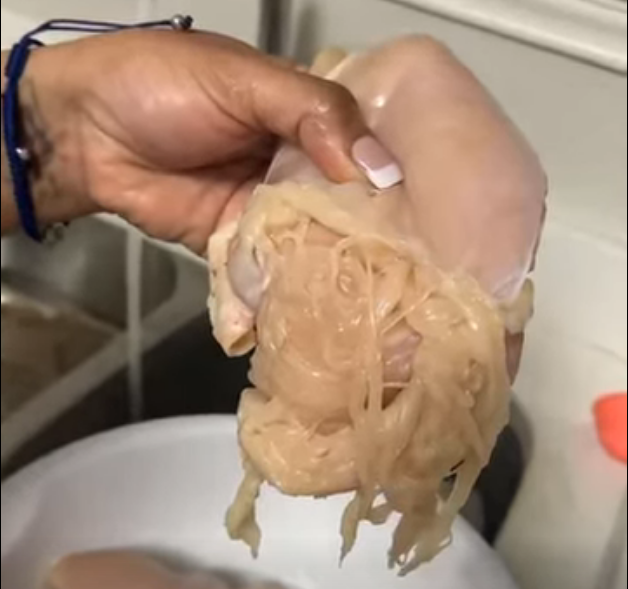
A photograph of chicken breast separating into thin strands sparked an online debate after Texas mother Alesia Cooper shared her experience in March 2024.
According to her account, she was preparing dinner for her children when she noticed the unusual texture. The meat appeared to pull apart into noodle-like pieces, prompting concern about what she had purchased.
Online reactions quickly moved beyond the photograph. Some commenters suggested the chicken was artificial or laboratory-grown. Others blamed growth hormones.
But poultry researchers have documented a muscle abnormality known as “spaghetti meat” that can produce a loose, stringy appearance in real chicken breast. Its existence offers a relevant explanation without proving a diagnosis from Cooper’s photograph alone.
The important questions are what researchers know about the condition, what remains uncertain, and how consumers should handle an unexpected product.
What Is “Spaghetti Meat”?
“Spaghetti meat” describes a chicken breast muscle abnormality involving a loss of cohesion between muscle-fiber bundles.
Instead of remaining firmly joined, the affected tissue can become soft, loosely connected, and prone to separating into strands.
This is a studied condition, not merely a nickname invented by social-media users. USDA Agricultural Research Service publications describe its effects on muscle integrity and the quality of breast fillets.
The name describes the resemblance to pasta. It does not mean that the meat contains pasta, synthetic fibers, or an unfamiliar ingredient.
An unusual appearance deserves investigation, but it should not be treated as proof of whichever explanation attracts the most attention online.
Is It the Same as Woody Breast?
The terms are sometimes used interchangeably in viral articles, but they describe different abnormalities.
Woody breast involves unusually firm or hardened tissue. Spaghetti meat involves reduced structural integrity, allowing muscle bundles to separate. Another condition, white striping, produces visible pale lines along the muscle.
Researchers distinguish these conditions even though they may be discussed together in studies of modern broiler chickens.
That distinction matters when describing a consumer’s experience.
Chicken that feels exceptionally hard is not necessarily experiencing the same defect as chicken that pulls apart into soft strands. Clear terminology helps avoid misleading explanations about texture and cause.
What Does Research Say About Its Causes?
Research connects these muscle abnormalities with fast-growing broiler chickens and large breast muscles. However, the mechanisms are complex, and investigators continue examining why particular birds develop them.
A 2024 study compared affected and unaffected breast tissue from chickens raised under the same commercial conditions. The researchers found differences in muscle structure and other characteristics, while emphasizing that understanding of the underlying causes remains limited.
It is therefore too simplistic to claim that one chemical, one feeding practice, or one company explains every case.
Selective breeding, growth, muscle development, and production conditions are subjects for research. A single photograph cannot establish which factors were involved in the product shown.
The Growth-Hormone Claim Needs Correcting
One claim in the discussion was that producers give chickens growth hormones to make their breasts larger.
That is not an accurate general explanation for U.S. poultry production. USDA states that hormones are not allowed in raising poultry. Rapid growth should not automatically be attributed to hormone administration.
Questions about breeding practices and meat quality remain legitimate. They become harder to address when they are mixed with an incorrect account of how chickens are raised.
Consumers can question production standards without accepting an unsupported allegation about hormones.
Likewise, a retailer being named in a customer’s account does not establish deliberate wrongdoing by that retailer.
Does the Photograph Prove the Chicken Was Lab-Grown?
No.
Loose or stringy muscle fibers are not evidence that meat was cultivated in a laboratory or produced by a printer.
Researchers have examined spaghetti-meat abnormalities in breast tissue taken from conventionally raised chickens.
That does not establish exactly what happened to Cooper’s purchase. It demonstrates why the appearance alone cannot support the “fake meat” conclusion.
Identifying a product requires information about its source, labeling, and production—not speculation based on an alarming image.
The same principle applies when photographs are reshared years later with new captions.
Can You Tell Whether It Is Safe From a Picture?
A photograph cannot reliably establish food safety.
Research into spaghetti meat primarily addresses muscle structure, composition, and product quality. Those questions are different from determining whether a particular package has been stored correctly or contains harmful bacteria.
It would be inappropriate to declare an individual piece safe solely because its appearance resembles a known defect.
If a product seems unacceptable, stop using it, retain the packaging information, and contact the retailer about a refund or complaint. A receipt, lot number, and photograph can help identify the purchase.
There is no need to eat something you are uncomfortable serving simply because an online explanation sounds reassuring.
Do Not Wash Raw Chicken
Cooper’s account mentioned cleaning the chicken before cooking. This is an opportunity to clarify an important handling recommendation.
USDA advises against washing raw poultry because it can spread bacteria around the kitchen. Rinsing or soaking chicken in water, vinegar, or lemon juice does not reliably destroy those bacteria.
Washing also cannot reverse a muscle abnormality.
Keep raw poultry and its juices away from ready-to-eat foods, and clean hands, utensils, and preparation surfaces appropriately.
For chicken that is otherwise suitable to cook, USDA recommends a minimum internal temperature of 165°F, checked with a food thermometer.
That cooking guidance does not mean spoiled or mishandled food should be salvaged.
A Better Conversation About Food Quality
Cooper’s photograph raised a reasonable concern: consumers expect chicken breast to have a familiar texture, and a visibly abnormal product can undermine confidence.
A useful response acknowledges that concern while separating evidence from speculation.
“Spaghetti meat” is a documented muscle defect. Its appearance does not prove laboratory production, and growth hormones are not a valid blanket explanation for U.S. chicken growth.
Consumers deserve clear product information and a straightforward way to report disappointing purchases. Accurate explanations support those expectations far better than frightening claims that the photograph cannot establish.