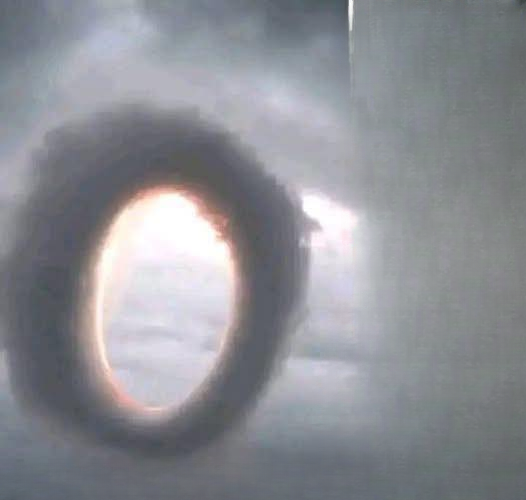
The sky has long inspired curiosity and wonder. From colorful sunrises to drifting cloud patterns, it offers an ever-changing display that captures attention in both subtle and dramatic ways. Every so often, however, a formation appears that feels especially unusual—something that immediately draws the eye and sparks questions.
One such phenomenon is the fallstreak hole, sometimes referred to as a “hole-punch cloud.” Its appearance is striking: a large, often circular gap in a cloud layer, with delicate streaks trailing beneath it. To those seeing it for the first time, it can look almost too perfect to be natural.
Yet despite its unusual look, this phenomenon is entirely natural and well understood by scientists. In fact, it provides a fascinating example of how sensitive and dynamic the atmosphere can be.
What Is a Fallstreak Hole?
A fallstreak hole is a visible opening that forms within a cloud layer, most commonly in mid-level clouds such as altocumulus or cirrocumulus. These clouds are made up of tiny water droplets that exist in a unique state known as supercooled water.
Supercooled droplets remain liquid even when temperatures fall below freezing. This happens because they lack the particles or disturbances needed to trigger the freezing process. While stable under the right conditions, they can quickly change when something disrupts them.
When freezing begins in one area, it sets off a chain reaction. The surrounding droplets evaporate, and a gap begins to form. At the same time, ice crystals fall downward, creating the streaked effect seen beneath the hole.
How the Formation Happens
Although the visual result looks dramatic, the process behind it is based on simple atmospheric principles.
First, a cloud layer forms containing supercooled water droplets. These droplets remain in liquid form despite low temperatures.
Next, a disturbance—such as a sudden change in pressure or temperature—causes some droplets to freeze into ice crystals.
Once ice forms, it begins to influence the surrounding environment. Water vapor in the air is more likely to attach to ice than to liquid droplets. This causes nearby droplets to evaporate while ice crystals grow.
As this process spreads outward, it clears a section of the cloud, creating a visible hole. The falling ice crystals beneath it form thin streaks, giving the phenomenon its distinctive appearance.
The Influence of Aircraft
In many cases, aircraft play a role in triggering fallstreak holes. When a plane passes through a cloud layer filled with supercooled droplets, it can create the conditions needed for freezing.
The movement of wings and propellers changes air pressure rapidly, which can lead to localized cooling. This cooling may be enough to initiate ice formation.
Even after the aircraft has passed, the reaction continues, and the hole gradually expands. What starts as a small disturbance can develop into a large and clearly visible formation.
Why They Look So Unique
Fallstreak holes stand out because of their shape and contrast. Unlike most cloud formations, which appear irregular, these holes are often smooth and rounded.
Several factors contribute to their visual impact:
- Well-defined edges that separate cloud from open sky
- Thin, wispy streaks extending downward
- Bright highlights caused by sunlight
- Strong contrast between light and shadow
Lighting conditions can make them even more noticeable. When the sun is low in the sky, the edges may appear to glow, and the falling ice crystals can reflect light in subtle ways.
Where They Occur
These formations can appear in many parts of the world, as long as the right atmospheric conditions are present.
They are most likely to form when:
- Mid-level cloud layers are present
- Temperatures are below freezing at altitude
- Supercooled water droplets exist
- The atmosphere remains relatively stable
They are often seen in regions with frequent cloud cover and regular air traffic, though they are not limited to specific locations.
Clearing Up Common Misconceptions
Because of their unusual appearance, fallstreak holes are sometimes misunderstood. Some people initially assume they are caused by unknown or artificial factors.
In reality, scientists have thoroughly studied these formations. Their causes are well documented and fully explained through atmospheric science.
Understanding the process helps replace confusion with appreciation for how natural systems work.
Why They Matter
Beyond their visual appeal, fallstreak holes provide useful insights into atmospheric behavior.
They help scientists study:
- Cloud formation and structure
- Phase changes between liquid and ice
- Moisture distribution in the atmosphere
- Precipitation processes
They also highlight how small changes—such as a slight shift in temperature or pressure—can produce noticeable effects.
A Favorite for Sky Watchers
For photographers and nature enthusiasts, fallstreak holes offer a rare opportunity to capture something unique.
Their combination of shape, lighting, and movement makes them especially appealing. Because they can change quickly, timing is important when trying to photograph them.
Using wide-angle shots and including elements like landscapes or buildings can help show their scale and depth.
Inspiring Curiosity
One of the most valuable aspects of this phenomenon is its ability to spark curiosity. Seeing an unusual formation often leads people to ask questions and seek explanations.
Moments like these encourage learning and remind us that even familiar environments hold complexity.
Looking up at the sky can be a simple yet meaningful way to reconnect with the natural world.
A Broader Perspective
Fallstreak holes also highlight how interconnected atmospheric systems are. They show that small disturbances—whether natural or influenced by human activity—can create visible changes.
This understanding encourages a balanced perspective: appreciating natural beauty while remaining aware of how environmental conditions interact.
Final Thoughts
Fallstreak holes are a perfect example of how science and visual beauty can come together. What may seem unusual at first glance is actually the result of precise and understandable processes happening high above us.
From supercooled droplets to falling ice crystals, each step plays a role in creating this remarkable display.
Rather than being mysterious, these formations remind us that knowledge can deepen our sense of wonder.
Conclusion
The next time you notice a gap in the clouds with streaks drifting below, take a moment to observe it. You are witnessing a natural process unfolding in real time.
Fallstreak holes remind us that:
- The atmosphere is full of intricate processes
- Small changes can lead to dramatic results
- Scientific understanding enhances appreciation
- Curiosity leads to discovery
In the end, they are more than just unusual cloud patterns—they are a window into the complexity and beauty of the world above us.
Sometimes, all it takes is a glance upward to discover something extraordinary.